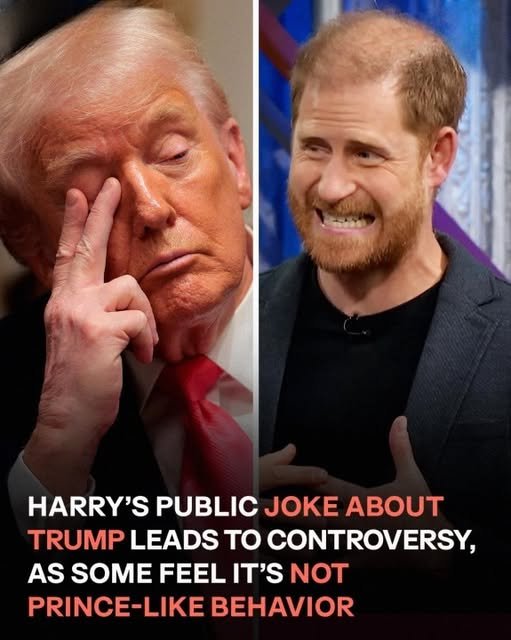
The image of a senior royal bantering with a late-night host would have been unthinkable a decade ago. Yet, there was Prince Harry, sharing the stage with Stephen Colbert, leaning into a joke that blended self-deprecation with political cheek. The moment was designed for virality, and it succeeded. By referencing the idea of Americans “choosing a king,” Harry didn’t just make a joke about Donald Trump; he highlighted the surreal nature of his own position—a man who left formal royalty behind only to find himself a recurring character in another nation’s political drama. His comedy was a tool to navigate that absurdity.
Colbert, playing the gracious but surprised host, set the table with talk of fictional movie royals. Harry’s entrance as a “real” one created an immediate, ironic contrast. His follow-up line was the masterstroke, pivoting from Hollywood fiction to political reality. It was a joke that required the audience to be in on the context—the crowned Trump post, the visa comments, the ongoing saga. In that sense, it was insider baseball for the politically and royally obsessed, a nod to the very media circus that constantly surrounds him. He was, in effect, joking about the machinery that feeds on his every move.
The reaction was a textbook example of the polarized environment Harry inhabits. One camp viewed his appearance as the final surrender of his dignity, a prince reduced to a talk-show sideshow. Their online comments dripped with nostalgia for a bygone era of silent, stoic duty. The other camp cheered a man finally seeming at ease, using humor to deflate his critics and connect with a public that appreciates authenticity over stuffy protocol. This divide is more than about Harry; it’s a clash between old-world expectations of monarchy and new-world celebrity, where visibility and voice are currencies of power.
Timing is everything in comedy and politics, and Harry’s quip was impeccably timed. It followed a fresh wave of headlines about Trump’s views on his residency, making the joke feel less random and more like a strategic volley in a long, indirect exchange. By responding on a comedy show, Harry avoided escalating a diplomatic incident but ensured his perspective was heard. It was a modern solution to a modern problem: how to address public slights from powerful figures without formal recourse.
Ultimately, this late-night appearance is a chapter in Harry’s ongoing experiment in building a public life outside the institution. Every action, from family photos to Netflix projects, is parsed for meaning. His choice to engage through Colbert’s show suggests a comfort with using American media institutions to craft his image and address his critics. In a world where his family’s Thanksgiving volunteering sparks conspiracy theories, perhaps a controlled environment like a late-night set, where the laughs are canned and the jokes are written, feels like a safer space to be seen and heard, one carefully crafted punchline at a time.