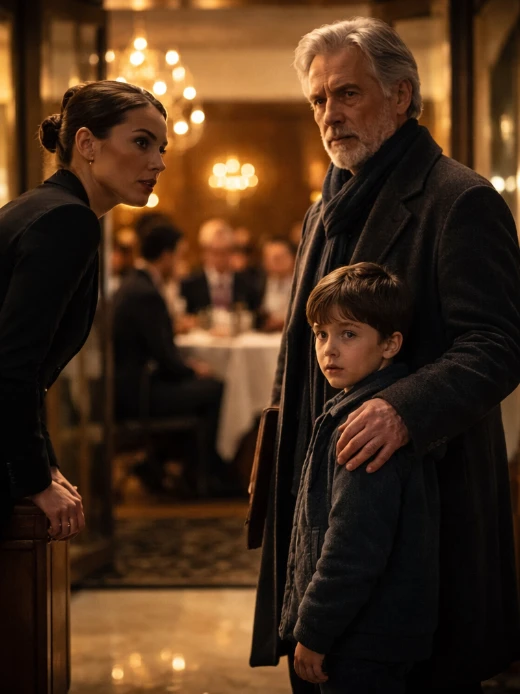
“You can’t be serious,” the hostess said, not even lowering her voice. “Sir, this isn’t the kind of place people wander into by mistake.”
The boy stopped so abruptly that the old man almost walked into him. For a second, the revolving door kept turning behind them, spilling warm gold light over polished floors and white linen, and the restaurant seemed to hold its breath just long enough for the insult to land where it would do the most damage—on a child standing in borrowed shoes.
The old man’s hand tightened gently around the boy’s shoulder.
“We’re here for dinner,” he said.
The hostess looked him up and down with the practiced glance of someone who had learned to sort human beings by fabric and posture. His coat was neat but old. The cuffs were shiny with wear. The boy’s navy sweater had been carefully mended at one elbow. Neither of them belonged to the room she had memorized as a hierarchy.
“Do you have a reservation?” she asked.
“No.”
“Then I’m afraid—”
A server passing by slowed just enough to listen. Two women near the bar lifted their glasses and looked over. A man in a charcoal suit paused while checking his phone. Tiny shifts. Tiny witnesses. The kind that made humiliation feel public long before anyone laughed.
The old man could feel the boy shrinking beside him.
“We can wait,” he said.
The hostess gave a short, disbelieving smile. “Sir, the wait for this room isn’t your problem.”
The boy looked up, confused at first, then wounded once he understood. “Grandpa—”
The hostess turned toward him, and somehow that made it worse. She bent slightly, as if speaking to a child entitled her to cruelty disguised as honesty.
“Sweetheart,” she said, “this place is expensive. Maybe pick somewhere more… comfortable for you two.”
The old man heard the tremor in the boy’s breathing before he saw the tears gathering.
He put a hand on the child’s back. “Eli.”
“It’s okay,” the boy whispered, but his voice cracked on the last word.
The old man looked past the hostess into the dining room. A pianist in the corner continued playing as if refinement could survive anything. Candles burned in low glass bowls. Servers moved with choreographed precision. On the back wall, in brass letters mounted above a dark oak wine display, the house motto gleamed beneath the soft lights:
EVERY GUEST LEAVES SEEN.
The boy followed his gaze and read it silently, moving his lips around the words.
That was when a second employee approached—a young waiter with a towel over one arm and the false ease of someone who enjoyed being cruel when it was socially protected.
“What’s the hold-up?” he asked.
The hostess didn’t answer. She only tipped her chin toward the old man and the boy.
The waiter took one look and smirked. “Ah.”
The old man recognized that sound. It wasn’t surprise. It was satisfaction.
“Sir,” the waiter said, “maybe you didn’t look at the menu outside. One entrée in here costs more than some people’s weekly groceries.”
Several nearby guests heard that. One of the women at the bar winced. The man in the charcoal suit stared openly now. Somewhere, glass touched glass. A server froze mid-step.
The waiter kept going because no one stopped him.
“And bringing a kid in here to get his hopes up?” He clicked his tongue and looked down at Eli. “That’s rough.”
Eli’s face flushed so hard it seemed to turn hot with shame. He pulled on his grandfather’s sleeve, not looking at him.
“Can we go?” he whispered. “Please.”
The old man did not move. Not yet.
He reached into the inside pocket of his coat and took out a small black notebook no larger than a wallet. Its edges were worn smooth. A tiny gold compass had been embossed on the cover, nearly rubbed away by years of use. He opened it, uncapped a pen, and wrote one line in a steady hand.
The hostess frowned. “What are you doing?”
He closed the notebook.
“Remembering,” he said.
The waiter laughed. “You want to leave a review? That’s fine. I can spell my name for you.”
The old man turned to Eli and crouched slowly despite the ache in his knees. The restaurant was so quiet now that the piano might as well have stopped.
“Look at me,” he said.
Eli did, though tears had slipped over and were tracking down his cheeks.
The old man took out a folded handkerchief and dried them one at a time, as carefully as if the room did not exist.
“Don’t cry because of them,” he said.
“I’m not,” Eli lied.
The old man gave the smallest nod, the kind that said he would not embarrass the boy further by naming the hurt.
Then he spoke in a voice low enough for Eli and high enough for the room.
“Just remember how they treated us tonight.”
Something changed then—not in power, not yet, but in temperature. The sentence settled into the air with an odd weight, not dramatic, not loud, only exact. It made the hostess straighten. It made the waiter’s smile falter for half a beat.
The old man rose, put the notebook back in his pocket, and guided Eli toward the door.
Behind them, the waiter muttered, “Good. Saves us trouble.”
The old man stopped with one hand on the brass door handle.
Without turning, he said, “Trouble has a way of arriving after it’s invited.”
Then he stepped out into the cold.
Outside, the city had gone silver with evening. The windows of the restaurant glowed behind them, reflecting chandeliers and moving silhouettes. Eli kept his face turned toward the sidewalk, trying to wipe his eyes before anyone inside saw.
His grandfather stood beside him without rushing him.
The traffic on Mercer Street moved in a steady ribbon. Across the road, a food cart steamed under a streetlamp. Two teenagers laughed by the curb while sharing noodles from a paper box. Somewhere nearby, a siren rose, then thinned into distance.
“I’m sorry,” Eli said.
His grandfather looked at him. “For what?”
“For making you come.”
“You didn’t make me do anything.”
“I asked for steak.”
“That’s true.” The old man adjusted the scarf at Eli’s neck. “And I said yes.”
Eli swallowed. “Maybe they were right.”
The old man’s expression changed so slightly that Eli almost missed it: not anger, exactly, but the controlled pain of hearing a wound deepen in real time.
“About what?”
“That we shouldn’t come to places like that.”
A gust of wind slipped between the buildings. The old man buttoned his coat all the way up and then buttoned Eli’s too, his fingers slow from arthritis.
“Listen to me,” he said. “A room does not decide who belongs in it.”
Eli stared at the pavement.
“What decides, then?”
The old man glanced back through the front window. The hostess was speaking quickly to someone near the reservation stand, still agitated, still irritated, as if they had inconvenienced her merely by existing.
“Character,” he said. “And tonight, theirs was expensive in the wrong way.”
That almost drew a smile from Eli, but not quite.
The old man put his hand over the shape of the notebook in his pocket, feeling the familiar edges. Eli noticed.
“You wrote down their names?”
“Not yet.”
“Then what did you write?”
The old man hesitated. In the reflection on the glass, he could see himself as the staff had seen him: stooped, gray, ordinary. Invisible until he became embarrassing.
“I wrote the time.”
Eli frowned. “Why?”
“So I’ll remember exactly when they decided who we were.”
They began walking.
For three blocks, neither of them spoke. The old man chose the quieter side streets, away from the restaurants and bright windows and people dressed for evenings that did not include shame. Eli kept close to him. At each corner the old man laid a hand across the boy’s shoulder before they crossed, a habit so automatic it felt like part of his breathing.
At the fourth block, Eli finally asked, “Can we still get dinner?”
His grandfather turned to him with such immediate warmth that Eli seemed startled by it.
“Of course.”
“Not steak.”
“We’ll see.”
“There’s a burger place near the train station.”
“There is.”
“It’s okay.”
The old man studied him for a second too long. Eli was trying to be easy now. Trying to undo the cost of wanting something. Children learned that skill far too fast.
“Tonight was supposed to be special,” the old man said.
“It can still be special.”
“How?”
Eli thought about it, serious as ever. “Maybe if it tastes better because they were mean.”
The old man laughed, and some of the tightness left the air between them.
“That,” he said, “is a very useful philosophy.”
They turned onto a narrower street lined with older buildings. Eli kicked a loose pebble ahead of him.
“Grandpa?”
“Yes?”
“Why did you say to remember?”
The old man was silent long enough that Eli thought he might not answer.
“Because forgetting is how people like that keep doing it,” he said at last.
Eli processed this with the solemn patience children sometimes have when they sense they are being told something they will need later.
“When Mom says not to be bitter,” he asked, “is this bitter?”
“No.” The old man’s voice was quiet. “Bitter is when pain makes you smaller. This should make you clearer.”
They passed a dark shop window. In its reflection, Eli saw his grandfather looking more tired than usual. The old man had been saving this dinner for weeks. Eli knew because he had once found the paper envelope in the kitchen drawer with folded bills inside and the words SATURDAY WITH ELI written on it in careful block letters. He had pretended not to see.
“You saved for it,” Eli said softly.
The old man glanced down. “Who told you that?”
“I saw the envelope.”
“Then you also know I’m bad at hiding things.”
“Were you?”
“Saving?”
Eli nodded.
“No.” He smiled faintly. “Only at hiding.”
That answer puzzled Eli, but before he could ask more, a black sedan rolled to the curb half a block ahead of them.
The old man stopped walking.
The sedan idled. A second car came up behind it. Not police. Not random. Too deliberate.
Eli looked up sharply. “Grandpa?”
The rear door opened and a woman stepped out in a dark wool coat, her hair pinned back, her expression composed in the way of people who live inside emergencies without displaying them. She scanned the sidewalk once, found the old man, and exhaled.
“There you are,” she said.
The old man did not look surprised. Only mildly inconvenienced.
“I had my phone off.”
“I noticed.”
She looked at Eli, and the hard edge left her face.
“Hello, Eli.”
“Hi, Ms. Bennett.”
“Your mother’s been trying to reach both of you.”
The old man sighed. “For how long?”
“Since the board started calling me fifteen minutes ago.” She glanced toward the bright façade of the restaurant at the end of the block. “And since the regional manager there started sending messages in all caps.”
Eli looked from one adult to the other. “Board?”
His grandfather gave him a rueful look. “I was hoping for ten more minutes.”
Ms. Bennett’s gaze sharpened. “Ten more minutes is apparently more than Halcyon Mercer has.”
The old man closed his eyes briefly, like a man being proven right sooner than expected.
Eli’s confusion deepened. “What’s Halcyon Mercer?”
The woman answered before his grandfather could. “That restaurant.”
Eli blinked. “Why are they calling you about it?”
She turned to the old man. “Do you want to do this here?”
He looked back at the restaurant. Through the long front windows, the dining room glowed as if nothing essential had happened inside it.
“Yes,” he said.
Ms. Bennett gave a short nod. She opened the front passenger door of the sedan and took out a thin leather folio. When she handed it over, the boy saw the same gold compass stamped in the corner that had been on his grandfather’s black notebook.
A minor thing. A shape. But once seen, impossible to miss.
The old man tucked the folio under his arm.
Eli stared. “That’s the same symbol.”
His grandfather met his eyes.
“Yes.”
“On your notebook.”
“Yes.”
“What is it?”
The old man looked at the restaurant again, then down at the child beside him. “It’s my company.”
The words did not fit the coat, the careful pennies, the old train pass in his wallet, the envelope of saved bills. Eli said the only thing his mind could reach.
“You have a company?”
Ms. Bennett almost smiled, despite the tension. “A few.”
The old man shot her a look. “That’s not helping.”
“Then help him yourself, Daniel.”
So that was another shift: the woman with the clipped executive voice calling him by his first name, not mister, not sir. Eli had always known his grandfather as simply Grandpa, as the man who fixed radiator knocks with a spoon, who over-watered basil on the windowsill, who saved rubber bands in a chipped coffee mug.
Now, standing under the streetlamp, he became someone with a gravity the night itself seemed to recognize.
“I used to help build restaurants,” Daniel said.
“Used to?”
“I still do, from time to time.”
Ms. Bennett corrected him. “You decide which companies get funded, acquired, expanded, or cut loose. You own enough of the parent group that no one moves on this without you.”
Eli looked back toward Halcyon Mercer as if the building might now rearrange itself into something he understood.
“The people in there… don’t know?”
“Some do,” Daniel said. “Not by face, usually.”
“Why not?”
“Because I prefer it.”
That sounded too simple to be the whole truth, and Eli knew it.
Daniel rested a hand on the roof of the car. “When a company gets big enough, people start performing for important people and forgetting ordinary ones. If you want to know who they really are, you don’t arrive with an entourage.”
Ms. Bennett’s phone vibrated. She checked it and handed him the screen.
“Regional director. Again. And the COO wants to know whether this was ‘a misunderstanding.’ His quotation marks, not mine.”
Daniel didn’t take the phone. “Tell them I’m still deciding.”
“On what?”
His eyes remained on the restaurant windows.
“Whether the problem is a branch,” he said, “or the culture that trained it.”
The sentence meant little to Eli and everything to Ms. Bennett. He saw it in her face.
“Daniel,” she said carefully, “the expansion vote is Monday.”
“I’m aware.”
“The Mercer branch was supposed to be the model site for the Northeast rollout.”
“I’m aware of that too.”
She lowered her voice. “Twelve planned openings. Hundreds of hires. Contracts already drafted.”
Daniel nodded once. “And tonight they humiliated a child under a wall that says every guest leaves seen.”
Ms. Bennett had no answer for that.
Eli’s cheeks went hot all over again. Somehow it had been one thing to be insulted by strangers. It was another to hear adults with power discussing his shame as evidence.
Daniel saw the change in his face immediately.
He crouched so they were eye level again.
“This isn’t about revenge,” he said.
“Then why are they scared?”
Daniel considered him. “Because consequences and revenge look similar to people who have never expected either.”
Ms. Bennett turned away, pretending to take another call so she would not be included in the intimacy of that lesson.
A memory surfaced in Eli’s mind: the first time Daniel had taken him to the little warehouse office downtown on a school holiday. He had shown Eli a conference room with a city map pinned to one wall and red, blue, and gold markers scattered across a table. On the map, tiny compass stickers had been placed over certain neighborhoods. Eli had asked if it was a treasure hunt. Daniel had laughed and said, “In a way.”
At the time, Eli had not understood that he had been standing in the middle of an empire designed by someone who still took the train.
The sedan’s driver stepped out and approached with cautious deference. “Sir,” he said to Daniel, “security from the restaurant is coming out.”
Daniel stood.
At the front of Halcyon Mercer, the hostess had disappeared. In her place, a man in a fitted suit came briskly down the steps, followed by the same waiter, now visibly pale, and a woman with an earpiece whose expression had the brittle efficiency of crisis management.
The suited man reached them first. “Mr. Vale—”
So Eli learned the other part too: the surname that appeared nowhere in his life because Daniel never used it unless he had to.
“Daniel Vale,” the man continued, breathless and already sweating, “I’m Martin Keene, general manager here. I am so sorry for what happened inside.”
Daniel said nothing.
Keene took that silence as permission to keep talking, which was a mistake.
“There was a terrible misunderstanding. We had no idea who you were.”
Eli felt his grandfather go very still.
When Daniel spoke, his voice was gentle enough to be dangerous.
“That,” he said, “is exactly the problem.”
Keene faltered. “Of course. I only mean—”
“You mean my grandson deserved dignity only if you knew my name.”
“No, sir, absolutely not.”
Daniel looked at the waiter. “What’s your name?”
The waiter swallowed. “Ryan.”
“And yours?” Daniel asked the hostess, who had stopped several paces back, as if proximity itself might indict her.
“Claire.”
Daniel nodded once, as though entering facts into a ledger only he could see.
“I would like to hear,” he said, “what each of you believed was happening when you spoke to my grandson.”
Keene tried to step in. “Sir, perhaps we should continue this in private.”
“No.” Daniel’s gaze did not leave Ryan or Claire. “Privacy is what humiliation usually hides behind later.”
The woman with the earpiece cut in. “Mr. Vale, if we can get you and your family back inside, we can arrange a private dining room, full comp, anything you want.”
Eli felt sick at the phrase full comp. It made the whole thing sound fixable with mushrooms and linen.
Daniel smiled without warmth. “Interesting.”
“Sir?”
“You heard my grandson ask to leave. You heard your staff suggest we couldn’t afford your menu. And your solution is to offer us the same room once it’s strategically useful.”
The woman’s face tightened. “We’re trying to make this right.”
“No,” Daniel said. “You’re trying to limit exposure.”
The street seemed to fall quieter around them. Even passing pedestrians slowed, sensing drama without knowing its shape.
Keene turned, angry now because panic had found no room to hide. “Claire, Ryan, say something.”
Ryan looked at the ground. Claire’s mascara had begun to smudge at one eye.
Claire spoke first, brittle and defensive. “We were managing the room. We get walk-ins all the time who just want pictures or who cause issues when they see the prices. We have to protect the experience of our guests.”
Daniel repeated it softly. “Your guests.”
She understood her mistake only after it was too late.
Ryan rushed in. “I shouldn’t have said what I said. I get that. But we see scams, chargebacks, people making scenes—”
“And a child in a sweater,” Daniel said, “made you think scam?”
Ryan said nothing.
Daniel turned to Keene. “Did you train them to evaluate risk by clothing?”
“No.”
“Did you train them that a guest without a reservation is an intrusion?”
“No.”
“Did you teach them that public humiliation is an acceptable form of screening?”
“Of course not.”
“Then why,” Daniel asked, still quiet, “did no one inside stop them?”
Keene opened his mouth and closed it.
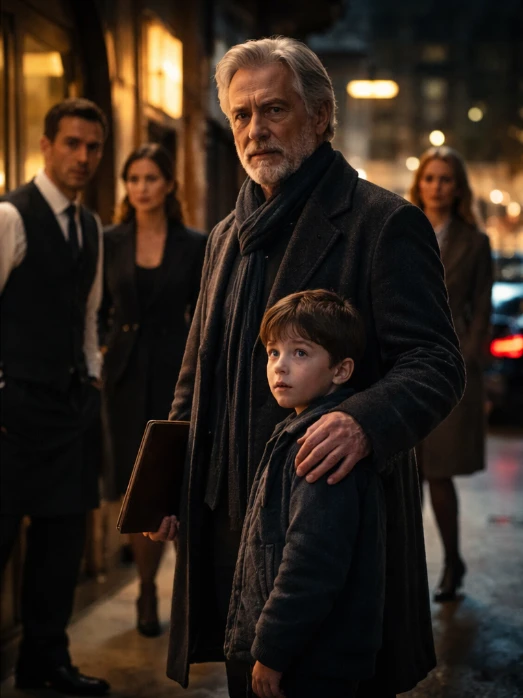
That was the real question. Not the cruelty of two employees. The permission of a room.
The man in the charcoal suit from the bar had come outside now, coat draped over one arm. He stood near the steps, not interfering, just watching with the pinched expression of someone realizing he had witnessed a turning point in another person’s career. One of the women from the bar followed and stood beside him. The story was widening in real time.
Ms. Bennett stepped forward at last.
“Mr. Keene,” she said, “for the record, this is not merely a customer complaint. Mr. Vale is the controlling investor on the Halcyon expansion committee.”
Keene went colorless.
Ryan’s face seemed to hollow. Claire actually took a step backward.
The woman with the earpiece recovered first. “Then I think the wisest thing,” she said carefully, “is to discuss corrective action immediately.”
Daniel looked at Eli. “Do you want to hear this?”
Eli wiped his face with both hands and tried to stand taller. “Yes.”
Daniel nodded.
Then he faced them all.
“Here is the corrective action,” he said. “This branch will suspend service training operations effective tonight. No promotional materials featuring this location will be used in Monday’s expansion meeting. Every proposed opening tied to this culture is under review.”
Keene stared. “Sir, you can’t decide that on the street.”
Daniel opened the folio Ms. Bennett had brought. Inside were documents marked for Monday’s vote, tabs color-coded, signatures flagged, maps folded with neat precision. He drew out the top sheet and showed only the header.
HALCYON NORTHEAST EXPANSION – FINAL AUTHORIZATION.
“You’re right,” Daniel said. “I decided before I crossed.”
Keene looked as though he might physically lunge for a different outcome.
“Please,” he said. “We employ seventy-three people in this branch alone. You’re talking about livelihoods.”
Daniel’s face changed then—not softened, but sharpened by grief.
“You think I don’t know numbers? I know every salary band attached to this rollout. I know the names of your line cooks, your porters, your dish staff, your prep team. I know how many of them work doubles. I know which managers fought for paid transportation after midnight and which ones said it was too expensive.” He stepped closer. “Do not lecture me about livelihoods after your staff taught my grandson that dignity is conditional.”
Keene stared, stunned into silence not only by the words but by the fact of being known.
The woman with the earpiece tried once more. “Then what would you have us do?”
Daniel looked at the brass motto above the entrance through the glass.
“Mean it.”
Nobody spoke.
A bus roared past at the corner, briefly filling the silence. Eli stood very still beside his grandfather, listening to the adults breathe too hard around money and fear.
Finally Daniel said, “I’m not closing this branch tonight.”
The sentence hit each of them differently. Keene nearly sagged with relief. Claire started crying. Ryan looked ready to collapse.
“But,” Daniel continued, “Monday’s expansion vote is suspended. Not delayed for a press statement. Suspended until an independent review of hiring, training, guest screening, complaint response, and management culture is complete across the chain.”
The relief disappeared just as fast.
Keene found his voice. “That could cost us months.”
Daniel nodded. “Good. Perhaps time is what your people needed before deciding my grandson was beneath your threshold.”
He handed the top document back to Ms. Bennett.
“Draft the order tonight. Full board at eight tomorrow.”
Ms. Bennett said, “Already started.”
Daniel looked at Claire and Ryan one last time.
“You two will not speak to my grandson again.”
Neither dared answer.
Then, unexpectedly, Eli did.
“It’s okay,” he said, though it clearly wasn’t.
Daniel turned to him.
Eli looked at Claire, then Ryan, with the strange steadiness children sometimes reach after being forced across a line too early.
“I just want to know something,” he said.
Ryan blinked. “What?”
Eli swallowed hard. “If Grandpa wasn’t who he is, would you still be sorry?”
No one answered. That was answer enough.
A heaviness moved through the group—one that had nothing to do with the possible loss of expansion contracts and everything to do with the nakedness of being seen at last.
Daniel rested a hand between Eli’s shoulders.
“Come on,” he said.
Keene stepped forward in desperation. “Mr. Vale, please. Let us at least prepare dinner for the boy.”
Daniel’s mouth tightened, almost in pity.
“You still don’t understand,” he said.
He turned and walked away with Eli.
The sedan rolled slowly behind them for half a block before Daniel waved it off. Ms. Bennett hesitated, then lowered the passenger window.
“I’ll send the order within the hour.”
Daniel nodded.
She looked at Eli. “You did nothing wrong tonight.”
Eli gave a small, uncertain nod back.
Then the car pulled away.
For a while they walked in silence again, but this time it was different. The air no longer felt like something pressing down on them. It felt raw, exposed, rearranged.
“Are you really not going to open the new places?” Eli asked.
Daniel took his time.
“I don’t know yet.”
“But you can?”
“Yes.”
“That’s… a lot.”
“It is.”
“Because of me?”
Daniel stopped under a pharmacy sign buzzing softly in the dark.
“Because of what happened to you,” he said. “That matters. But not only because of you. A child makes the truth impossible to excuse. Adults in those rooms have probably been swallowing it for years.”
Eli thought of dishwashers, cooks, night porters—people he had never seen but who were somehow now part of the story too.
“So you’re helping them?”
“I’m trying not to reward the people who built this.” Daniel’s eyes moved to the traffic again. “Sometimes helping means stopping growth until the foundation deserves it.”
Eli considered that as if it were a math problem.
“Does it feel good?” he asked.
“What?”
“Having the power.”
Daniel’s answer came quickly. “Not tonight.”
They reached the burger place near the station. It was cramped, bright, and alive in all the practical ways the restaurant had been elegant. Grease hissed behind the counter. A college student in a beanie called out order numbers with bored kindness. Two nurses laughed over fries at a corner table. No one looked at them twice.
Daniel let Eli choose anything he wanted.
“Even the milkshake?”
“Especially the milkshake.”
They sat by the window with paper wrappers and plastic trays. Eli bit into his burger and closed his eyes.
“It is better because they were mean,” he said around the first mouthful.
Daniel laughed, truly this time.
“That philosophy is aging well.”
For a little while, they talked about ordinary things. School. A science project involving magnets. Whether pigeons ever got tired of being pigeons. The room slowly put Eli back together in places the other one had cracked.
But after the milkshake arrived, Eli set it down untouched.
“Grandpa?”
“Yes?”
“Why do you live like… us?”
Daniel looked amused. “That is a dangerous sentence.”
Eli flushed. “I mean—if you have companies. And cars appear. And people know your name.”
Daniel unwrapped half a fry, then didn’t eat it.
“When I was younger,” he said, “I thought money could protect people from humiliation. Then I met rooms where it only changed the costume. People bowed lower, but not deeper.”
Eli waited.
“Your grandmother hated that world,” Daniel went on. “Not success. Performance. She used to say the real test of a place is whether it makes a tired person feel smaller.” His mouth softened at the memory. “So after she died, I stopped dressing for other people’s comfort. I kept enough to live the way I wanted. The rest I put to work.”
“In restaurants?”
“In neighborhoods nobody thought deserved good ones.”
That sounded exactly like him and somehow still new.
“You could have told me.”
“I could have.” He smiled faintly. “But then you might have thought the car was the interesting part.”
Eli looked down at his milkshake.
“I thought the steak was.”
Daniel leaned back in the plastic seat and looked at the reflection of both of them in the dark window. Old coat. Mended sweater. Salt on the sidewalk. Grease on paper. The world had not corrected itself because power had been revealed. The hurt still existed. The shame had still happened.
“That’s what bothers me,” Daniel said quietly, more to himself than to Eli.
“What?”
“That they nearly taught you to ask for less.”
Eli pushed the straw in a small circle through the shake.
“I did ask for less.”
“Yes.”
“Does that mean they won?”
Daniel reached across the table and stilled the cup.
“No,” he said. “It means you’re human.”
They sat with that.
After dinner, they took the train home. Daniel refused the car Ms. Bennett sent back. On the platform, Eli watched him in the harsh fluorescent light and could see both men at once now—the grandfather who folded grocery coupons in his wallet, and the investor whose phone could halt a twelve-site expansion before midnight.
At home, Daniel hung up both coats, set the black notebook on the kitchen table, and finally opened it again.
Eli peered over the edge.
Only one line was written under the time stamp.
HE HEARD IT TOO.
“Who?” Eli asked.
Daniel closed the cover with one finger resting on the gold compass.
“The room,” he said.
Very late that night, after Eli had fallen asleep on the sofa and Daniel had draped a blanket over him, Ms. Bennett called again.
“Board confirmed for eight,” she said. “You were right. There are already other complaints surfacing from three branches. Staff screening, guest profiling, selective seating.”
Daniel stood at the kitchen sink, looking out into the black window where his own reflection hovered.
“And Mercer?”
“Keene’s requesting leniency. Says he can clean house internally.”
Daniel was silent.
“Daniel?” she asked.
He thought of Eli under the chandeliers. Of the brass words on the wall. Of how easily culture dressed itself in polish.
“Not yet,” he said. “If this were only about one ugly waiter, he’d already have his answer.”
He ended the call and returned to the sofa.
Eli stirred but did not wake. One hand was still curled around the train ticket Daniel had forgotten to take from him. Children held onto strange proof when they slept.
Daniel sat beside him in the dim room, the notebook in his lap, and listened to the old building settle around them. Power was a blunt thing. Tonight had proved that again. It could stop expansion. It could start investigations. It could frighten managers into apologies they should have offered long before fear improved their manners.
What it could not do was erase the moment a boy learned to feel ashamed of wanting dinner.
In the morning, board members would call him decisive. Ruthless, perhaps. Principled, if they were flattering. None of it would matter much. The real decision had happened in a doorway beneath a lie written in brass.
Daniel looked at his sleeping grandson and understood, with the ache of it, that consequences were the easy part. The difficult part—the part no vote could guarantee—was making sure the child beside him did not carry that room inside himself for the rest of his life.
He reached over and gently loosened Eli’s fist from the crumpled ticket.
“Remember,” he whispered to no one awake.
Then, after a long silence, he added the part that was heavier and truer:
“But not so deeply that they get to stay.”