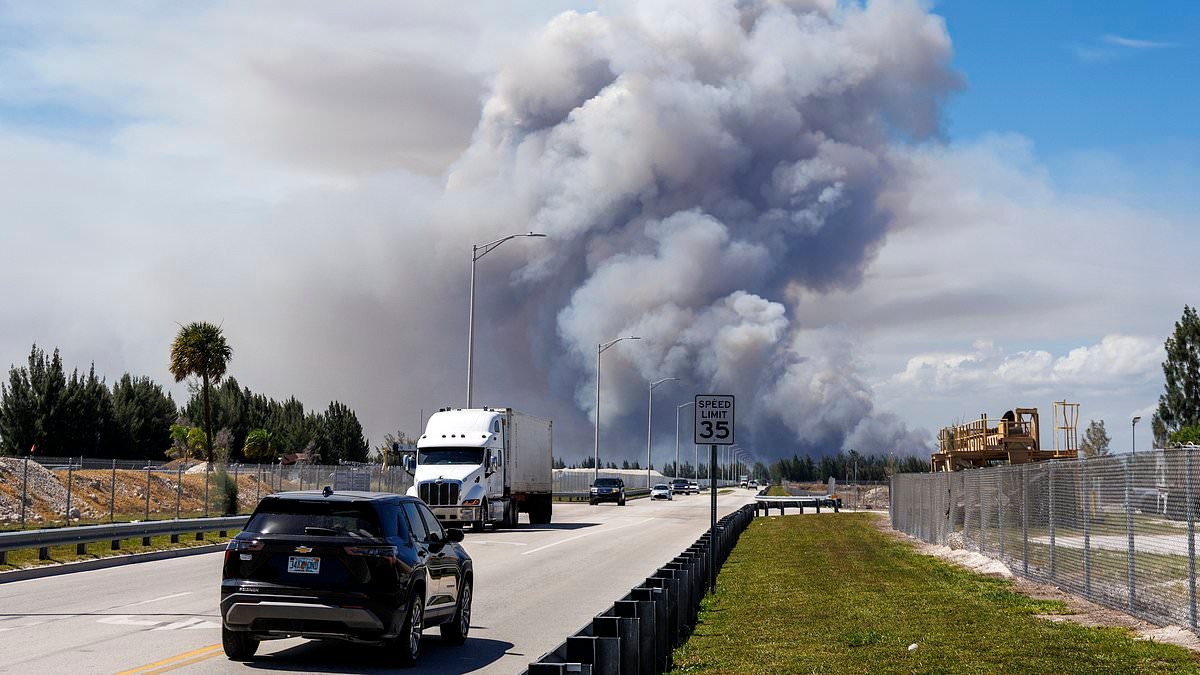
Officials are urging hundreds of thousands of Americans in two states to stay inside as toxic air engulfs parts of the nation.
The National Weather Service (NWS) issued an alert on Thursday, warning Americans in 17 Colorado counties to brace for wildfire smoke blowing from Utah and Nevada.
An Air Quality Health Advisory is in effect until 9am local time.
‘If smoke is thick or becomes thick in your neighborhood, you may want to remain indoors,’ the NWS said in a Thursday morning release.
‘Consider relocating temporarily if smoke is present indoors and is making you ill. If visibility is less than 5 miles in smoke in your neighborhood, the smoke has reached levels that are unhealthy.’
In a separate alert, an Air Quality Alert for fine particulate pollution remains in effect until 3pm Thursday for much of Miami-Dade County in Florida, where pollution levels may also approach or exceed unhealthy standards.
Officials warned that concentrations of fine particulate pollution could approach or exceed unhealthy standards across the region. Fine particulate matter, often referred to as PM2.5, consists of microscopic airborne particles small enough to penetrate deep into the lungs.
Exposure can irritate the eyes and throat, trigger asthma attacks, worsen existing lung and heart conditions, and increase the risk of breathing difficulties during periods of elevated pollution.
The cause of the elevated fine-particle pollution in Florida was not specified in the advisory, but authorities are currently battling three active wildfires in the Everglades, just west of Miami
Wildfire smoke is a complex cocktail of gases, toxic chemicals and microscopic particles.
While the exact composition depends on what is burning, the most prevalent and harmful toxins include PM2.5, carbon monoxide (CO) and hazardous air pollutants like benzene and formaldehyde.
In Colorado, Rio Blanco, Garfield, Eagle, Pitkin, Mesa, Delta, Gunnison, Montrose, San Miguel, Ouray, Dolores, San Juan, Montezuma, La Plata, Hinsdale, Mineral and Saguache are under the Thursday alert.
Other communities under the advisory include Glenwood Springs, Vail, Aspen, Grand Junction, Gunnison, Montrose, Telluride, Ouray, Cortez, Durango, Silverton, Lake City and Creede, among others.
The advisory comes as unstable atmospheric conditions make it difficult to predict exactly where the thickest smoke will settle throughout the day.
Officials warned that smoke concentrations may increase or decrease quickly throughout the advisory period because of shifting winds and highly unstable atmospheric conditions.
That means areas with relatively clear skies could see air quality deteriorate in a short period of time as smoke plumes move across the region.
One of the easiest ways to judge whether smoke has reached unhealthy levels is by checking visibility.
According to the advisory, if visibility drops below five miles because of smoke in your neighborhood, pollution has reached levels considered unhealthy and outdoor exposure should be minimized.
The advisory covers a large portion of western Colorado, stretching from communities near the Utah border to mountain towns in the central Rockies.
Meanwhile, a separate air quality alert is in place across Inland, Metropolitan, Coastal and Far South Miami-Dade County in Florida.
Concentrations of PM2.5 will linger around the cities of Fortymile Bend, Shark Valley Obs Tower, Florida City, Pa-Hay Okee Overlook, Redland, Hialeah, Kendall, Carol City, Kendale Lakes, Miami, Mahogany Hammock and Royal Palm Ranger.
The cause of the elevated fine-particle pollution was not specified in the advisory.
However, Miami-Dade County has been battling active wildfires this week, and local forecasters said shifting winds were expected to push smoke farther inland, potentially contributing to deteriorating air quality.
The primary health concern in wildfire smoke is PM2.5, which the NWS noted is causing hazardous air quality in the region.
Authorities reported on Sunday that the two largest wildfires were nearing full containment, following a week of evacuations, road closures and air quality concerns across South Florida.
As of Thursday, data shows at least four wildfires blazing west of Miami.