In the middle of the Great Depression, when millions of Americans were struggling to survive, a little girl with golden curls and a smile that seemed impossible to resist became the brightest star in Hollywood. Shirley Temple was more than a child actress. She was a symbol of hope. Her movies offered audiences a temporary escape from unemployment, hardship, and uncertainty. For fifteen cents, people could sit in a theater and watch a child who seemed to believe that everything in the world could still turn out all right.
But one of the most important moments of her career was not created by a famous director, a dramatic speech, or a box-office record.
It happened on a staircase.
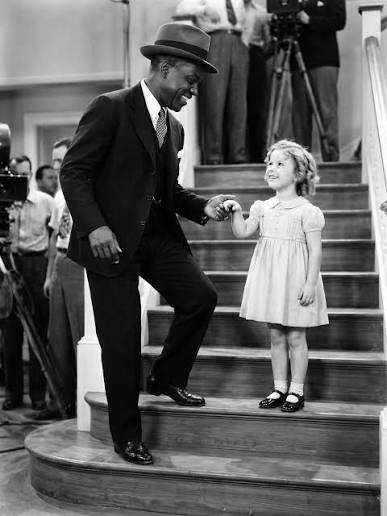
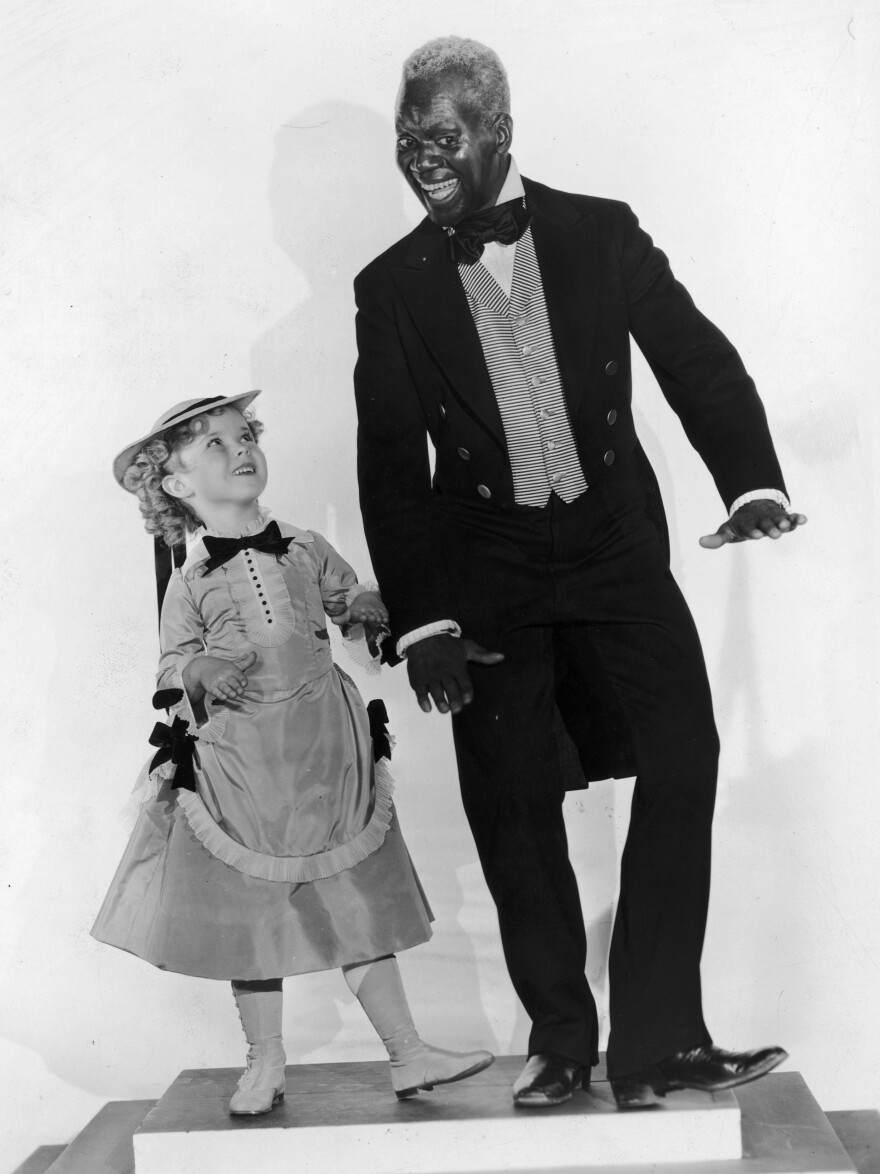
In 1935, inside a Hollywood studio, a six-year-old white girl and a fifty-seven-year-old Black man stepped onto a set together. They held hands. They smiled. They tapped their feet in perfect rhythm. They created a moment of pure joy that challenged the rules of a deeply divided America.
His name was Bill “Bojangles” Robinson.
Her name was Shirley Temple.
And the simple act of two people dancing together became one of the most quietly revolutionary scenes ever filmed in Hollywood history.
For many audiences, it was just a charming dance number in the movie The Little Colonel. But for others, especially in the segregated American South, it represented something far more threatening: equality.
A Black man and a white child holding hands on a movie screen.
Hollywood executives knew exactly what they had created. They also knew exactly what parts of America would refuse to accept it.
So the scene was cut.
The staircase dance disappeared from many Southern prints of the film. A moment of friendship, trust, and human connection was removed because some people believed even a child’s innocent affection crossed an unacceptable line.
But history remembered.
Because the truth was never really about a staircase.
It was about two people who saw each other as equals in a world that insisted they should not.
The Man Who Changed the Art of Tap Dancing
Before Bill Robinson ever met Shirley Temple, he was already a legend.
Born Luther Robinson in Richmond, Virginia, in 1878, he grew up in a world where opportunities for Black performers were painfully limited. Yet from a young age, he possessed a rare gift: an extraordinary ability to create rhythm through movement.
He began performing as a child and eventually became one of the greatest entertainers of the twentieth century.
But Robinson was not simply a talented dancer.
He transformed tap dancing itself.
Before him, many tap dancers performed with their feet mostly flat on the floor, emphasizing speed and complexity. Robinson introduced a lighter, more elegant style that focused on precise footwork, upright posture, and musical expression.
He made tap dancing look effortless.
His famous “stair dance” became his signature achievement. Instead of simply moving across a stage, Robinson turned a staircase into an instrument. Each step produced a different rhythm, creating the illusion that he was playing music with his feet.
Audiences were amazed.
He could move from one step to another with such control that people often wondered how a human body could create sounds so perfectly timed.
Future legends of dance studied him carefully.
Fred Astaire openly admired Robinson’s work and credited him as one of the performers who helped shape modern dance. Gene Kelly also recognized Robinson’s influence.
Robinson was not simply another entertainer.
He was one of the people who built the foundation that later allowed Hollywood dancers to become international icons.
But despite his fame, talent, and success, America still placed limits on him because of his race.
Hollywood’s Golden Child Meets a Dance Legend
When Twentieth Century Fox decided to make The Little Colonel in 1935, Shirley Temple was already the biggest child star in America.
She was six years old and had become a national sensation.
Her movies arrived during some of the darkest years of American history. Families struggling through the Great Depression found comfort in her performances. She represented innocence, optimism, and the belief that tomorrow could be better.
Even President Franklin D. Roosevelt recognized her cultural impact, famously acknowledging how her movies helped Americans escape their worries.
But behind the scenes, Hollywood was still a place where racial barriers controlled what performers could do.
Bill Robinson was a superstar among entertainers, but the roles available to him were severely restricted.
Hollywood rarely allowed Black actors to portray characters with authority, complexity, or independence. Instead, they were often limited to servants, workers, or supporting roles designed to reinforce existing social attitudes.
When Robinson was cast alongside Shirley Temple, nobody expected their partnership to become historic.
At first, it was simply a professional arrangement.
A famous dancer.
A famous child actress.
A movie studio looking for magic.
But something unexpected happened when they met.
Robinson was careful.
When they walked together on the studio lot, he stayed slightly ahead of Shirley.
Not because he disliked her.
Not because he was distant.
Because he understood the rules of the society around him.
A Black man walking casually hand in hand with a white child in public could create danger and controversy.
But Shirley Temple did not understand those rules.
She was six years old.
She only saw a man who was kind to her.
She kept reaching for his hand as they walked.
At first, Robinson did not notice.
Then his wife, Fannie, pointed it out.
Robinson stopped.
He looked down at the little girl beside him.
Then he bent down with his famous smile and took her hand.
Years later, Temple remembered that moment.
She described his hand as large and cool.
To her, it was not a political statement.
It was not an act of rebellion.
It was simply friendship.
She asked him:
“Can I call you Uncle Billy?”
Robinson smiled and answered:
“Why sure you can. But then I get to call you darlin’.”
From that day forward, their bond became one of the most memorable friendships in Hollywood history.
The Staircase Dance That Changed Everything
The famous staircase sequence in The Little Colonel was originally designed around Robinson’s incredible dancing ability.
The problem was simple:
The routine was extremely difficult.
Robinson had spent decades mastering his craft. Shirley Temple was only six years old.
Expecting a child to perfectly copy his movements in just a few days would have been impossible.
So Robinson did something remarkable.
He adapted.
Instead of demanding that Shirley become a professional dancer overnight, he adjusted the routine around her abilities.
He simplified the steps.
He created movements she could perform naturally.
He changed his own choreography so that the scene would appear as a partnership rather than a demonstration.
He was not trying to make Shirley look like she was following him.
He was making them look like they were dancing together.
And that difference mattered.
Shirley later explained that she did not learn from watching his feet.
She learned by listening.
She learned his rhythm.
She learned the feeling behind the dance.
The result was something Hollywood had rarely seen.
A Black man and a white child performing as equals.
Not master and servant.
Not background performer and star.
Partners.
The camera captured something that went beyond choreography.
It captured trust.
Their smiles were real.
Their connection was genuine.
Audiences could feel it.
And that was exactly why some people wanted it removed.
A Dance Too Powerful for Segregated America
The United States of the 1930s was deeply segregated.
In many parts of the country, Black Americans and white Americans were separated by law and custom.
Schools were divided.
Restaurants were divided.
Transportation was divided.
Even entertainment was controlled by racial boundaries.
Hollywood itself reflected those attitudes.
Black performers could become famous, but they were often forced into narrow roles. They could entertain white audiences, but they were not always allowed to appear as equals.
The staircase dance challenged that.
The image was simple:
A Black man holding the hand of a white child.
But to segregationists, that image represented something unacceptable.
Southern theaters removed the scene from many prints.
Other moments showing Robinson and Temple together were also edited.
The reason was not because the dance was inappropriate.
It was because the relationship shown on screen was too human.
It suggested equality.
It showed affection without fear.
It showed a Black performer being respected by a white child.
And in a society built around racial separation, even that small gesture was considered dangerous.
The Complicated Reality Behind Their Hollywood Partnership
Robinson and Temple continued working together after The Little Colonel.
They appeared in several more films, including The Littlest Rebel, Rebecca of Sunnybrook Farm, and Just Around the Corner.
Their chemistry remained undeniable.
Audiences loved them.
But their films also reflected the limitations of the era.
Robinson’s characters were often written as servants or figures connected to slavery.
He was one of the greatest performers alive, yet Hollywood rarely gave him roles worthy of his talent.
Film historians later criticized these portrayals.
Donald Bogle described Robinson’s screen image as fitting the traditional “Tom” stereotype — the loyal, non-threatening Black character designed to comfort white audiences.
Many Black viewers had complicated feelings.
They were proud that Robinson was achieving mainstream success.
They celebrated his talent.
But they also recognized that Hollywood was not allowing him to show his full humanity.
The world saw Bill Robinson the entertainer.
But many people did not see Bill Robinson the man.
The Man Behind the Smile
Away from Hollywood cameras, Robinson was far more than the character he often played.
He was independent.
Successful.
Influential.
And deeply involved in improving opportunities for Black Americans.
He was a founding member of the Negro Actors Guild of America, an organization created to fight discrimination against Black performers.
He helped establish the New York Black Yankees baseball team.
He had served during World War I with the Harlem Hellfighters, one of the most decorated military units of the war.
He was also known for refusing to quietly accept discrimination.
Restaurants and public places that treated him unfairly learned quickly that Bill Robinson was not someone who would simply walk away.
The man who played cheerful characters on screen was also a person who understood his own worth.
But around Shirley Temple, he protected her innocence.
He never forced a child to carry the burden of understanding racism.
He simply treated her with kindness.
The Friendship Shirley Temple Never Forgot
As a child, Shirley Temple did not fully understand what Bill Robinson experienced.
She did not understand why he sometimes lived in different accommodations.
She did not understand why society treated him differently.
When they filmed in Palm Springs, Shirley stayed in a private cottage.
Robinson stayed in a room above a drugstore.
When she asked why they were separated, he simply told her not to worry.
He even joked that his chauffeur was staying there too.
He protected her from the painful reality surrounding their friendship.
Years later, when Temple was older, she finally understood.
She realized that the man who taught her to dance had also been navigating a world filled with unfair rules.
And she understood something important.
Bill Robinson had never treated her like a child who was beneath him.
He treated her like a person.
“He treated me as an equal,” Temple later said.
That simple statement may have been the greatest tribute she could give him.
Because equality was exactly what Robinson gave her at a time when society told him he should not.
The Legacy of a Stolen Moment
Bill “Bojangles” Robinson died in 1949.
By then, he had lived a remarkable life.
He had transformed dance.
He had inspired generations of performers.
He had created one of Hollywood’s most memorable partnerships.
And he had carried photographs of Shirley Temple with him wherever he went.
Their friendship had lasted long after the cameras stopped rolling.
Decades later, the staircase scene from The Little Colonel remained a powerful symbol.
Not because it was perfect.
Not because it erased the racism of its era.
But because it showed something rare:
Two people refusing, even briefly, to accept the divisions placed around them.
A fifty-seven-year-old Black man.
A six-year-old white girl.
A staircase.
A song.
A dance.
A friendship.
That was all it took to create a moment powerful enough that some people tried to erase it.
But history has a way of bringing erased moments back.
Today, viewers can watch that staircase dance and see what others once tried to hide.
They do not see a controversy.
They see joy.
They see two performers connected through music.
They see a little girl reaching for a hand.
And they see a man reaching back.
The world around them said they should stand apart.
But for a few minutes on a Hollywood staircase in 1935, Bill Robinson and Shirley Temple showed millions of people what equality could look like.
And no amount of editing could make that moment disappear forever.