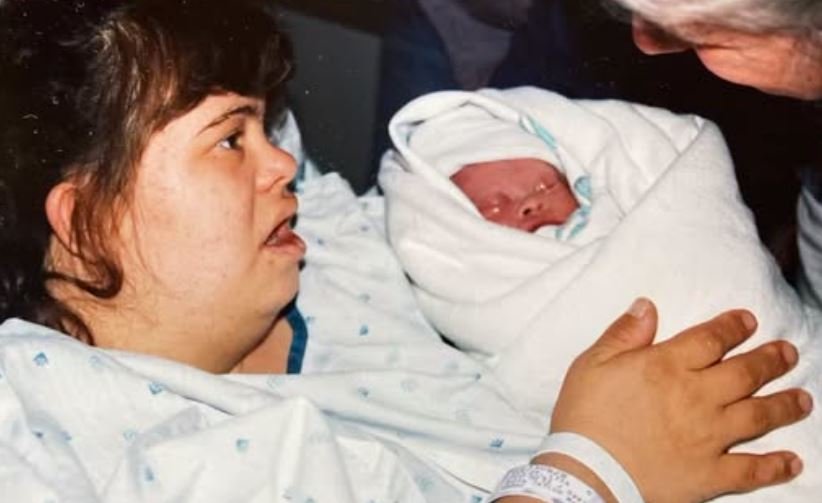
When Lisa Newtop discovered she was pregnant at 30 years old, she was already living independently, holding down a full‑time job, and proving that people with Down syndrome could lead fulfilling, self‑determined lives. But the moment she shared her news, the world around her seemed to shrink.
People assumed she couldn’t do it.
They told her she wasn’t capable. They suggested adoption. Some of her closest friends disappeared entirely — their families worried Lisa might inspire their own daughters to want children too.
Lisa heard every word. She just didn’t listen.
“If I have a baby with Down syndrome, he will be like me — and I’ll be so proud of him.”
In February 1996, Lisa gave birth to a son. She named him Nic. Like his mother, Nic was also born with Down syndrome.
Lisa’s mother, Patti, and stepfather, Norm, stepped in to help. But this was never a story about Lisa handing over her child. It was a family learning how to make motherhood, responsibility, and support work together.
Nic grew up in Patti and Norm’s home, while Lisa lived nearby — always involved, always present. She attended his therapy sessions. She helped with his care. She was there for the everyday moments that define what it means to be a mother.
“I have two mothers,” Nic would later say. “Lisa gave me life and love. She’s always been beautiful and wonderful to me.”
A Story of Support, Not a Story of Doing It Alone
Lisa’s journey wasn’t easy. She faced judgment from strangers, skepticism from professionals, and loneliness when friends walked away. But what she never lost was her conviction.
She knew what she wanted. She knew what she could give. And she knew that needing help didn’t make her less of a mother — it made her human.
As Nic grew older, he attended a California program designed to help young adults with disabilities build skills for greater independence. Lisa was there every step of the way, proudly telling anyone who would listen about her son.
What Society Gets Wrong
Lisa Newtop’s story isn’t about overcoming Down syndrome. It’s about overcoming the limits other people place on us.
Too often, society confuses needing support with having nothing meaningful to give. We assume that if someone requires help, they must be incapable — of love, of responsibility, of raising a child. But Lisa proved that support doesn’t diminish a person. It enables them.
She couldn’t do it alone. She didn’t have to. And neither should anyone else.
The Real Lesson
Lisa’s story isn’t about proving that support is unnecessary. It’s about proving that needing help doesn’t make someone incapable of love, connection, or having an important place in their child’s life.
The question isn’t whether someone with Down syndrome can be a mother. The question is: How often does society mistake needing support for having nothing meaningful to give?
Lisa Newtop answered that question with her whole life.