For twenty-five years, that money sat in my chest like a stone. My husband came home one night with split knuckles and blood on his sleeve, and the next evening he told me he’d handed every cent we had to a woman named Celeste. He never explained. He just kept saying, “One day, you’ll understand.” He died before that day ever came. Or so I thought.
Part 1: The Woman on My Porch
I opened the door expecting a delivery.
I’d ordered new curtains for the spare room, and the tracking said they’d arrive that morning. So when the bell rang, I didn’t even take off my reading glasses. I just wiped my hands on a dish towel and pulled the door open.
There was no box on the porch.
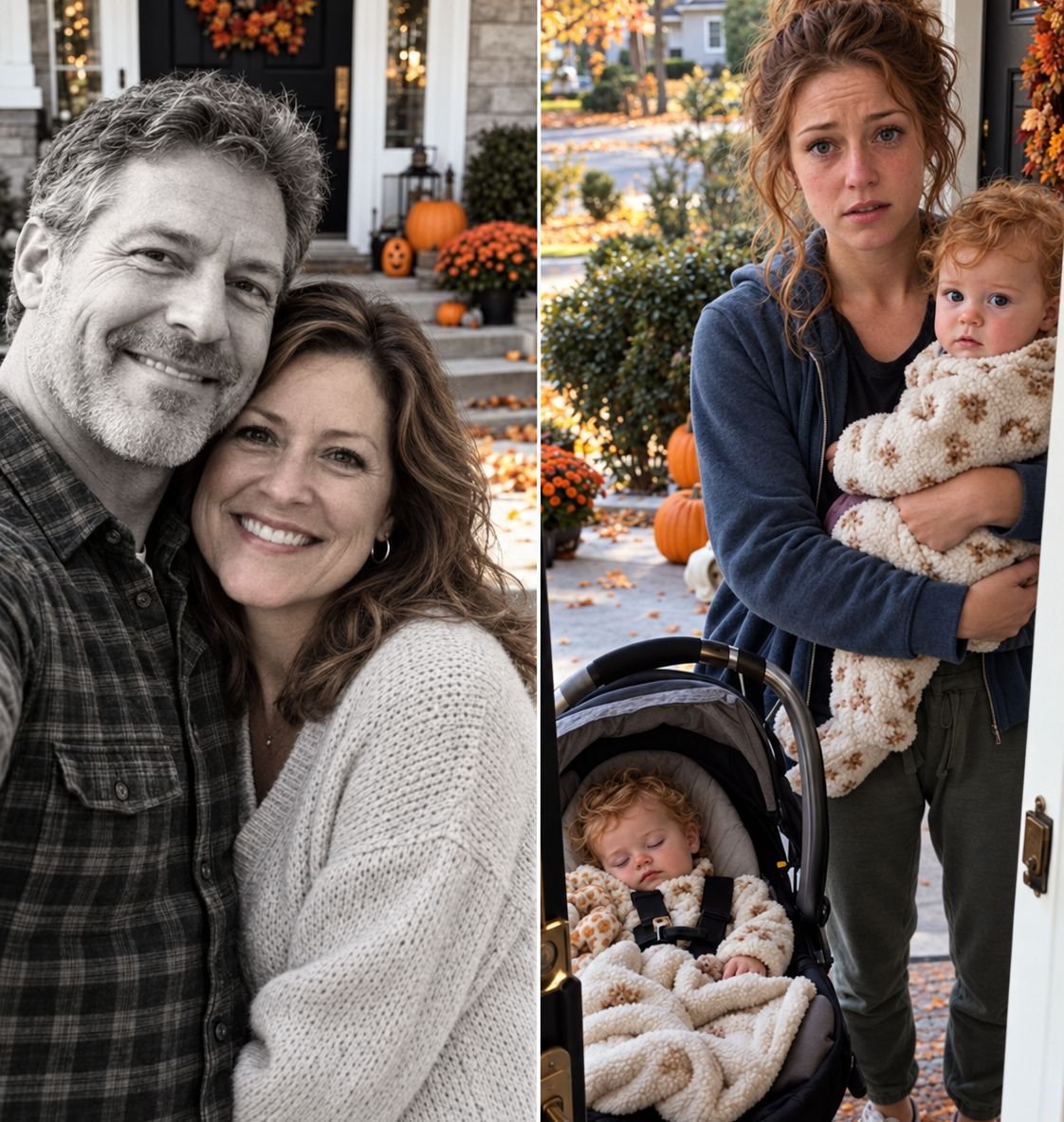
Instead, a young woman stood there with one baby on her hip and another asleep in a car-seat carrier at her feet. She was maybe twenty-four, with dark hair in a messy knot and the hollow, gray look under the eyes that every new mother wears like a uniform. Her coat was buttoned wrong.
“Are you Thomas’s wife?”
My heart skipped.
Thomas had been gone eight years. A heart attack on a Tuesday morning, in the middle of making coffee. One minute he was complaining we were out of half-and-half, and the next he was on the kitchen floor.
Since then, his name had slowly faded from other people’s mouths. Nobody came knocking on my door asking for him.
“Yes,” I said carefully. “Who’s asking?”
“My name is Lily.” She swallowed. “Celeste was my mother.”
Celeste.
The dish towel slipped out of my hand.
I had heard that name exactly once in my life. Twenty-five years ago, in my own kitchen, from my own husband’s mouth. I had never forgotten it.
The baby on her hip stirred, blinked up at me, and broke into a gummy smile that pulled higher on the left side.
Something about that little face stopped me cold. I had seen that crooked smile before. I just couldn’t think where.
I gripped the doorframe.
“Did Thomas ever tell you,” Lily asked quietly, “why he gave my mother that five thousand dollars?”
“No,” I said. “He never did.”
Something shifted in her face. Not surprise. Closer to pity, as if she’d hoped someone else had already done the hard part.
“Then I think,” she said, “you need to know what happened the night before he gave it to her.”
It happened twenty-five years ago.
I was twenty-two. Thomas and I had been married two years, and we were barely hanging on.
We rented a tiny house with a furnace that groaned like a dying animal and a roof that leaked into a saucepan every time it rained. The car needed a new transmission. The payment on the little lot we’d bought, the one we were going to build on someday, was two months overdue.
The five thousand dollars in our savings account was everything we had left. Two years of skipped dinners, secondhand furniture, and Christmases where we only bought gifts for our parents.
One night, I woke at four in the morning to the sound of the front door clicking shut.
Thomas stood in the hallway, still in his work jacket. His knuckles were split and swollen. A dark, rust-colored smear ran down one sleeve.
“Tom? Oh my God. What happened?”
“Slipped on the ice.” He didn’t look at me. “I’m fine. Go back to sleep, Jo.”
There hadn’t been a frost in weeks.
I should have said so. But something about the way he held himself, rigid and shaking at once, made me afraid of the answer. So I said nothing. I watched him wash his hands at the kitchen sink for a very long time. Long after the water should have run clear.
The next evening, Thomas came home unusually quiet. He sat down at our wobbly kitchen table, folded his hands, and stared at them.
“I gave the money away,” he said.
I thought I’d misheard. “What money?”
“The savings.”
I turned off the burner. “All of it?”
He nodded.
“To who?”
“A woman named Celeste. She’s pregnant. She needed help.”
“Who is she?”
“Someone I met a few times. Through a guy I used to work with.”
“You gave our last five thousand dollars to a stranger?”
“She needed it more than we did.”

We argued for hours, until our voices were hoarse and the neighbors’ porch light flicked on. I asked if she was family. He said no. I asked if he owed her something. No.
Then I asked the question sitting in my throat the whole time.
“Is there something between you two?”
He looked me dead in the eye. “No. Never. I swear it on my life, Jo.”
But every time I asked why, I got the same maddening answer.
“One day, you’ll understand.”
He never mentioned her again. Not once in the next seventeen years of our marriage. We rebuilt our savings. We built the house on the lot. We raised two beautiful children, Megan and Sam. We had a thousand ordinary, happy days.
But some nights, I’d lie awake beside him and wonder. Who was Celeste? And what did she have that was worth everything we owned?
Then the heart attack took him, and he took the answer with him.
I told myself I’d stopped wondering.
I hadn’t. Not for one day.
“Say it plainly,” I told Lily. My voice had gone hard. “Whatever you came here to tell me.”
“I can’t. Not here.” She glanced at the sleeping twin. “There’s someone I need you to meet first. Someone I’d honestly rather not see myself.”
“Who?”
“Please. I know you have no reason to. But just trust me.”
I looked at this stranger, standing on my porch with my dead husband’s name in her mouth, and every ugly thought I’d ever buried came crawling back out.
Maybe Thomas had cheated on me after all. Maybe the money was a payoff. Maybe Lily was his daughter, and that crooked smile on the baby’s face was his, and whatever waited at the end of this ride was the proof I’d spent twenty-five years trying not to find.
Or maybe I should just close the door and let the silence stay silent.
But some questions don’t let you sleep forever.
“Give me five minutes,” I said.
I called my daughter, Megan, who lives ten minutes away, and asked her to come watch two infants she’d never met.
“Mom, whose babies?”
“I’ll explain later, sweetheart.”
Because apparently, I was going.
I didn’t understand where we were going until I saw the gates.
Lily drove. Neither of us spoke for forty minutes. Then the road curved, and I saw two rows of fences topped with razor wire, glinting in the pale autumn sun.
A state prison.
Inside, it smelled like bleach and burnt coffee. We handed over our IDs. We emptied our pockets into gray plastic bins. Then we walked through three heavy doors, each one buzzing and locking behind us with a sound that went straight through my teeth.
At the last door, Lily stopped. Her eyes were wet.
“I’ll wait out here. I’m sorry. I can’t see him.”
“See who?”
She just opened the door and stepped back.
The visiting room was small and windowless. One metal table, bolted to the floor. Two plastic chairs. I sat and pressed my shaking hands flat against the cold tabletop.
A buzzer sounded. A door opened on the far side.
A man in a gray uniform walked in with his back to me, talking over his shoulder to the guard. And my heart stopped dead.
Those broad shoulders, rounded slightly at the top. That particular tilt of the head, a little to the right, as if he were always listening for something just out of earshot.
I had woken up next to that tilt for nineteen years.
“Thomas?” I whispered.
I was already halfway out of my chair.
The man turned around.
Part 2: The Man in the Gray Uniform
He was older. Harder. His hair was iron-gray and shaved close, and a thin white scar ran straight through his left eyebrow.
But that jaw. That was Thomas’s jaw.
It wasn’t Thomas.
Of course it wasn’t. I had held my husband’s cold hand in a hospital room. I had stood by his grave in the rain. And still, for one wild second, my whole body had believed.
I sank back into the chair.
“Sorry for the shock,” the man said, sitting down across from me. His smile pulled higher on the left. Thomas’s smile. The baby’s smile. “Nobody warned me they were bringing you. I’d have combed my hair.”
“Who are you?”
“Russell. Thomas’s brother. Older by two years. Uglier by a lot.”
I laughed, a sharp, ugly bark that bounced off the cinderblock walls. “Thomas didn’t have a brother.”
“That’s what he wanted everyone to think.” He rubbed the back of his neck, an exact copy of a gesture I’d seen ten thousand times. “Honestly? I wouldn’t have claimed me either.”
“Why?”
“You want the polite version or the real one?”
“The real one.”
“Your parents had a country club membership. Thomas had a bus pass and a cousin’s couch. The first time he came to Sunday dinner, your mother looked at him like he’d tracked something in on his shoe.” Russell tipped his head toward himself. “I was the something.”
I thought of those dinners. My mother’s tight smile. Her voice, low and sharp in the kitchen: That boy from the wrong side of town, Joanne. You could do so much better.
He’d heard her. Somewhere, I’d always known he had.
“I was at your wedding, you know,” Russell said.
“You weren’t.”
“Back row, borrowed tie. Thomas spotted me during the toasts, walked over in his rented suit, pressed a hundred bucks into my hand, and told me to go home before your mother called the cops.”
“Did you?”
“After the cake.” He shrugged. “Don’t be mad at him, Joanne. He was building something with you. Something clean. A brother like me was a crack in the foundation.”
I had no answer for that.
“I have something you should see.” He reached into his shirt pocket and slid a photograph across the table, its colors faded, its corners worn soft.
Three young people on a beach. Russell on the left, shirtless and grinning like the devil. Thomas in the middle, skinny and sunburned, so young it hurt to look at him. And on the right, a girl with a wild mane of dark curls, both arms thrown around Thomas’s neck, her cheek pressed tight against his.
I didn’t need anyone to tell me her name.
Celeste.
Everything in me went cold.
The pregnant stranger. The woman Thomas swore he barely knew. Someone I met a few times, Jo.
And there she was, wrapped around my husband like she belonged there.
So that was the truth. Twenty-five years of wondering, and there it was in faded color on a scratched prison table. He had lied to my face. He had sworn on his life.
“That’s enough.” I stood so fast the chair screeched across the floor. The guard by the door straightened.
“Wait.” Russell leaned forward. “Don’t you want to hear the rest of the story?”

My head was spinning. A brother I never knew existed. A photograph. A baby with a familiar face. I couldn’t hold any more of my husband’s secrets.
There was no point in being angry at a man who couldn’t answer for himself.
I was angry anyway.
“The only person I wanted to hear this story from,” I said, “took it to the grave.”
“You mean my brother?”
“No.” I jabbed a finger at the curly-haired girl. “Her.”
Russell looked at me strangely. “As far as I know, Celeste is alive.”
“But Lily said…” I stopped.
Celeste was my mother. Was. I’d heard that one word and buried the woman myself, right there on my porch.
Only one thing mattered now.
“Where is she?”
The cab dropped me in front of her house just as the sun went down.
Lily had stayed in the prison parking lot, her forehead pressed against the steering wheel. When I came storming out demanding an address, she’d written it on the back of a gas receipt without a word.
All the way across town, I replayed that one little word. Was. I’d let the past tense bury Celeste, and every answer with her.
Apparently, I’d buried her too early.
The house was a small ranch at the end of a cul-de-sac, painted a pale, tired yellow. Someone had built a wooden ramp up to the front door. A wind chime made of old spoons tinkled on the porch.
I stood at the bottom of that ramp for ten minutes, rehearsing.
In one version, I was calm and dignified. In another, I screamed every name I’d been storing up for twenty-five years. In a third, I slapped her and walked away without a word.
I knocked before I could change my mind.
A long pause. Then the sound of something rolling slowly across a wooden floor. The door swung open.
There was no glamorous girl with wild curls.
A thin woman with short gray hair sat in a wheelchair, a crocheted blanket over her knees. She couldn’t have been much older than me, but she looked twenty years older than she should have, worn down by something I couldn’t see.
Her eyes widened.
“Joanne,” she breathed. “You came.”
Every version I’d rehearsed collapsed.
“You know who I am?”
“Thomas showed me your picture once. A long time ago.” A faint, sad smile. “He said you were the best decision he ever made.”
My throat closed.
“I’m sorry,” I stammered. “This was a mistake. I feel ridiculous. It’s just, my husband, and you, and that photograph…”
I started backing down the ramp. Then, over her shoulder, I saw the shelf.
On a pine bookshelf sat a framed photograph. Thomas, maybe thirty, grinning ear to ear. On his hip was a tiny girl in a yellow sundress, laughing so hard her eyes were squeezed shut, tugging on his ear with one chubby fist.
Lily.
He was holding her like she was his.
He’d never told me. Not once in seventeen years.
Something hot rose in my chest, and I stopped moving.
“What was he to you?” I asked. My voice was low and steady now. “Tell me straight. I’ve waited twenty-five years.”
Celeste took a slow breath.
“I hated him.”
I blinked. “What?”
“For years and years, I hated Thomas with everything I had.”
That was not an answer I’d rehearsed for.
“I know why you came,” she went on. “It’s the money.”
“It isn’t,” I said, much too fast. “It was five thousand dollars, a hundred years ago. If your daughter hadn’t shown up this morning, I wouldn’t have thought about it in years.”
Celeste almost smiled. We both knew I was lying.
“Five thousand dollars,” she said, “was just the beginning.”
“The beginning?”
“He gave me so much more after that. He paid for my rehabilitation. Every surgery. Every therapy session, for years. When I couldn’t even lift my own daughter, he sat with Lily so I could sleep.”
I grabbed the porch railing.
The memories came flooding back, things I’d noticed and let slide. Thomas coming home after nine with no explanation. Saturday mornings “helping a buddy move.” Plain white envelopes he’d seal at the kitchen table and say were for “an old coworker who’d fallen on hard times.”
And then the question I’d carried for twenty-five years finally fell out of my mouth.
“Is it because she’s his daughter?”
Silence. The wind chime tinkled above us.
Celeste slowly shook her head.
“No.”
“Then why? Why would he do all that for you?”
Her hand tightened on the blanket until her knuckles went white.
“Because he wouldn’t let me get rid of the baby,” she said. “And because of that, I’ll never walk again.”
Part 3: The Promise He Kept
I stared at her. The words wouldn’t fit together.
“Come in,” Celeste said gently, backing her chair away from the door. “Sit down, Joanne. You’re going to need to.”
She made tea and set a chipped mug in front of me. By the end of her story, it had gone stone cold, and I hadn’t taken a single sip.
“It was a triangle,” she began. “Just not the kind you’re imagining.”
She told it in pieces.
She’d met Thomas and Russell the same summer, when she was seventeen. The three of them were inseparable: weekends at the lake, nights on the hood of Russell’s beat-up Pontiac, talking about all the places they’d go once they got out of that town. Both brothers fell in love with her. Both were too stubborn to say it.
“I picked Russell,” she said. “He was funny. Wild. Dangerous. And I was nineteen and stupid enough to think dangerous meant exciting.”
“And?”
“And I was a fool. Russell was a criminal, Joanne. And a cruel man when he drank, which was most nights. The first time he hit me, I made excuses. By the fifth time, I’d stopped counting.”
My chest ached for the girl in that photograph, the one with her arms around everybody.
“You and Thomas were already married by then. One night, Russell came home blind drunk, worse than I’d ever seen him. I knew that if I didn’t get out, he was going to kill me. I locked myself in the bathroom, shoved the hamper against the door, and called the only person I still trusted.”
“Thomas,” I whispered.
Four in the morning. The cold side of the bed. The split knuckles. The smear on his sleeve.
Slipped on the ice, Jo.
“He drove across town in twenty minutes,” Celeste said. “I heard them fighting. I heard something break. Then Thomas was there, pulling me off the floor. He got me out of that house with nothing but my purse.” Her voice cracked. “He’d never hit anyone in his life before that night. He broke two knuckles on his own brother’s face.”
I pressed my hand over my mouth.
“In the car, I told him everything. That I was pregnant. That I didn’t want Russell’s baby. That I wanted to get rid of it, get on a bus, and leave town forever.”
She hesitated.
“And I told him I wanted him to come with me.”
I went very still.
“With my Thomas?”
“I’d regretted my choice for years.” She met my eyes without flinching. “I thought if I just asked, I could go back to that summer at the lake and pick the right brother this time.”
“What did he say?”
“He said no. Twice.” She held up two thin fingers. “No to running away with me. And no to ending the pregnancy.”
She swallowed.
“He pulled the car over and said, ‘Celeste, I love my wife. I don’t love you anymore. I haven’t for a long time. But I swear I’ll help you raise that child, whatever it takes. Keep the baby.’”
Somewhere in the house, a clock was ticking.
“The next day, he came to the motel where he’d put me up and handed me an envelope with five thousand dollars. ‘Start over,’ he said. ‘And I promise Russell will never touch you again.’ He went to the police that same week and told them everything he knew. Then he testified at the trial, with his brother staring at him from the defense table. Russell’s been inside ever since.”
“He kept his word,” I whispered.
“He always did.”
I thought of the man I’d married. The man who’d drive back to the grocery store if they gave him a dollar too much in change. Of course he’d kept his word.
Then Celeste’s face darkened.
“Six months later, Lily was born. Something went wrong. A bleed near my spine. Emergency surgery.” She smoothed the blanket over her knees. “When I woke up, I couldn’t feel my legs.”
“Oh, Celeste.”
“I blamed him for everything. If he’d just let me do what I wanted, I’d still be able to walk. That’s what I told myself. I threw a water pitcher at his head in that hospital room. I told him to get out of my life forever.”
“But he didn’t leave,” I said quietly.
“No. Every month, for seventeen years, there was money in my mailbox. Birthday presents for Lily on the porch. When she was six, he taught her to ride a bike.” Her lips trembled. “From the sidewalk. Because I wouldn’t let him inside.”
I closed my eyes and pictured it. Thomas, running beside a wobbly little bike with one hand on the back of the seat, never once coming through that front door.
All those Saturdays “helping a buddy move.”
“Lily said ‘was,’” I murmured. “On my porch. I told myself you were dead.”
“To her, I might as well have been.” Celeste stared at her hands. “Until three months ago.”
“What happened?”
“Thomas happened.” She smiled, terribly sad. “He loved her, Joanne. Every birthday. Every school play, sitting in the back row so I wouldn’t see him. And at home, she had a mother who smiled with her mouth and looked at her like she was the reason I’d never walk again.”

As a mother, I couldn’t understand that.
But as a woman who had spent twenty-five years quietly resenting a choice I didn’t understand, I understood her completely.
“When Thomas died, she was sixteen. She lost the only person who ever loved her without conditions, and I couldn’t even comfort her, because I was still so angry at him. Two years later, she stood in that doorway with a packed bag and told me she’d never forgive me. For the way I’d treated her. For the way I’d treated him.”
“And the twins?”
“Three months ago, she called me from the hospital, sobbing. She said the first time she held them, she finally understood what it meant to choose a child over yourself. She said she wanted to understand all of us. Thomas. Me.” Celeste paused. “Her father.”
“Her father?” I repeated.
Celeste frowned. “Russell. Lily is Russell’s daughter.”
And just like that, the last piece clicked into place.
The man with the scar through his eyebrow. That crooked smile, pulling higher on the left. It wasn’t Thomas’s smile I’d recognized on that baby’s face. It was the family’s. And I’d just spent an hour sitting across a table from it.
“Wait.” Celeste’s voice thinned. “You didn’t know?”
“Nobody told me anything.”
“But you went to see Russell. When you knocked, I assumed you already knew everything. I thought you’d come to yell at me.”
“Russell tried to finish the story,” I said slowly. “I didn’t let him. Lily called after me in the hallway, and I didn’t even turn around.”
Broken telephone. Three people, each one certain someone else had already said it. And me in the middle, the only one who hadn’t heard a word.
Celeste laughed softly, helplessly, and wiped her eyes. “Oh, Joanne.”
“Why did she come to me?”
“She’s been looking for her family. The real one.” Celeste reached across the table. “She wanted her babies to meet the wife of the good man who gave her life. She said they deserved to know where they came from. All of it. Not just the bad parts.”
So that was why Lily had come. Not for money. Not to tear down my memories.
For family.
The tears I’d held back all day finally came.
“Why didn’t he just tell me? I would have understood. I would have helped him.”
“Would you?” She said it gently. “At twenty-two? With your mother already sure he wasn’t good enough? He’d hidden his brother. He’d hidden me. And now he was supposed to tell you he’d given away every cent you had to a pregnant woman who used to love him?” She shook her head. “He believed he didn’t deserve you. He thought if you ever saw where he really came from, you’d finally see what your mother saw. And you’d leave.”
“That’s absurd.”
“It’s love. The stupid, stubborn kind.” She took my hand and held on tight. “But he never left you, Joanne. Not for a single day. Whatever you lay awake wondering about, it never happened. He stayed faithful to you until the very end.”
“He didn’t betray me,” I whispered.
“No. He just carried too much alone.”
We sat there a long time after that. The sun went all the way down, and neither of us got up to turn on the light. Two women in the dark, holding hands across a table, crying over the same stubborn, impossible, good man.
Finally, I stood and wiped my face.
“Where are you going?” Celeste asked.
“To find Lily. I owe her an apology.” I pulled out my phone. Three missed calls from Megan, and a text: Mom, these babies are ADORABLE but WHERE ARE YOU? “And then I’m calling my kids. It’s time they met their cousin.”
Celeste’s lips trembled. “Thomas would have liked that.”
At the door, I looked back at the photograph on the shelf. My husband, young and grinning, a laughing little girl tugging his ear.
One day, you’ll understand, he used to say.
“I understand now, you stubborn idiot,” I whispered.
And I smiled through the tears.
I found Lily at my house. She’d driven there from the prison, unsure where else to go, and Megan had made her a grilled cheese and tucked her onto the couch with a blanket. She was asleep sitting up, a twin under each arm.
She woke when the door clicked and looked at me with wide, frightened eyes, as if she expected me to tell her to leave.
I sat down beside her.
“I’m sorry,” I said. “I didn’t let you finish this morning.”
Her face crumpled.
“Thomas talked about loyalty all the time. About keeping your word. About showing up. I always thought he meant us.” I touched the baby girl’s tiny hand, and she wrapped her fist around my finger. “I didn’t know he meant you, too.”
Lily started to cry. So did I. And Megan, who still had no idea what was going on, cried too, just because everybody else was.
That Sunday, Sam drove in with his wife. Megan brought a casserole. Lily brought the twins, Grace and little Thomas. She’d named her son after the man who taught her to ride a bike from the sidewalk.
Around the dining table my husband built with his own hands, I told my children everything. The five thousand dollars. The uncle they never knew. The night their father broke his knuckles to save a woman’s life, then spent seventeen years quietly keeping a promise he never once asked anyone to thank him for.
When I finished, Sam was quiet for a long moment.
“That sounds like Dad,” he said.
I looked around the table at my family, bigger now than it had been that morning.
“Yes,” I said. “It sounds exactly like him.”
What This Story Taught Me
The secrets people keep aren’t always the ones we fear. Sometimes what someone hides isn’t a betrayal at all. It’s a burden they were too proud, or too frightened, to ask anyone to help them carry.
Real loyalty doesn’t make speeches. It shows up on the sidewalk every Saturday, even when it isn’t allowed through the front door.
And it’s never too late to set another place at the table. Sometimes family is whoever knocks on your door twenty-five years later, holding the answer you’d given up on finding.
This story is a work of fiction inspired by real events. Names, places, and details have been changed, and any resemblance to real people is coincidental.