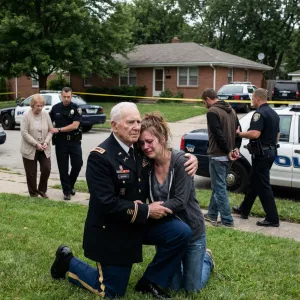
The morning sun lay gently over the quiet town of Briar Glen, painting the wooden fences and mailboxes in soft gold. Behind a small white house at the end of a gravel road, a man knelt in a garden bed, his hands deep in dark soil as he loosened the roots of lavender bushes. The scent of herbs, roses, and freshly watered earth wrapped around him like a familiar blanket.
To the neighbors, he was simply Harold Bennett, a widower in his late sixties who spoke little and worked his garden with devotion. They saw the slow measured walk, the weathered flannel shirts, the thermos of black coffee resting beside a stone bench. They waved politely. He nodded politely. They thought him harmless, perhaps lonely, perhaps gentle.
They did not know that the stiffness in his left leg came from an explosion in a desert half a world away. They did not know that his quiet eyes had once tracked threats in darkness before others even sensed danger. They did not know that the steady hands trimming rose thorns had once guided young soldiers through fear and fire.
For many years, Harold had served as an instructor for elite military units. He had retired without medals on display or stories to tell. When his wife passed, he chose peace. He bought this house, planted this garden, and built a life where the loudest noise was the wind through oak branches.
That morning, peace ended with a single vibration in his pocket. His phone buzzed.
He pulled off his gloves and answered.
“Hello.”
A faint voice answered. It was breathless and trembling.
“Dad… please…”
Then silence. The line went dead. Harold stood very still. The breeze moved the lavender stems. A bird chirped. Everything else faded away.
His daughter, Emily Parker, lived thirty minutes away in an affluent gated neighborhood called Lakeview Crest. She had married a wealthy man named Curtis Hale six months earlier. Harold had never liked him, but Emily had insisted she was happy. Harold had trusted her judgment and kept his concerns quiet.
Now something was wrong. He felt it as surely as he felt the earth beneath his boots.
He checked the time. Ten twelve in the morning.
He walked into his house, not rushing, not hesitating. Inside a hallway closet sat an old duffel bag that had not been opened in years. He pulled it out and unzipped it. Inside lay simple items. A flashlight. Medical supplies. A set of handcuffs. A worn leather wallet with old identification he hoped never to use again.
He did not take any weapons. He did not need them. This was not a battlefield. This was his child.
He grabbed his truck keys and walked to his faded blue pickup parked beneath a maple tree. The engine started with a familiar rumble. As he drove away, the gentle gardener disappeared. Something older took his place. Something steady and unyielding.
The highway stretched ahead. Harold did not speed recklessly. He drove with purpose. Calm always arrived faster than panic.
At the entrance to Lakeview Crest, a security gate blocked the road. A keypad blinked beside a camera. Harold did not bother stopping. He turned onto the grass shoulder, drove around the barrier, and continued forward. The manicured lawns of the neighborhood blurred past. Fountain sculptures and polished stone driveways flashed by.
He reached a large mansion with white pillars and dark tinted windows. Tire marks cut across flowerbeds as he parked directly before the entrance.
The front door opened. Curtis stepped outside. Curtis wore designer clothing, a gold watch, and a confident smirk that did not reach his eyes. In his hands he held a metal baseball bat. He rested it on his shoulder as if posing for a photograph.
“You should not be here,” Curtis said loudly. “Emily is having a private family moment. Go home old man.”
Harold stepped out of the truck and closed the door quietly. He walked toward the porch. His posture was relaxed. His face showed no anger. Only certainty.
“Move aside,” Harold said.
Curtis laughed. “Or what. You think you can scare me. I will make sure you never see your daughter again if you keep interfering.”
Curtis lifted the bat and swung it toward Harold with clumsy bravado. Harold stepped forward at the same time, avoiding the strike with a simple shift of weight. The bat passed through empty air. Curtis stumbled slightly.
Harold placed one hand on Curtis shoulder and guided him gently but firmly toward the ground. Curtis collapsed onto his knees, gasping, shocked, humiliated, unable to understand how he had been neutralized without dramatic struggle.
Harold did not strike again. He simply stepped past him and opened the front door.
Inside the house, soft classical music played from hidden speakers. Harold followed the sound of muffled crying upstairs. He moved swiftly but quietly.
At the top of the stairs, a bedroom door stood open.
Inside, Emily knelt on the carpet. Her long hair lay uneven and ruined around her shoulders. A woman in a silk robe stood beside her holding scissors. This was Curtis mother, Doris Hale, a woman who loved social status and control more than kindness.
Emily was shaking. Her cheeks were flushed with fever. Her eyes were unfocused.
“You will learn obedience,” Doris said coldly. “You embarrassed this family. You will not attend events until you understand gratitude.”
Harold stepped into the room.
“Step away from my daughter,” he said.
Doris turned, startled. “You broke into my home.”
Harold crossed the room and gently took the scissors from her hand. He set them on a table.
Emily looked up. “Dad,” she whispered.
Harold knelt beside her and placed a hand on her forehead. Her skin burned with heat.
“You are safe now,” he said.
Doris recovered her arrogance quickly. “You cannot touch me. My lawyers will bury you. This girl is my daughter in law. She belongs to this family.”
Harold stood slowly. He did not raise his voice. He did not shout.
“She belongs to herself,” he replied. “And she is coming with me.”
Doris moved toward the door, reaching for her phone. Harold stepped in front of her. His presence was enough. Doris stopped. Her breath hitched. Something in Harold eyes told her that threats meant nothing here.
Harold lifted Emily into his arms. She weighed far less than she should. He carried her downstairs. Curtis lay near the entrance trying to regain dignity. He looked up in disbelief.
“You cannot take her,” Curtis rasped. “She is my wife.”
“You lost that privilege the moment you harmed her,” Harold replied.
He placed Emily gently in the passenger seat of his truck. He turned on the air to cool her. He gave her a bottle of water.
“Dad will handle the rest,” he said.
He closed the door and turned back toward the house.
Curtis stood on the porch again, shaky but defiant. Doris appeared beside him clutching her phone.
“You will regret this,” Doris screamed. “We own judges. We own police. You are finished.”
Harold reached into his pocket and pulled out his old flip phone. He dialed a number stored in memory.
The call connected quickly.
“Colonel Adams,” Harold said. “This is retired Sergeant Major Harold Bennett. I need assistance at a domestic violence scene in Lakeview Crest. Victim secured. Perpetrators on site.”
A calm voice answered. “Understood. Local department has been alerted. Remain present.”
Harold hung up. Within minutes, police vehicles arrived. Officers stepped out. One senior officer approached Harold and nodded with recognition. He did not salute, but his respect was clear.
“We received your report,” the officer said. “We will take it from here.”
Curtis and Doris shouted protests. Officers handcuffed them despite threats and insults. Neighbors watched through curtains and behind gates. A perfect family image shattered in full daylight.
Harold did not gloat. He simply watched until Curtis and Doris were placed in separate vehicles.
The officer turned to Harold. “Your daughter needs medical attention.”
Harold nodded and climbed into his truck. He drove Emily to the hospital himself, holding her hand at red lights, speaking softly to keep her awake.
Doctors treated her fever and dehydration. They documented injuries. They asked questions. Emily told the truth with quiet strength.
Days passed.
Curtis faced charges. Doris faced charges. Wealth delayed nothing when evidence was clear.
Emily stayed with Harold in Briar Glen while healing. She sat in the garden wrapped in blankets as he tended roses beside her.
“I thought I was trapped,” she admitted one afternoon. “I thought no one could stand up to them.”
Harold handed her a cup of tea. “Evil only looks large when good people doubt themselves,” he said.
Emily touched her short uneven hair. “I hate what they did to me.”
Harold nodded. “Scars fade. Strength remains.”
She leaned against his shoulder. “I am glad you came.”
Harold smiled gently. “A father never stops being a father.”
That evening, Harold watered his garden as the sun dipped behind the hills. Neighbors waved. He waved back. They still saw a quiet old man who loved plants.
They did not know that peace was not weakness. They did not know that beneath soil stained fingers lived a guardian who never truly retired.
And if danger ever returned to threaten what he loved, the garden would wait.