“You have no idea what you’ve done.”
For a moment, neither of us moved.
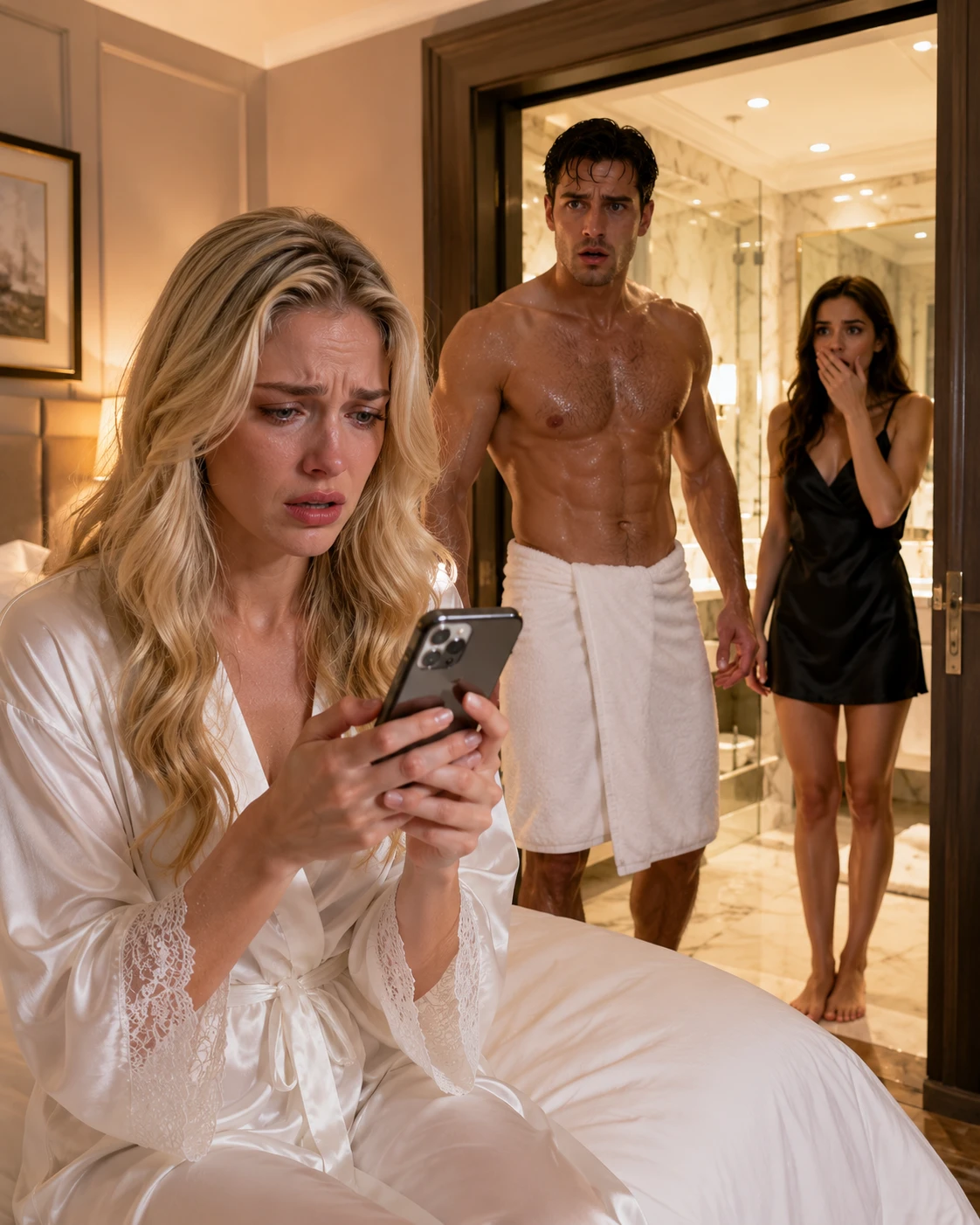
The words settled between us like a third person in the room, heavy and breathing. Owen stood at the foot of the bed with water still dripping from his hair onto his bare shoulders, his towel clutched at his waist, his eyes fixed on the phone in my hand as if it were something dangerous.
Not incriminating.
Dangerous.
That was what frightened me.
I had expected panic. Denial. Maybe anger. I had expected him to lunge for excuses the way guilty people do when they realize the floor has disappeared beneath them. But this was different. This wasn’t the fear of a man caught having an affair.
This was the fear of a man whose secret had walked in through the front door.
Downstairs, Marissa called again.
“Claire?”
Her voice floated up the staircase, sweet and familiar, carrying the same warmth she used when she arrived early for family dinners with a bottle of wine and a paper bag full of pastries from the bakery I loved.
My stomach twisted.
Owen turned sharply toward the hallway.
“Don’t say anything,” he whispered.
I laughed once, but there was no humor in it. The sound came out thin and unfamiliar.
“Don’t say anything?” I repeated. “My husband is sleeping with my cousin, and somehow I’m the one who needs instructions?”
He stepped closer, lowering his voice. “This is not about that.”
I stared at him.
There are moments when the human mind refuses to process what it has already understood. I had seen months of messages. I had seen the hotel names, the little private jokes, the cruel casualness of their betrayal. And yet, somehow, Owen’s words managed to make the room tilt again.
Not about that.
As if the affair were only the outside layer of something worse.
From downstairs came the soft sound of Marissa setting her keys on the entry table. She had a key to our house. Of course she did. I had given it to her two years earlier when I twisted my ankle and she came every morning to help me get ready for work.
I thought about that key in her hand.
I thought about all the doors I had opened for her.
Owen reached for a pair of sweatpants folded on the chair. His fingers fumbled with the fabric.
“Claire,” he said, and for the first time his voice cracked on my name. “Please. Let me talk to her first.”
“No.”
He froze.
The word surprised both of us.
I had never been the loudest person in a room. In our marriage, Owen was the practical one, the one who made decisions quickly, who could call the plumber, negotiate a bill, tell a waiter the order was wrong without apologizing six times. I was the soft place. The mediator. The person who made sure everyone had enough food and nobody felt left out.
But something had shifted in me while I held that phone.
Maybe betrayal burns away hesitation before it burns away love.
“I invited her here,” I said. “So she can come upstairs and explain herself.”
“She won’t explain anything,” he said. “Not if she thinks—”
He stopped.
“Thinks what?”
His mouth closed.
Downstairs, Marissa began climbing the stairs.
Every step was measured. Slow.
Not confused.
Not rushed.
Measured.
I noticed it then, the first thing I would later replay a hundred times. Marissa did not call my name again. She did not ask what was wrong. She did not laugh, or apologize for using her key so late, or make some breezy excuse about needing to talk.
She already knew something was wrong.
A shadow fell across the hallway.
Then she appeared in the bedroom doorway.
Marissa was wearing a cream-colored coat over black leggings, her auburn hair twisted into a loose knot at the back of her neck. She looked elegant even in panic, which felt unfair. Her cheeks were flushed from the cold, and her eyes went first to Owen, then to me, then to the phone in my hand.
For half a second, her expression was unreadable.
Then she smiled.
Not warmly. Not kindly.
Carefully.
“Claire,” she said, “whatever you think you saw—”
“I heard you,” I said.
Her smile faltered.
The smallest crack. Barely visible.
But I saw it, and seeing it gave me something solid to stand on.
“I heard your voice on the phone,” I continued. “I heard you say he still smelled like you. I heard you say I didn’t suspect a thing.”
Marissa’s eyes flicked toward Owen.
He looked away.
That hurt. Even then, with rage rising hot in my chest, it hurt that he wouldn’t look at her either. It suggested history. Shame. Complication. Something deeper than desire.
Marissa stepped into the room and quietly closed the door behind her.
That simple act made my skin prickle.
“Why are you closing the door?” I asked.
“Because we need privacy,” she said.
“From who? The houseplants?”
She didn’t smile this time.
“Claire, sit down.”
“I am sitting down.”
Owen ran a hand over his damp hair. “Marissa, don’t.”
She ignored him and looked only at me.
“You shouldn’t have called me from his phone,” she said softly. “That was careless.”
Something cold moved through me.
Careless.
Not understandable. Not shocking. Not even justified.
Careless.
I looked down at the phone again, at the message still glowing on the screen—the message that had stopped my breath when I found it buried in their conversation.
Did you move the account before Friday? If Claire signs the refinance papers, she’ll never see the old statements. We just need three more weeks.
I lifted the phone.
“Tell me what this means.”
Neither of them answered.
The silence confirmed what their words had not.
I scrolled up with shaking fingers. More pieces appeared now that I knew what shape to look for. Mentions of my father’s estate. A bank name I recognized but had not used in years. “Old statements.” “The trust paperwork.” “The cabin account.” Phrases that meant nothing at midnight and everything under the right light.
My father had died eighteen months earlier.
He had left me a modest inheritance—not life-changing, but meaningful. Enough to pay off some debt, repair the roof, and keep the little lakeside cabin that had belonged to my grandparents. Owen had handled most of the paperwork because, at the time, grief had made numbers blur on the page.
I had trusted him.
I had trusted Marissa too. She had helped me clean out Dad’s house. She had held me while I cried into one of his old flannel shirts. She had told me, “You don’t have to carry all of this alone.”
Now I understood.
I hadn’t carried it alone.
They had carried parts of it away.
“What did you do?” I asked.
Owen sat on the edge of the chair as though his legs had given out. Marissa remained standing.
That was another thing I noticed.
Owen looked ruined.
Marissa looked prepared.
“Claire,” she said, “you are upset, and you have every right to be upset about Owen and me. But the financial stuff is not what you think.”
“Then explain it.”
She inhaled slowly. “Your father was in trouble before he died.”
The sentence struck me in a place I wasn’t defending.
“My father was not in trouble.”
“You didn’t know everything.”
“I knew my father.”
Marissa’s eyes softened, and somehow that made me angrier. I did not want softness from her. I did not want her pity dressed up as concern.
“He was borrowing against the cabin,” she said. “There were liens. Owen found them when he started helping with the estate.”
I turned to Owen.
He looked at the floor.
“Owen?”
“I was trying to fix it,” he said.
His voice was hoarse.
“By hiding it from me?”
“I didn’t want you to lose the cabin right after losing him.”
“Do not make this noble.”
His face tightened as if I had slapped him, but he said nothing.
Marissa took another step forward. “The refinance papers were supposed to consolidate everything. It was messy, but it would have worked.”
“Worked for who?”
“For you.”
I laughed again, sharper this time. “You were laughing at me on the phone fifteen minutes ago.”
Color rose in her face.
The room went quiet.
Outside, wind dragged bare branches against the bedroom window with a dry scratching sound. It made me think of fingernails.
Marissa looked at Owen.
He still would not look at her.
Something passed between them anyway—some old unspoken language I was not part of.
And that, more than the messages, more than the affair itself, pierced me.
I had shared my childhood with Marissa. We had slept in sleeping bags on my grandmother’s living room floor, whispering secrets under quilts while the adults played cards in the kitchen. We had stolen cherries from pies, traded sweaters, cried over boys, complained about our mothers, promised that no matter what happened, we would never become the kind of family who only saw each other at funerals.
There are betrayals that break your heart.
Then there are betrayals that rewrite your memories.
“Tell me the truth,” I said. “All of it.”
Owen lifted his head. “Claire, I swear, I never meant for any of this to happen.”
“That is not the truth. That is what people say when consequences arrive.”
He flinched.
Marissa folded her arms. “You want truth? Fine. Your father came to me before he died.”
I stared at her.
“No, he didn’t.”
“He did.”
“You barely saw him that last year.”
“I saw him more than you knew.”
The words hit quietly, but they landed hard.
Marissa’s voice lowered. “He asked me to help him keep something from you.”
“My father would never ask you that.”
“He did because he knew you’d try to save him.”
The room seemed to recede around me.
My father had been proud. Stubborn. The kind of man who changed his own oil and refused to admit when his knees hurt. After Mom died, he became quieter, more inward, as if some room inside him had gone dark and he didn’t know how to turn the light back on. But he loved me. I knew that. I built my life on that certainty.
Marissa reached into her coat pocket.
Owen stood abruptly. “Don’t.”
She turned on him. “It’s already happening.”
“Not like this.”
“There is no good way left.”
My fingers tightened around the phone.
“What do you have?”
Marissa pulled out a folded envelope.
It was old, the paper softened along the creases, my name written across the front in handwriting I knew instantly.
Claire.
The sight of it stole all the air from the room.
My father’s handwriting.
For several seconds, I could not move. The anger in me did not disappear, but it shifted, making space for something more fragile and far more dangerous.
Grief.
“Where did you get that?” I whispered.
“He gave it to me,” Marissa said.
“When?”
“Three weeks before he died.”
I looked at Owen. “You knew?”
He closed his eyes.
“Owen.”
“Yes,” he said.
My voice came out small. “You both had a letter from my father for eighteen months?”
Marissa’s face tightened. “We were supposed to give it to you when the cabin was safe.”
“What does that mean?”
Neither answered.
I stood.
The motion startled them both. My knees shook, but I stayed upright and held out my hand.
“Give it to me.”
Marissa hesitated.
That hesitation told me she still thought she had a choice.
“Give me my father’s letter.”
Slowly, she placed it in my palm.
The paper was warm from her pocket.
I wanted to tear it open right there, but my fingers wouldn’t obey. Part of me feared what waited inside. Another part of me already knew that whatever my father had written would divide my life into before and after.
Owen took a step toward me.
“Claire, please don’t read it with her here.”
I looked at him. “You lost the right to decide what happens in this room.”
He stopped.
Marissa’s chin lifted, but there was pain in her eyes now. Real pain. I hated that it looked real.
I opened the envelope.
Inside was a single sheet, folded once.
My father’s handwriting filled the page in uneven lines.
My dearest Claire,
If you are reading this, then I have failed to say out loud what I should have told you years ago.
I paused.
The room blurred.
Owen whispered my name, but I continued.
There are mistakes a man makes because he is foolish, and there are mistakes he makes because he is afraid. Mine were both. After your mother died, I made decisions I thought would protect you. Some of them did. Some of them will hurt you when you learn the truth.
I need you to know first that I loved you more than anything in this life. Nothing written after this changes that.
My throat tightened so painfully I had to stop.
Marissa looked away.
I forced myself to keep reading.
The cabin was never only mine. Years ago, before your grandmother passed, she changed part of the ownership in secret. She did it because your uncle was in debt and she feared creditors would come after his share. She placed it under another name temporarily, intending to fix it later.
That name was Marissa’s.
I looked up.
Marissa’s face had gone pale.
“What?” I said.
She swallowed. “Keep reading.”
My hands trembled.
By law and paperwork, Marissa has a claim. By blood and memory, I believe the cabin belongs to you. I tried to correct it after your mother died, but I waited too long. Then the debt came. Then the medical bills. Then pride did what pride always does. It made a bad thing worse.
I borrowed against what I could, believing I could pay it back. I could not.
Marissa knows some of this. Owen knows more than I wanted him to. I asked them not to tell you until they had found a way to keep the cabin from becoming another loss laid at your feet.
That was my mistake too.
Forgive them only if they have earned it. Forgive me if you can.
There is one more thing.
My breath caught.
At the bottom of the page, the handwriting became shakier.
The blue folder in the cabin wall is for you alone. Not Owen. Not Marissa. You alone. Behind the loose board in the upstairs bedroom, under the window where your mother kept the yellow curtains.
Trust what is in it more than you trust any of us.
Dad
I read the last line again.
Then again.
The room was silent except for the distant hum of the heater.
A loose board. A blue folder. The upstairs bedroom with the yellow curtains.
Images rose unbidden. Summer dust in sunbeams. My mother brushing her hair by the window. Me at eight years old, lying on the floor with a coloring book, listening to my parents argue in low voices downstairs without understanding why.
I folded the letter carefully because my hands needed something gentle to do.
“You read this,” I said.
Marissa shook her head. “No.”
I looked at Owen.
He didn’t answer.
“Owen.”
He pressed his palms against his eyes.
“I read it,” he said.
The words landed like stones.
“When?”
“After the funeral.”
“You opened my father’s letter?”
“I thought it might explain the accounts.”
“You opened my father’s letter,” I repeated.
His eyes were red when he lowered his hands. “Yes.”
“And then you kept it from me.”
“I didn’t know how to tell you.”
“You didn’t know how to tell me my father left me a letter?”
“I didn’t know how to tell you that everything you thought was simple wasn’t.”
Marissa let out a bitter breath. “That’s convenient.”
Owen turned on her. “Don’t start.”
“Oh, now you want honesty?”
“You don’t get to stand there like you were dragged into this.”
“I wasn’t the one who emptied the account.”
The words cut through the room.
Everything stopped.
Owen stared at her.
Marissa stared back.
I felt something inside me go very still.
“What account?” I asked.
Neither of them looked at me.
“What account, Marissa?”
She closed her eyes briefly, as if regretting the sentence even before it finished echoing.
“The maintenance account for the cabin,” she said.
Owen’s voice was low. “That is not what happened.”
“Then tell her what happened.”
“I was moving money to keep the lien from triggering.”
“You moved money into an account under your brother’s business name.”
My head turned toward Owen.
His brother, Daniel, ran a small contracting company two towns over. He had remodeled our kitchen. He had been at my father’s funeral, solemn and kind, carrying folding chairs back to the church basement after the service.
Owen shook his head. “It was temporary.”
Marissa laughed softly. It was a sad laugh, but I still hated it. “Everything is temporary when you’re the one holding the pen.”
I looked at Owen and saw, for the first time, a stranger wearing my husband’s face.
“How much?” I asked.
He didn’t answer.
“How much money, Owen?”
“Claire—”
“How much?”
“Forty-two thousand.”
The number was so specific, so clean, that it felt impossible.
Forty-two thousand dollars.
Not an accidental overdraft. Not a confusing transfer. Not a mistake made in grief.
A decision.
My knees weakened, and I sat back down on the bed.
Owen moved toward me, but I raised one hand. He stopped.
I thought of the months after Dad died. Owen telling me not to worry about bills. Owen saying he had spoken to the bank. Owen bringing me tea while I signed papers at the kitchen table, too tired to read every line, too broken to imagine the man beside me could use my grief as cover.
And Marissa.
Marissa sitting across from me, texting him beneath the table.
“You both watched me mourn,” I said.
The sentence broke something in the room.
Owen’s face crumpled. “Claire, I am so sorry.”
Marissa looked down.
“You watched me pack his clothes,” I said to her. “You held the garbage bags open.”
Her mouth trembled. “I know.”
“You told me I was strong.”
“I know.”
“You knew there was a letter?”
“I knew he left one. I didn’t know what it said.”
“But you knew enough.”
She nodded once.
That nod did more than any excuse could have done.
The rage I had been holding began to change shape. It did not disappear. It became clearer. Cleaner.
I stood again.
“I want you both out of my house.”
Owen looked startled. “Claire, it’s midnight.”
“Then you have excellent motivation to move quickly.”
“This is my house too.”
I looked at him until his expression changed.
The legal truth might have been complicated. The moral truth was not.
He went to the dresser and pulled out a sweatshirt. His hands were shaking now. He dressed in awkward, uneven movements, avoiding my eyes.
Marissa remained near the door.
“Claire,” she said quietly, “there is more you need to know.”
“No.”
“Yes.”
“I said no.”
“If you go to the cabin alone—”
“I didn’t say I was going anywhere.”
“But you are.”
I hated that she knew me well enough to be right.
Owen turned. “Do not go tonight.”
“Why?”
“Because you’re upset.”
“No. That’s not why you don’t want me to go.”
He said nothing.
I picked up my father’s letter and held it against my chest.
“What’s in the blue folder?”
Owen and Marissa exchanged another look.
I had spent years believing looks like that belonged to families who were close enough to speak without words. Now I understood they could also belong to conspirators.
“I don’t know,” Marissa said.
Owen’s silence answered differently.
“You know,” I said.
He swallowed.
“I didn’t find the folder.”
That was not the same as no.
“But you looked for it.”
His jaw tightened.
“You went to the cabin after reading the letter, and you looked for it.”
“I checked the room.”
“When?”
“Last winter.”
I remembered that trip.
He had told me the pipes needed checking after a cold snap. I had offered to come with him, but he said it would be quick and boring, and he brought me back a jar of jam from the farm stand near the highway.
Strawberry rhubarb.
I had spread it on toast the next morning and thanked him.
“How long have I been living inside your lies?” I asked.
He looked at me then, really looked at me, and the misery in his face was almost unbearable.
“I don’t know when it became lying,” he said.
“That is the most honest thing you’ve said tonight.”
He looked as though he deserved the blow and knew it.
Marissa opened the bedroom door.
“I’ll go,” she said. “But I’m not leaving you alone with this.”
“You do not get to decide that.”
“No,” she said. “But I still care what happens to you.”
For one wild second, I almost threw something.
“You care?”
“Yes.”
“You slept with my husband.”
Her face tightened. “I know.”
“You stole pieces of my inheritance.”
“I didn’t steal from you.”
“You lied.”
“Yes.”
“You laughed at me.”
Her eyes filled then, not dramatically, not with the pretty tears people use to soften consequences, but with quiet shame that seemed to surprise even her.
“I did,” she whispered.
The admission caught me off guard.
Owen stared at her.
Marissa looked at me. “I don’t have a clean explanation. I was angry, and I was jealous, and I let it become something ugly.”
“Jealous of what?”
“You.”
The answer was so absurd I almost didn’t understand it.
“Of me?”
She gave a small, broken smile. “You were always the loved one.”
I shook my head. “That is not true.”
“It felt true.”
“That doesn’t make it true.”
“No,” she said. “It doesn’t.”
For a moment, I saw us at fourteen, sitting on the dock at the cabin, our feet in the water. Marissa had been crying because her mother forgot to pick her up from school again. My dad had driven over and gotten her without complaint, bought us both ice cream, and said, “Around here, nobody gets left behind.”
I had forgotten that.
Maybe Marissa never had.
But childhood wounds do not excuse adult choices. They only explain the direction the cracks spread.
Owen grabbed his keys from the dresser.
“I’ll stay at Daniel’s,” he said.
I almost laughed at the perfection of it.
“Of course you will.”
He stopped beside me, close enough that I could smell soap and steam and the faint unfamiliar trace of perfume beneath it. Once, that nearness would have comforted me. Now it made my stomach turn.
“I love you,” he said.
I looked at him.
The terrible thing was that I believed he thought he meant it.
“Not enough to tell me the truth.”
He flinched again, and then he left the room.
I listened to his footsteps move down the stairs. A moment later the front door opened and closed.
Marissa remained.
I did not look at her.
“Leave your key,” I said.
She took it off her key ring slowly. The small metallic sound of it sliding free felt final.
She placed it on the dresser.
“I know you don’t want to hear this,” she said, “but don’t trust Owen’s brother.”
I turned.
“Why?”
“Because Daniel’s business name is on more than one transfer.”
My chest tightened. “You knew that and said nothing?”
“I confronted Owen. He said it was temporary.”
“And you believed him?”
“I wanted to.”
The honesty was worse than a lie.
Marissa wiped under one eye with the heel of her hand. “The affair started after that. Not before.”
I stared at her.
She looked ashamed, but steady.
“I’m not saying that to make it better. It doesn’t. I’m saying it because the money came first.”
The money came first.
Those four words rearranged the night again.
The affair had felt like the center of the betrayal, but maybe it had been a symptom. A distraction. A knot tied around another knot.
“What does Daniel know?” I asked.
“I don’t know.”
“What do you suspect?”
She hesitated.
“Say it.”
“I think Owen needed somewhere to put money where you wouldn’t see it. I think Daniel helped him, but I don’t know whether Daniel understood where it came from.”
“And you?”
Her face hardened with self-disgust. “I told myself I was helping preserve the cabin until everything settled. I told myself your father had made it complicated, and I was just helping untangle it.”
“But really?”
“Really, I liked being needed.”
The answer was so painfully human that I hated her for it more.
“Go,” I said.
She nodded.
At the doorway, she paused. “Claire?”
I said nothing.
“If you find the folder, don’t bring it back here.”
“Why?”
She looked toward the stairs, then back at me.
“Because Owen already searched this house for it.”
Then she left.
I stood alone in the bedroom while the house absorbed the quiet.
For a long time, I did nothing.
I listened to the hum of the heater, the settling of old wood, the distant sound of Marissa’s car starting in the driveway. I watched her headlights sweep across the wall and disappear.
Then I locked the front door.
And the back door.
And the little side door to the mudroom that Owen always forgot.
Only after that did I sit at the kitchen table with my father’s letter, Owen’s phone, and a silence so deep it felt like falling.
The kitchen still smelled faintly of the soup I had made for dinner. Owen had eaten two bowls. He had kissed the top of my head while I washed the pot.
How ordinary betrayal can be.
How politely it sits at your table.
I spent the next hour taking pictures of everything on Owen’s phone. Not because I had a plan. Not yet. But some new part of me understood that grief without evidence becomes easy for other people to explain away.
I photographed the messages with Marissa. The transfers. The names of banks. The references to the refinance papers. Daniel’s company. Dates. Amounts. Half-finished sentences that now seemed to glow with meaning.
At 1:37 a.m., Owen texted from his own phone.
Please don’t do anything until we talk.
I stared at the message for a long time.
Then I turned the phone face down.
At 2:10, Marissa texted me.
I’m sorry. That doesn’t fix anything. But I am.
I did not answer that either.
At 3:02, I went upstairs and packed a small bag.
Jeans. Sweater. Toothbrush. Phone charger. Dad’s letter.
At 3:18, I found the folder of refinance papers in Owen’s office drawer. The tab was labeled HOME, but beneath the home insurance documents and tax receipts was a packet with my signature on three pages I did not remember reading carefully.
I sat on the office floor and went through each page.
There were words I understood and words I didn’t. Collateral. Consolidation. Secondary lien. Disbursement. Spousal acknowledgment.
My signature appeared at the bottom of the final page, slightly slanted, written in blue ink.
Above it, in small print, was the cabin address.
I pressed my fingers to my mouth.
The cabin had not been saved.
It had been tied to our house.
At 4:05, I called my friend Nadia.
She answered on the fourth ring, her voice thick with sleep.
“Claire? Are you okay?”
I tried to say yes, but the word dissolved.
That was when I finally cried.
Not loudly. Not dramatically. Just one breath that broke in half, and then another, until the careful structure holding me upright collapsed.
Nadia did not interrupt. She had known me since college and understood silence better than most people understood advice.
When I could speak, I told her only the necessary things.
Owen. Marissa. The money. The letter. The cabin.
By the time I finished, Nadia was fully awake.
“Come here,” she said.
“I need to go to the cabin.”
“No, you need coffee and a lawyer.”
“I need the blue folder.”
There was a pause.
Then Nadia said, “I’m coming with you.”
“No.”
“Not a question.”
“Nadia—”
“You found out your husband and cousin have been lying to you about your inheritance in the middle of the night. You are not driving two hours alone before dawn.”
I looked at the window above the sink. The sky beyond it was beginning to soften from black to charcoal.
For once, I did not argue against help.
“Okay,” I whispered.
Nadia arrived forty minutes later wearing a long coat over pajama pants and carrying two coffees. Her hair was piled messily on top of her head, and her eyes took in my face with a tenderness that nearly undid me again.
She set the coffees down and hugged me without asking.
I stood stiffly at first.
Then I folded into her.
“I feel stupid,” I whispered.
“You are not stupid.”
“I gave them everything.”
“You loved them. That is not the same thing.”
The distinction felt too generous, so I said nothing.
Nadia pulled back and held my shoulders. “We are going to the cabin. We are going to find whatever your dad hid. Then we are going to take it to someone who understands paperwork better than cheating husbands.”
Despite everything, I almost smiled.
Almost.
We left as the first pale line of morning appeared behind the roofs.
The drive to the cabin was one I knew by heart. Out of town, past the old grain silos, beyond the stretch of highway where maple trees leaned close enough to knit their branches overhead. In summer, the road felt like a green tunnel. In winter, it looked stripped and honest.
Nadia drove because my hands would not stop trembling.
I watched familiar landmarks pass in the gray morning light and felt as though I were traveling backward through my own life.
The gas station where Dad bought me orange soda on fishing trips.
The church with the crooked steeple where my parents renewed their vows on their twenty-fifth anniversary.
The field where Marissa and I once picked wildflowers until our arms itched.
Every mile hurt.
Halfway there, Nadia glanced at me.
“What was she like when she came over?”
“Marissa?”
“She admitted things?”
“Some.”
“That surprises me.”
“Me too.”
“You believe her?”
I watched frost shine along the fence posts.
“I believe she told the truth when it cost Owen something. I don’t know if that means anything.”
“It means something,” Nadia said. “Just not enough.”
That felt right.
We reached the cabin just after sunrise.
It sat at the end of a gravel road, small and weathered, its cedar siding silvered by years of rain and sun. The lake beyond it was still, a sheet of dull pewter beneath the winter sky. Bare trees ringed the water like witnesses.
For a moment, I could not get out of the car.
Nadia turned off the engine.
The silence pressed in.
I had not been back since summer. Owen had suggested we wait until spring, said it was too painful, too much work, too cold. I had agreed because agreeing had become easy.
Now I wondered how many of my decisions had been gently arranged for me.
Nadia touched my arm.
“I’ll go in first.”
“No,” I said. “I need to.”
The key stuck in the lock. It always did. Dad used to jiggle it twice and mutter that he’d fix it before winter, a promise he made for twelve straight years.
The door opened with a groan.
Inside, the cabin smelled like dust, pine boards, and the faint mineral dampness of the lake. Sheets covered the furniture. The braided rug in the living room was faded from sun. On the mantel sat a photograph of me at seven years old holding a fish and crying because I didn’t want anyone to hurt it.
Dad had laughed so hard he almost fell off the dock.
I stood there until Nadia gently closed the door behind us.
“Upstairs bedroom?” she asked.
I nodded.
The stairs creaked under our feet. At the top, the hallway was narrow and cold. The last door on the right led to the bedroom that had once belonged to my parents. After Mom died, Dad never slept there again. He moved to the smaller room across the hall and called it practical.
The room was nearly empty now. A bed frame. A dresser. A chair with a cracked cane seat. The yellow curtains were gone, but the rods remained above the window, two brass ends shaped like small leaves.
Under the window, the wall was paneled in old pine boards.
Nadia crouched first, running her fingers along the seams.
“What exactly did the letter say?”
“Loose board. Under the window.”
We searched slowly. Pressing. Tapping. Listening for hollow spaces.
My fingers were numb from cold and nerves. Twice I thought I found something, only to realize it was ordinary warping in the wood.
Then Nadia said, “Claire.”
She was kneeling beside the left corner of the window. One narrow board sat slightly proud of the others, its edge lifted just enough to catch a fingernail.
My heart began pounding.
Nadia pulled a key from her pocket and wedged it into the gap. The board resisted, then shifted with a dry little pop.
Behind it was a shallow space in the wall.
Inside lay a blue folder.
For several seconds, neither of us touched it.
It seemed impossible that something so ordinary could have waited there through seasons of rain and snow, through my father’s death, through my marriage unraveling, through every lie told in warm kitchens and over holiday tables.
Finally, I reached in.
The folder was dusty but intact, held closed by a stretched rubber band that snapped as soon as I touched it.
Inside were documents.
Old ones.
New ones.
A photograph.
And a smaller sealed envelope.
Nadia sat back on her heels. “Maybe take it somewhere else before reading?”
But I was already opening the folder.
The first document was a copy of the cabin deed from decades earlier, with names highlighted in yellow. My grandparents. My father. My uncle. Marissa’s mother.
The second was a notarized statement signed by my grandmother.
The third was a letter from an attorney dated fifteen years ago.
I skimmed, unable to absorb every legal phrase, catching only fragments.
Transfer made under pressure.
Possible undue influence.
Temporary holding arrangement.
Intent to restore interest to Claire Elizabeth Morgan upon inheritance.
Nadia leaned over my shoulder. “This is legal evidence.”
“I think so.”
The photograph slipped partly from the stack.
I pulled it free.
It showed my father standing on the cabin dock with another man I did not recognize. Between them stood a little girl with auburn hair, maybe five or six years old, squinting into the sun.
Marissa.
On the back, in Dad’s handwriting, were three words.
She deserved better.
A strange chill moved through me.
“Nadia,” I whispered.
“What?”
I turned the photo over again.
The man beside my father had one arm around Marissa’s shoulders. He was tall, broad-faced, with a familiar tilt to his smile.
Familiar, but not because I knew him.
Because I had seen that smile in my own bathroom mirror.
The same crooked left corner.
The same dimple that appeared only when the smile was real.
My mouth went dry.
I opened the sealed envelope.
Inside was another letter, shorter than the first.
Claire,
If you have found this, then you have chosen truth over comfort. I am sorry for what that will cost you.
The legal papers matter, but this matters more.
Marissa is not only your cousin.
I stopped reading.
The room tilted.
Nadia whispered, “Claire?”
I forced my eyes back to the page.
Marissa is your sister.
Not by your mother. By a mistake I made before you were born and spent the rest of my life trying to repair without destroying the people I loved. Your mother knew. Your aunt knew. Marissa was never told. I wanted to tell you both, but cowardice can look very much like patience when a man is trying to forgive himself.
The cabin was meant to protect her as much as you.
Do not let them use this secret to divide you.
There is one person who knows the full arrangement, and it is not Owen.
It is Daniel.
My breath stopped.
Not Owen.
Daniel.
Nadia read the line over my shoulder and went completely still.
From downstairs came a sound.
A floorboard creaking.
We both turned toward the open bedroom door.
“Claire?” a man’s voice called softly from below.
Not Owen’s.
Daniel’s.
END OF PART 2 – LIKE, SHARE AND COMMENT “”THE ENTIRE STORY”” IF YOU WANT TO READ THE FULL STORY