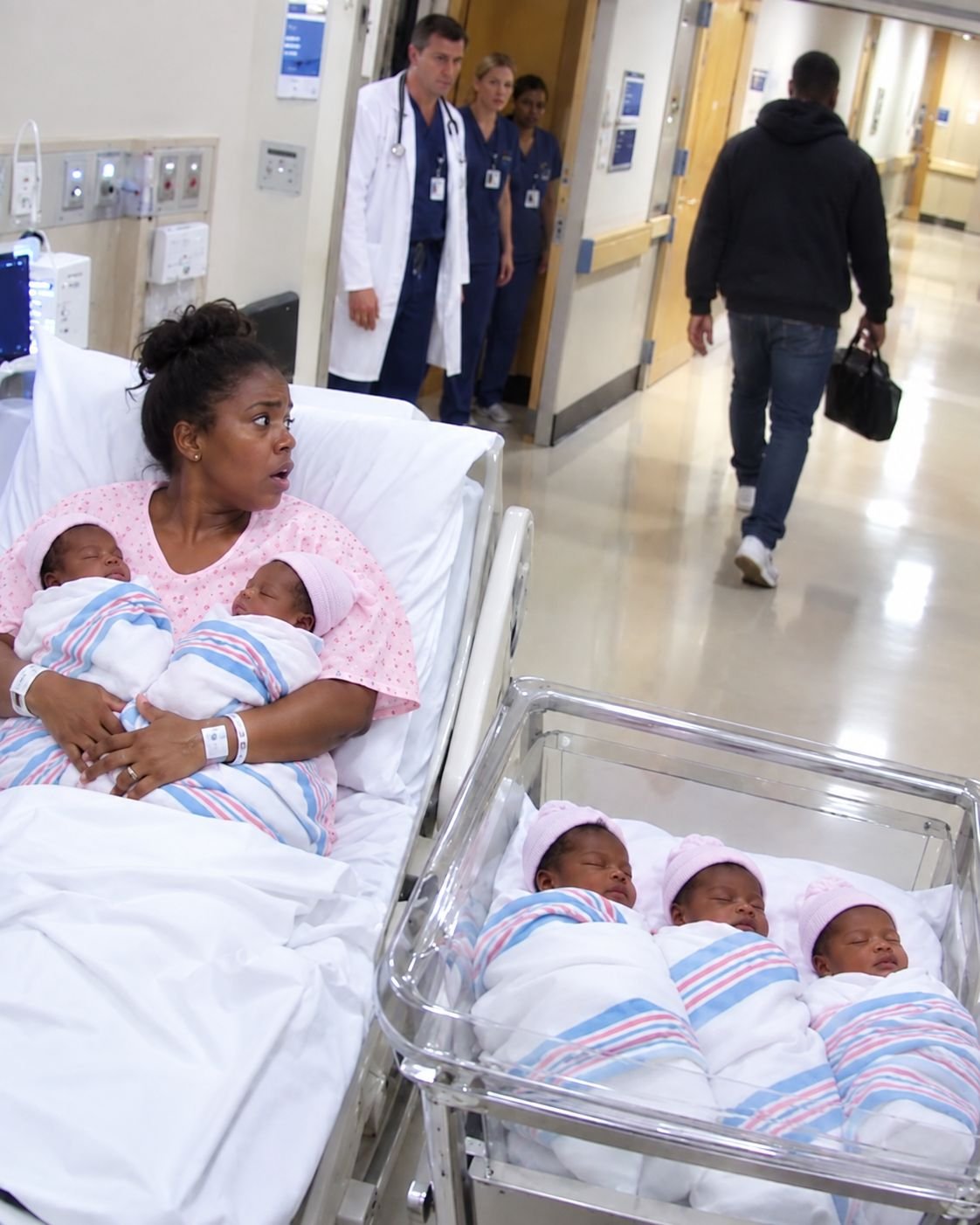
All five babies in the bassinets were Black. My husband took one look and screamed, “Those aren’t my children!”
Then he rushed out of the hospital and never came back. I was left alone, holding five newborns as nurses whispered behind me and the doors closed in his wake.
Thirty years later, he stood before us again… and the truth waiting for him destroyed everything he thought he understood.
I never believed the most important day of my life would begin with a scream.
My name is María Fernández, and thirty years ago I gave birth to five babies in a public hospital in Seville. The labor was long, brutal, and draining.
When I finally woke up and saw five bassinets lined up in front of me, I was overwhelmed by fear and love all at once. They were so small, so delicate… and every one of them was Black.
Before I could even gather my thoughts, my husband, Javier Morales, walked into the room. He stared at one crib. Then another. His jaw tightened. His lips shook. Rage flooded his eyes.
“They’re not my children!” he yelled. “You deceived me!”
The nurses tried to intervene, telling him tests could be done, explaining the babies hadn’t even been officially registered yet, that answers would come. But Javier wouldn’t hear it.
He pointed at me with nothing but disgust and said, “I won’t live with this shame.”
Then he turned and walked out.
He didn’t look back. He didn’t ask for an explanation. He didn’t demand proof. He simply left.
I remained there alone, five newborns in my arms, while the nurses exchanged uneasy glances and the doors slowly shut behind him. No one knew what to say. Neither did I. I just held my children, fighting the urge to collapse.
In the days that followed, rumors spread. Eyes lingered. Silence grew heavy. Some people believed I’d been unfaithful. Others suspected a hospital error. No one had real answers.
Javier never returned. He changed his phone number, moved away, and erased our life together as if it had never existed.
I signed every form by myself. I named my children—Daniel, Samuel, Lucía, Andrés, and Raquel—and left the hospital with a borrowed stroller and a shattered heart.
That night, as all five slept around me, I made myself a promise. One day, I would uncover the truth. Not out of revenge—but so my children would always know who they truly were.
What I didn’t know then was that thirty years later, Javier would stand in front of us again… and the truth waiting for him would be far more devastating than he could have imagined.
But that truth did not wait thirty years to begin revealing itself.
It started six days after I brought my babies home.
There was a knock on my apartment door.
I was standing in the kitchen with Raquel against my shoulder and Lucía crying from a basket beside the table.
Daniel and Samuel were asleep.
Andrés had just finished feeding.
I hadn’t showered.
I hadn’t slept more than forty minutes at a time.
My breasts hurt.
My back hurt.
Everything hurt.
I opened the door expecting my sister Elena.
Instead, I found a woman in a navy coat.
She was perhaps fifty.
She carried a leather folder.
“Señora Fernández?”
“Yes?”
“My name is Dr. Isabel Romero. I work with the hospital.”
My stomach dropped.
I pulled Raquel closer.
“What’s wrong?”
“May I come inside?”
“No.”
The answer surprised both of us.
But after Javier, after the whispers, after leaving that hospital without understanding what had happened, I wasn’t letting another stranger walk into my home carrying secrets.
“Tell me here.”
Dr. Romero looked down the corridor.
Then back at me.
“The hospital has completed preliminary blood-group testing.”
My heart began pounding.
“And?”
“There are inconsistencies.”
“What does that mean?”
“We need further testing.”
“Are they my babies?”
Her expression softened.
“We have no reason at this point to believe they are not.”
I almost collapsed against the doorframe.
“Then what?”
She hesitated.
“The issue concerns paternity.”
Javier.
I stared at her.
“He left.”
“I understand.”
“No, you don’t.”
My voice broke.
“He looked at them and left.”
Dr. Romero said nothing.
“He didn’t even wait one hour.”
“I am sorry.”
“So am I.”
I looked at the folder.
“What do you need?”
“Samples from you and the children. And ideally from your husband.”
“He won’t give you anything.”
“We can still learn quite a lot without him.”
I let her inside.
That decision changed our lives.
The first tests established something important.
The babies were mine.
All five.
That sounds obvious now.
At the time, it felt like being given permission to breathe.
No nursery mix-up.
No accidental exchange.
No nightmare where five strangers’ babies had somehow been placed beside my bed.
They were mine.
But the paternity question remained unresolved because Javier could not—or would not—be located.
Then Dr. Romero asked about our family histories.
Mine was boring.
My parents were from Andalusia.
My grandparents too.
Javier’s history was less clear.
His father, Arturo Morales, had died when Javier was nineteen.
His mother, Carmen, was still alive.
And there had always been one subject nobody discussed.
Arturo’s father.
Javier’s grandfather.
I had heard three versions.
He died young.
He abandoned the family.
He worked overseas.
Whenever I asked Carmen, she changed the subject.
At the time, I had never thought that mattered.
Suddenly it mattered very much.
I went to her apartment.
She almost didn’t open the door.
When she saw the five babies with my sister Elena helping me, her face collapsed.
Not with disgust.
Recognition.
That frightened me.
“Carmen?”
She covered her mouth.
“Oh, God.”
“What?”
She started crying.
“Carmen, look at me.”
She couldn’t.
“Do you know something?”
“I told Arturo.”
“Told him what?”
She sat down.
Her hands shook.
“Javier doesn’t know.”
My heart hammered.
“Know what?”
She looked at the babies again.
Then she whispered:
“His grandfather was Black.”
The room went completely silent.
I stared at her.
“What?”
“Arturo’s biological father.”
She wiped her face.
“His name was Tomás.”
I sat down because my legs stopped working.
Carmen told me the story in pieces.
Arturo’s mother, Pilar, had been involved with a Black Cuban man named Tomás Baptista when she was young.
Spain in that era was not the Spain my children would grow up knowing.
Families guarded reputations brutally.
Pilar became pregnant.
Tomás disappeared from the official family story.
Arturo was raised under another man’s surname.
The truth became something spoken only behind closed doors.
Arturo inherited relatively light features.
Javier did too.
And eventually the family decided that what couldn’t easily be seen didn’t need to be discussed.
I stared at Carmen.
“You knew this when Javier left us?”
She began crying harder.
“No.”
“What do you mean, no?”
“I didn’t know he’d left because of the babies.”
“He called you.”
Her eyes moved away.
I knew immediately.
“He called you.”
“Yes.”
“When?”
“The day they were born.”
“And what did he say?”
“That you’d betrayed him.”
My hands clenched.
“And you said nothing?”
“I tried.”
“Did you tell him?”
“I told him to come home and calm down.”
“Did you tell him about Tomás?”
“No.”
I stood.
“Why?”
“Because I was ashamed.”
That word.
Ashamed.
I looked at the five children around us.
Five tiny human beings.
Five grandchildren.
And an entire family had nearly been destroyed because grown adults were ashamed of ancestry.
“You let him believe I cheated.”
“No.”
“Yes.”
“I didn’t know—”
“You knew there was another explanation.”
Carmen cried.
“I was afraid.”
“So was I.”
I picked up Daniel.
“You had a secret.”
Then Samuel.
“I got the punishment.”
I left.
For years afterward, that sentence stayed with me.
You had a secret.
I got the punishment.
The genetic testing available to us then could answer some questions, but not with the ease and precision people expect today.
The doctors explained something else too.
Appearance alone could not establish paternity.
Traits could emerge unpredictably across generations.
If I wanted certainty, we needed Javier.
We didn’t have him.
So I did what mothers do when certainty isn’t available.
I raised my children.
Five babies became five toddlers.
Five toddlers became five children.
And if you’ve never tried to get five six-year-olds dressed for school at the same time, you have not experienced true negotiations.
Daniel was serious.
Always watching.
Samuel was loud enough for three children.
Lucía loved books before she could properly read them.
Andrés dismantled everything.
Radios.
Clocks.
Toys.
Once, disastrously, my washing machine.
Raquel was the smallest and the fiercest.
At four, another child pushed Samuel at the playground.
Raquel bit him.
I was horrified.
Secretly, Elena was proud.
Money was difficult.
There is no poetic version of that.
I worked.
Then worked more.
I cleaned offices at night after spending mornings doing administrative work for a shipping company.
Elena watched the children.
Carmen occasionally sent money.
For the first three years, I returned it.
Then one winter Daniel needed dental work, the refrigerator broke, and I had twelve euros left until payday.
Pride became a luxury.
I accepted help.
But never silence.
Carmen eventually told my children about Tomás.
Not when they were babies.
When they were old enough to ask why people sometimes stared at us.
They deserved an answer.
I told them the part I knew.
“Your father’s family has Black ancestry.”
Daniel, eight years old, frowned.
“So?”
Exactly.
So?
Children often understand in one syllable what adults spend generations complicating.
“Nothing,” I said.
“It’s just part of who you are.”
Samuel asked:
“Is Papa Black?”
I swallowed.
“Your father has Black ancestry.”
“Where is he?”
That question was harder.
“He left.”
“Why?”
I looked at five faces.
I had promised myself never to poison them with my anger.
So I told the truth without making them carry it.
“He saw something he didn’t understand, and instead of asking questions, he ran away.”
Raquel crossed her arms.
“That’s stupid.”
Elena choked on her coffee.
I tried not to smile.
“Yes.”
I finally said.
“It was.”
The years passed.
Javier never called.
Not on birthdays.
Not at Christmas.
Not when Daniel broke his arm.
Not when Lucía won a scholarship.
Not when Andrés spent three nights in hospital with pneumonia.
Not when Samuel graduated.
Not when Raquel asked me, at fourteen, whether her father would recognize her if he passed her on the street.
I didn’t know.
That was the cruelest part.
Not that he left me.
That he left them.
Children measure absence differently from adults.
Adults count years.
Children count moments.
Empty chairs.
School performances.
Father’s Day crafts.
Graduations.
Questions on medical forms.
My children accumulated thousands of those tiny absences.
And still they grew.
Daniel became a civil engineer.
Samuel became a teacher.
Lucía studied genetics.
That one felt almost like the universe had a sense of humor.
Andrés became an emergency physician.
Raquel became an attorney.
Five babies Javier had called shameful became five adults I could barely look at without wondering how I had been lucky enough to raise them.
Then, when they were twenty-seven, Lucía changed everything.
She called me one Sunday.
“Mamá, I want to do something.”
Her tone made me nervous.
“What?”
“DNA testing.”
I went quiet.
“For what?”
“You know what.”
“Lucía.”
“I need to know.”
“We know about Tomás.”
“We know a family story.”
She paused.
“I want evidence.”
I understood.
All five children agreed.
I gave a sample too.
Carmen was still alive.
She gave one.
Then Lucía spent months doing what she did best.
Following data.
The results confirmed substantial African ancestry through the paternal line.
They also connected Carmen’s family to descendants of Tomás Baptista’s relatives.
That was the first answer.
The second was harder.
The five children were full siblings.
Same mother.
Same father.
But without Javier’s sample, we still lacked the direct comparison that could silence every doubt.
Lucía didn’t care.
“The genetics fit.”
Raquel cared.
“He accused Mom publicly.”
She looked at me.
“He abandoned us because he thought we weren’t his.”
Samuel sighed.
“He’s gone. Let him stay gone.”
Andrés agreed.
Daniel said nothing.
He was always the quietest when something mattered most.
Then Carmen died.
She was eighty-two.
In her final years, she became close to the children.
Not because I forced it.
Because they chose it.
She apologized to them.
More than once.
For silence.
For shame.
For allowing fear to become inheritance.
After her funeral, a solicitor contacted us.
Carmen had left boxes.
Photographs.
Letters.
Documents.
And one envelope marked:
FOR JAVIER IF HE EVER COMES HOME.
Raquel wanted to open it.
Daniel stopped her.
“It’s not ours.”
“He left.”
“Still not ours.”
So we stored it.
Three years passed.
Then Javier came home.
I was sixty-two.
My children were thirty.
He appeared on a Tuesday afternoon.
No warning.
No dramatic storm.
Just a knock.
I opened my door.
And there he was.
Older.
Gray hair.
Deep lines around his mouth.
A man who had occupied so much space in my memory reduced suddenly to someone standing on a doormat.
“María.”
I didn’t answer.
His eyes moved over my face.
“You look…”
“Careful.”
He stopped.
“Can I come in?”
“No.”
He looked down.
“I deserve that.”
“That doesn’t answer why you’re here.”
His eyes filled.
“My mother died.”
“Three years ago.”
“I know.”
“You didn’t come to the funeral.”
“I couldn’t.”
“You chose not to.”
He accepted that.
Then he said:
“I received a letter.”
My stomach tightened.
“What letter?”
“From a lawyer handling something from my mother’s estate.”
Carmen.
Of course.
“She left something for you.”
“I know.”
“Then why are you here?”
His voice broke.
“Because the lawyer told me I have children.”
I stared at him.
“You’ve known for thirty years that you have children.”
“No.”
His eyes filled.
“I thought—”
“I know what you thought.”
“María, please.”
“No.”
“I need to know.”
Something inside me became very still.
Thirty years.
He needed to know.
Now.
I looked at him.
Then I did something I had imagined many times and never expected to actually do.
I called Daniel.
Not because he was the oldest.
He was older than Samuel by eleven minutes, which Samuel considered an administrative error.
I called because Daniel was the one who had spent thirty years refusing to hate a man he didn’t know.
“Your father is here.”
Silence.
Then:
“Where?”
“At my door.”
“Don’t let him leave.”
I almost laughed.
“That’s a strange request considering our family history.”
“Mamá.”
“I know.”
Within ninety minutes, all five were in my living room.
Javier waited outside until they arrived.
I would not let him enter first.
He had walked out on five babies.
He wasn’t going to walk into their adult lives before they chose to open the door.
When everyone was ready, Daniel opened it.
Javier stepped inside.
Then stopped.
Five adults faced him.
For thirty years, I had wondered what his expression would look like.
Nothing I imagined came close.
Daniel had Javier’s height.
Samuel had his eyebrows.
Lucía had the same dimple in her left cheek that appeared when Javier smiled.
Andrés had his hands.
Raquel—
Raquel had Arturo’s eyes.
Javier’s father’s eyes.
I watched recognition destroy him one detail at a time.
“Oh my God.”
Nobody answered.
He looked at me.
Then back at them.
“Oh my God.”
Raquel folded her arms.
“You’ve said that twice.”
Javier started crying.
“I…”
Daniel spoke.
“Sit down.”
The words struck me.
Thirty years earlier, nurses had tried to make Javier sit and listen.
He had refused.
This time, he sat.
Lucía placed a folder on the table.
Javier stared at it.
“What is that?”
“DNA analysis.”
His face went white.
She sat opposite him.
“I’m a geneticist.”
He looked at her.
“You’re—”
“Lucía.”
His lips trembled.
“Lucía.”
She didn’t smile.
“We tested ourselves. We tested Mom. We tested your mother before she died.”
Javier looked at me.
I gave him nothing.
Lucía continued.
“We are full siblings.”
His shoulders shook.
“Our paternal ancestry connects directly to your father’s family.”
Javier closed his eyes.
“No.”
Raquel laughed without humor.
“Interesting choice of word.”
Lucía glanced at her.
Then continued.
“Your paternal grandfather’s biological father was a Black Cuban man named Tomás Baptista.”
Javier opened his eyes.
“What?”
“Your grandmother Pilar concealed the relationship.”
He shook his head.
“No.”
“Your mother confirmed it.”
“No.”
“She gave us her DNA.”
He stared.
Lucía slid photographs across the table.
Old photographs Carmen had eventually found.
One showed Tomás.
Tall.
Dark-skinned.
White shirt.
Serious expression.
Another showed him beside Pilar.
Javier picked it up.
His hands began shaking.
“Who is this?”
“Your grandfather.”
“No.”
Daniel spoke for the first time since telling him to sit.
“That’s the problem, isn’t it?”
Javier looked up.
“You’ve spent your whole life saying no before you know anything.”
Silence.
Javier looked back at the photograph.
Then at his children.
Then at me.
“They’re mine?”
Lucía’s expression hardened.
“Biologically?”
She opened another folder.
“We can answer that completely now.”
Javier frowned.
“How?”
“You’re here.”
Raquel placed a sealed DNA kit on the table.
“If you want certainty, give the sample you should have given thirty years ago.”
He stared at it.
Nobody spoke.
Finally he picked it up.
“Yes.”
The test was done properly.
Documented.
Chain of custody.
No internet screenshot.
No family guessing.
And when the results came back, all six of us gathered again.
Javier sat alone on one side of the table.
The five children sat together.
I sat at the end.
Lucía read the report.
The probability of paternity for all five children was greater than 99.99 percent.
Javier covered his face.
Nobody celebrated.
There was nothing to celebrate.
Thirty years earlier, a test could have prevented decades of uncertainty.
He had chosen accusation instead.
He lowered his hands.
“I was wrong.”
Raquel’s eyes flashed.
“That’s your opening?”
“I don’t know what to say.”
Samuel leaned forward.
“Try thirty years’ worth.”
Javier cried.
“I thought your mother betrayed me.”
Daniel said quietly:
“And we paid for what you thought.”
That silenced everyone.
Javier looked at him.
Daniel continued.
“You were angry with her.”
“Yes.”
“So you abandoned us.”
“I thought you weren’t mine.”
“We were babies.”
Javier looked down.
“You didn’t need us to be yours to avoid screaming about shame in a hospital.”
Samuel’s voice broke.
“You could’ve waited for a test.”
“I know.”
“You could’ve called.”
“I know.”
“You could’ve come back one week later.”
“I know.”
“One year.”
“I know.”
“Ten years.”
Javier sobbed.
“I know.”
Raquel shook her head.
“No, you know now.”
That sentence landed harder than shouting could have.
“You didn’t know when Daniel had surgery.”
Javier looked up.
“You didn’t know when Andrés nearly died of pneumonia.”
His face changed.
“You didn’t know when Samuel got married.”
Samuel looked away.
“You didn’t know when Lucía finished her doctorate.”
Lucía remained still.
“You didn’t know when I passed the bar.”
Raquel’s voice trembled.
“You don’t get to collect our thirty years in one afternoon because a DNA report made you feel guilty.”
“I don’t expect that.”
“Good.”
He looked at me.
“María.”
“No.”
I knew what was coming.
He stopped.
“You don’t apologize to me first.”
His eyes widened.
“You apologize to them.”
He turned back.
And he did.
Not well.
Not elegantly.
There is no elegant apology for abandoning five children.
He stumbled.
Repeated himself.
Cried.
Tried to explain the fear.
The humiliation he’d imagined.
The assumptions he’d made.
At one point Raquel stopped him.
“You keep explaining why you left.”
He stared at her.
“I don’t care why you left.”
She pointed toward the DNA report.
“I care why you stayed gone.”
That was the question he couldn’t answer.
Because there was no answer good enough.
Pride.
Cowardice.
Shame.
Fear of discovering he’d been wrong.
Eventually, absence becomes easier to continue than to explain.
Javier admitted that.
“I thought about coming back.”
“When?”
I asked.
He looked at me.
“The first year.”
“And?”
“I was afraid.”
“Of me?”
“Of the truth.”
There it was.
“The fifth year?”
“Yes.”
“Tenth?”
He nodded.
“Twentieth?”
Tears ran down his face.
“Yes.”
“So for thirty years, you weren’t running from me.”
I looked toward our children.
“You were running from the possibility that you had done this to yourself.”
He couldn’t deny it.
Then Daniel remembered Carmen’s envelope.
He went upstairs.
When he returned, he placed it in front of Javier.
“Your mother left this.”
Javier recognized her handwriting immediately.
His hands shook as he opened it.
Inside was a letter.
He read silently.
Then stopped.
His face changed.
“What?”
Samuel asked.
Javier couldn’t speak.
He handed the letter to Daniel.
Daniel read aloud.
My son,
If you are reading this, then either I finally found the courage to tell you everything or death did what fear prevented me from doing.
Javier bent forward.
Daniel continued.
María did not betray you.
I knew there was another explanation from the beginning.
Javier looked up sharply.
The room went still.
Your grandfather Arturo was the biological son of Tomás Baptista, a Black Cuban man your grandmother Pilar loved when she was young.
Our family buried that truth because people were cruel and because we were cowards.
Then came the sentence that broke Javier.
When you called me from the hospital and said María had given birth to five Black babies, I knew immediately what might have happened.
Javier stood.
“No.”
Daniel stopped reading.
Javier shook his head.
“No.”
His entire body trembled.
“My mother knew?”
Nobody answered.
He grabbed the letter.
Read the sentence himself.
Then continued.
His knees gave way.
He sat back down.
Carmen had written:
I should have told you that day.
Instead, I told you to calm down and come home because I was ashamed to speak the truth aloud.
When you disappeared, I convinced myself you would return.
When you didn’t, every year made my silence harder to confess.
Javier was openly sobbing now.
But the letter wasn’t finished.
Do not blame María for my cowardice.
Do not blame your children for looking like the history our family tried to erase.
And do not blame Tomás.
The shame was never in who he was.
The shame was in what we did with the truth.
Nobody moved.
I looked at my children.
Lucía was crying.
Samuel had his hand over his mouth.
Andrés stared at the floor.
Raquel’s anger had softened into something more complicated.
Daniel kept reading.
If María raised those children without you, then understand this clearly: whatever blood they received from our family, whatever features came through generations, she gave them what we did not.
Courage.
Javier lowered his head.
The final lines were short.
You may discover they are yours.
If you do, do not ask them to repair the years you chose to lose.
Ask only whether they are willing to let you know the people they became without you.
Your mother,
Carmen
For several minutes, nobody spoke.
Javier finally whispered:
“She knew.”
I answered:
“Yes.”
“All these years?”
“Eventually she told me.”
His head snapped up.
“When?”
“Six days after I brought them home.”
Pain twisted his face.
“You knew?”
I understood what he was asking.
“You knew they might be mine?”
“Yes.”
“Why didn’t you find me?”
Raquel stood so quickly her chair scraped backward.
But I raised my hand.
I wanted to answer.
“Because you left.”
He stared.
“You changed your number.”
I kept my voice calm.
“You moved.”
“You could’ve—”
“No.”
Thirty years of restraint entered that one word.
“I was twenty-nine years old with five newborn babies.”
He stopped.
“I was feeding someone every hour.”
My voice trembled.
“I was sleeping in pieces.”
“You had—”
“I had no money.”
Silence.
“I had no husband.”
My eyes burned.
“And I had five children who needed me more than you apparently did.”
Javier looked down.
“I spent years looking for answers.”
I pointed at Lucía.
“She found them.”
Then at all five.
“They grew up knowing the truth we had.”
I shook my head.
“It was never my responsibility to chase the man who abandoned us so I could convince him to become a father.”
He whispered:
“I’m sorry.”
“I know.”
“Can you forgive me?”
I looked at him for a long time.
“I stopped needing to answer that question years ago.”
His face crumpled.
That wasn’t cruelty.
It was truth.
My forgiveness was no longer the central issue in my life.
My children were.
My peace was.
The years I’d built were.
Javier didn’t get a dramatic reunion.
He didn’t move into our lives.
Nobody started calling him Papa the next morning.
Daniel agreed to coffee.
Once.
Samuel waited six months before seeing him again.
Lucía asked him for a detailed medical history before she asked anything personal.
Andrés remained polite but distant.
Raquel refused contact for almost two years.
Javier accepted it.
That mattered.
He stopped demanding.
Stopped explaining.
Stopped asking me to mediate.
He sent birthday cards.
No money.
No guilt.
No requests for replies.
When Daniel eventually invited him to lunch, Javier came.
When Samuel didn’t invite him to Christmas, Javier stayed away.
When Raquel finally agreed to meet him, she gave him one condition.
“No speeches about lost time.”
He nodded.
“Why?”
“Because you didn’t lose it.”
She looked directly at him.
“You gave it away.”
He accepted that too.
I watched from a distance.
I had no interest in rebuilding a marriage that had died thirty years earlier.
Javier once asked me whether I had ever remarried.
I smiled.
“No.”
His expression changed.
Not hope.
He knew better by then.
“Why not?”
“Because I had five children.”
He laughed softly.
“That couldn’t have been easy.”
“No.”
I looked at him.
“But it was worth staying for.”
He lowered his eyes.
He understood.
Years later, when we were all together for Daniel’s fiftieth birthday, someone took a photograph.
Five siblings.
Their spouses.
Children.
Grandchildren.
Me in the middle.
Javier stood at the edge.
Not excluded.
Not central.
Exactly where thirty years of choices had placed him.
Before the photograph, my granddaughter Sofía pointed at an old picture of Tomás Baptista that Lucía had framed.
“Who is that?”
Lucía crouched beside her.
“Your ancestor.”
Sofía studied him.
“He looks like Uncle Daniel.”
We all laughed.
Because he did.
There was no shame in the room.
That was perhaps the greatest victory.
The thing generations before us had hidden had become simply a fact.
A face.
A name.
A branch on a family tree.
Nothing dirty.
Nothing frightening.
Nothing that needed to be erased.
I was seventy-nine when Javier died.
Daniel called me.
I sat beside the kitchen window afterward for a long time.
I expected grief.
Some came.
Not for the marriage we lost.
For the young people we had once been.
For the five babies in bassinets.
For the man who could have stayed five more minutes and changed everything.
At Javier’s funeral, all five children attended.
Raquel stood beside me.
“Are you okay, Mamá?”
I smiled.
“Yes.”
She narrowed her eyes.
“You always say that.”
I laughed.
“Then no.”
She took my hand.
“I’m sad.”
“Me too.”
“But I’m not broken.”
“I know.”
After the service, Daniel placed a photograph inside Javier’s casket.
Not one of Javier and me.
A photograph of the five babies.
The original hospital photograph.
Five tiny faces.
Five bassinets.
Five children their father had looked at for seconds before deciding he knew the truth.
Daniel whispered:
“You should’ve stayed.”
Then he stepped away.
That sentence followed me home.
Because in the end, that was the entire tragedy.
Javier didn’t need advanced genetics that morning.
He didn’t need to understand inheritance patterns.
He didn’t need to know Tomás Baptista’s name.
He didn’t even need to believe me immediately.
He only needed to stay.
Stay long enough to ask.
Stay long enough to test.
Stay long enough to listen.
Stay long enough to discover that appearances can tell a story without telling the whole story.
Instead, he chose certainty before evidence.
And certainty cost him thirty years.
People sometimes ask whether the truth destroyed Javier.
I don’t think that’s quite right.
The truth didn’t destroy anything.
The truth had been there from the beginning.
Hidden in blood.
Hidden in history.
Hidden in a grandmother’s shame.
Hidden in five newborn faces.
What destroyed Javier was the decision he made before he knew it.
My children never needed the DNA report to become worthy of his love.
They were worthy in those bassinets.
They were worthy before anyone knew whose eyes they had inherited.
And I was not vindicated because science eventually proved I had been faithful.
I had always known that.
The test changed nothing about my truth.
It only forced Javier to confront his.
Thirty years earlier, he had stood in a hospital room, looked at five babies, and believed their skin told him everything he needed to know.
Thirty years later, those same five children sat across from him as an engineer, a teacher, a geneticist, a doctor, and an attorney.
He finally saw what he’d abandoned.
Not evidence of betrayal.
Not shame.
Not somebody else’s family.
His children.
His history.
His own blood looking back at him.
And by then, the only thing a DNA test could give him was the answer.
It could never give him back the years.