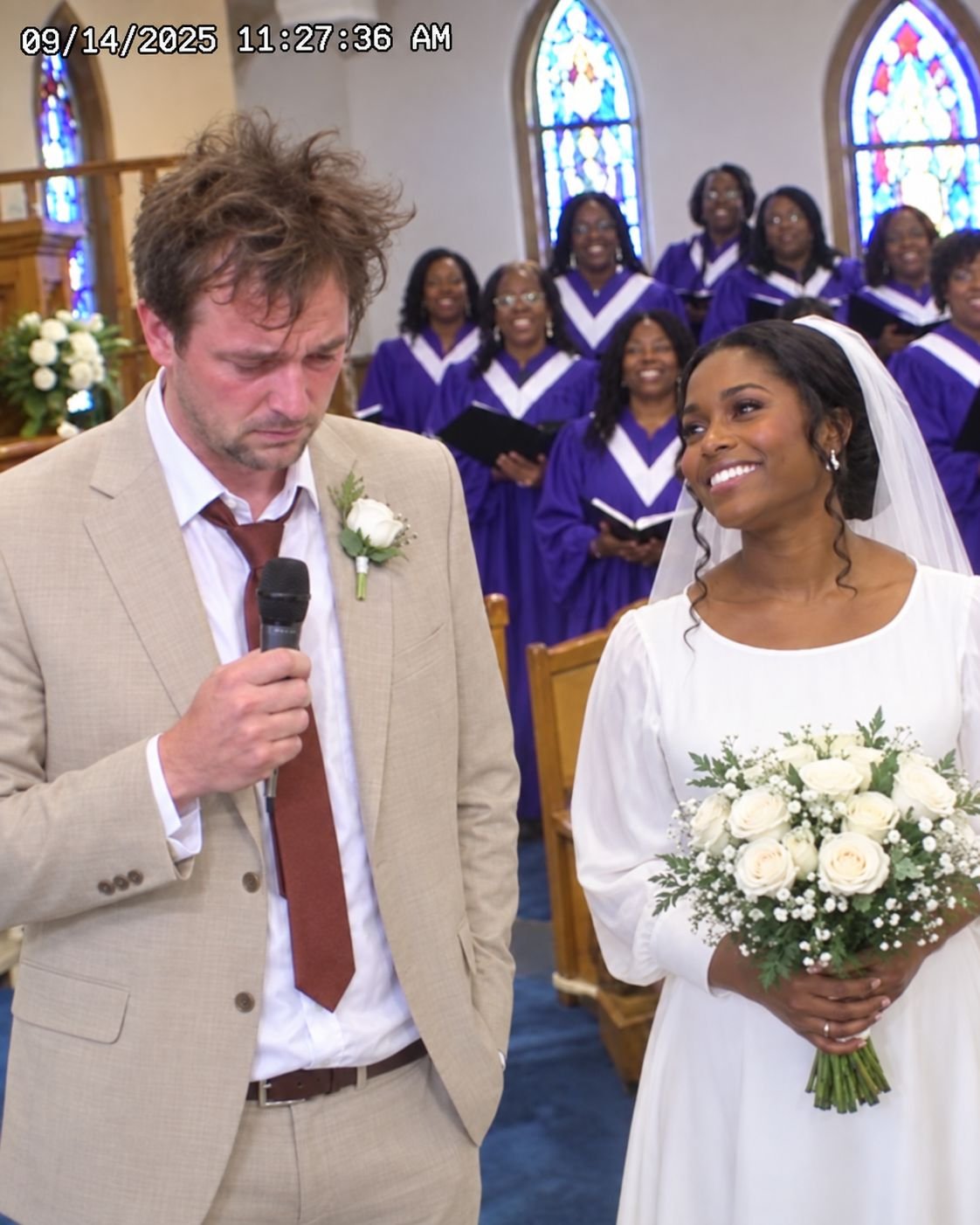
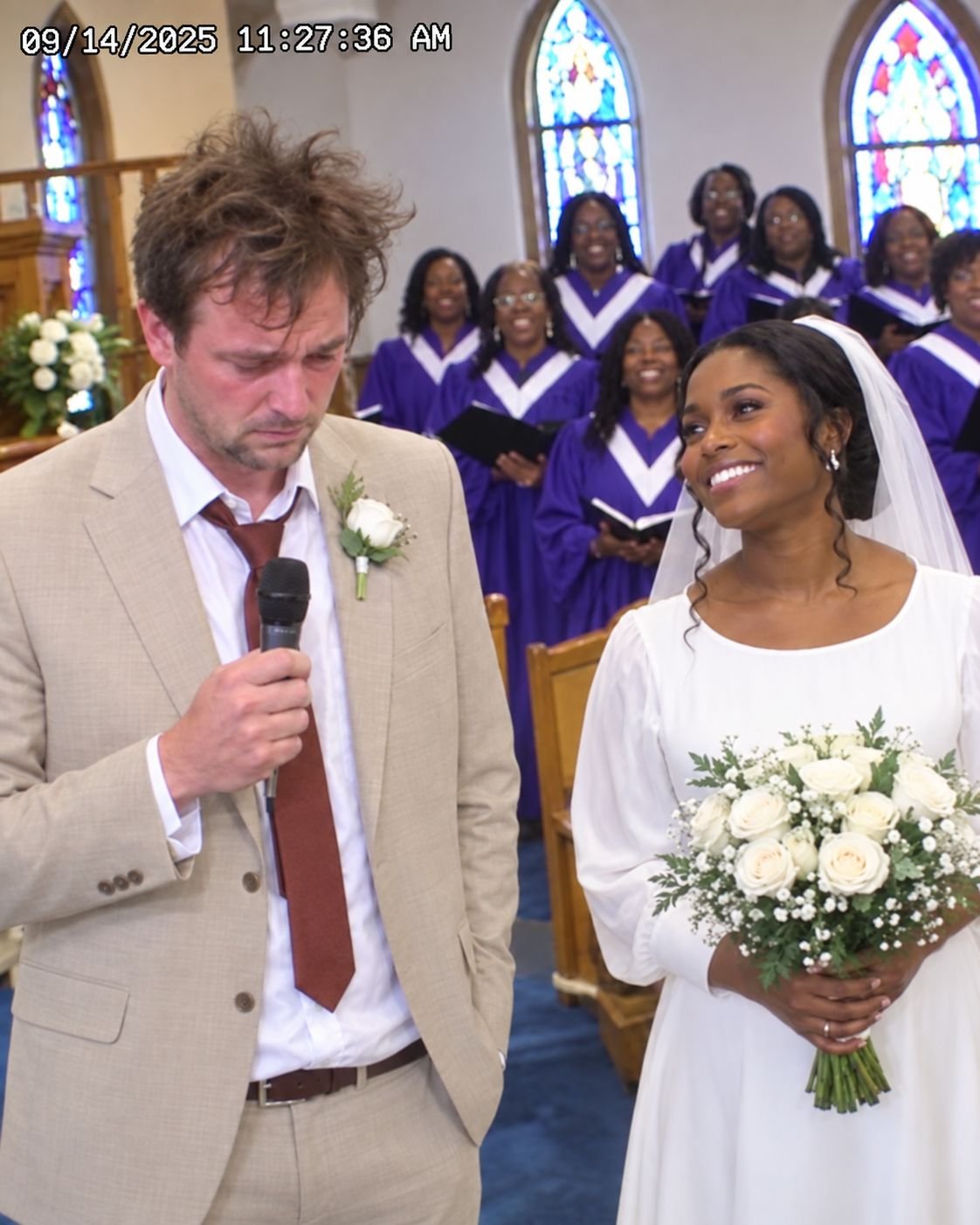
A Black nanny marries a homeless man.
Guests laugh at their wedding until he takes the microphone and says this…
It was a warm Saturday morning in Birmingham, England.
The church bell rang softly as people filled the pews, whispering to each other.
Everyone was there to witness what many had already deemed the strangest wedding of the year.
The bride was a Black nanny named Grace Johnson, a kind-hearted woman known for caring for children in various wealthy homes around the city.
She was 32 years old, soft-spoken, with a smile that could light up any room despite her life filled with hardships.
She wore her simple nanny uniform as a wedding dress because she couldn’t afford anything else.
The guests whispered and laughed about it.
The groom was a man named Daniel Brooks, a tall man with a rough beard, wearing a suit so worn it looked like it had come from a donation bin.
His shoes had cracks on the sides, and his tie was old and faded.
Everyone thought he was a homeless man Grace had foolishly fallen in love with.
He had no family present, no friends, no expensive ring, nothing.
Her close friends, Melissa, Claire, and Janet, sat together in the left row of the church, whispering loud enough for everyone to hear.
Melissa shook her head and whispered,
“I told her not to marry this man.
Look at him.
He looks like he’s sleeping under a bridge.”
Claire chuckled and added,
“Grace deserves better.”
Janet smirked,
“This wedding is a joke.”
The ceremony began.
The pastor asked if anyone had a reason these two shouldn’t be together.
The church fell silent, but the whispers didn’t stop.
Grace could hear the stifled laughter, the pitying glances, the critical stares.
Her heart ached, but she stood tall, holding Daniel’s rough hand.
When the time came for the vows, Grace’s voice trembled, but it was heard clearly.
Some guests rolled their eyes, others shook their heads.
Then Daniel spoke softly.
The church erupted in laughter.
Melissa whispered aloud,
“Will I love him for the rest of his days?
What days?
He doesn’t even have a home.”
Others laughed.
But then Daniel did something unexpected.
He raised his hand to the pastor and said,
“Please, may I say something before we finish?”
The pastor nodded.
Daniel walked slowly to the microphone at the front of the church.
His shoes squeaked, his old suit creased, and everyone got ready…
…for another reason to laugh.
Daniel adjusted the microphone.
A burst of feedback squealed through the church.
Someone in the back chuckled.
Grace remained beside the altar.
She knew Daniel was nervous because his left thumb kept rubbing the side of his index finger.
He always did that when he was trying to find the right words.
Daniel looked across the pews.
Then he looked at Grace.
“I wasn’t planning to make a speech.”
Melissa whispered something to Claire.
Another giggle.
Daniel heard it.
He didn’t react.
“But since so many people here seem worried about whether Grace knows what she’s doing…”
The laughter weakened.
“…I think I should tell you what she knows.”
Grace’s expression changed.
“Daniel.”
He smiled at her.
“It’s okay.”
Then he turned back toward the congregation.
“Most of you think Grace met me on the street.”
Silence.
“That’s true.”
Melissa folded her arms as if she’d just been proven right.
Daniel continued.
“Fourteen months ago, I slept behind New Street station.”
A few guests looked down.
“I had one backpack. Two shirts. One pair of trousers. And these shoes.”
He lifted one foot slightly.
The cracked leather was clearly visible.
Someone laughed again.
Daniel looked toward the sound.
“Yes.”
He nodded.
“They’re terrible shoes.”
That drew a different kind of laughter.
Not cruel.
Uneasy.
“I had been homeless for eleven months.”
Grace’s eyes filled.
She knew this story.
But not all of it.
Daniel had never told her everything.
“I met Grace on a Tuesday evening.”
His voice softened.
“It was raining.”
He looked at her.
“She was walking home after finishing work with the Whitmore family.”
Grace remembered.
The rain.
The cold.
The man sitting against the brick wall with his head lowered.
“I asked her for nothing.”
Daniel continued.
“I didn’t even look at her.”
“But she stopped.”
Grace wiped one tear from her cheek.
“She asked if I’d eaten.”
The church was completely quiet now.
“I lied.”
A tiny smile crossed his face.
“I said yes.”
Grace whispered:
“You were terrible at lying.”
A few people smiled.
Daniel nodded.
“She went into a shop and came back with soup, bread and coffee.”
He paused.
“Then she did something more important.”
He looked across the room.
“She sat down.”
Melissa’s smile disappeared.
“On the pavement.”
“Beside me.”
“She didn’t stand over me.”
“She didn’t toss money into my hand.”
“She didn’t ask what I’d done wrong with my life.”
“She sat beside me and asked my name.”
Daniel’s voice caught.
“Do you know how long it had been since somebody asked my name?”
Nobody answered.
“Four months.”
Grace covered her mouth.
Daniel looked at her.
“That’s why I’m marrying her.”
He paused.
“Not because she rescued me.”
“She didn’t.”
“She reminded me I was still a person worth rescuing myself.”
The pastor lowered his head.
Daniel gripped the microphone.
“The next week, Grace brought me information about a shelter.”
“Then a job centre.”
“Then she found a charity that helped people replace identification documents.”
“She never did things for me that I could do myself.”
“She just kept showing me the next door.”
“And when I stopped believing there was a next door, she stood there until I could see it.”
Grace was crying openly now.
Daniel smiled at her.
“I fell in love with her before I had anything to offer.”
He looked down at his suit.
“And judging from your faces, some of you think I still don’t.”
Nobody laughed.
Then Daniel reached inside his jacket.
He removed a folded piece of paper.
Grace frowned.
She had never seen it.
“This arrived six days ago.”
He unfolded it.
“I didn’t tell Grace.”
“Daniel?”
He looked at her.
“I wanted to tell you today.”
The church became still.
“Before I became homeless, I wasn’t always sleeping behind stations.”
He swallowed.
“I was a structural engineer.”
Grace stared at him.
“What?”
Daniel’s eyes filled.
“I worked for a construction consultancy in Manchester for almost nine years.”
A murmur moved through the church.
Melissa sat forward.
Claire stopped smiling completely.
Grace whispered:
“You told me you worked construction.”
“I did.”
“You never said you were an engineer.”
Daniel smiled sadly.
“Because by the time I met you, I didn’t feel like one anymore.”
He turned toward the congregation.
“Three years ago, my wife and our daughter were killed in a motorway collision.”
Grace’s hand flew to her mouth.
She knew Daniel had lost people.
He had never told her exactly how.
His voice shook.
“My daughter was six.”
Nobody moved.
“I stopped sleeping.”
“I stopped eating.”
“I stopped going to work.”
“I started drinking.”
“I ignored letters.”
“Lost my job.”
“Lost the flat.”
“And eventually I lost every place I could pretend I was still functioning.”
He looked down.
“Homelessness wasn’t a disguise.”
“It wasn’t a test.”
“It wasn’t some clever plan to discover who would love me without money.”
His voice became firmer.
“I really was homeless.”
That sentence changed the room.
There would be no fantasy reveal where poverty had secretly been wealth.
No billionaire costume.
No hidden mansion.
Daniel had been exactly what everyone thought.
What they had been wrong about was what that made him worth.
He held up the letter.
“Six days ago, I received confirmation that my professional reinstatement had been approved.”
Grace stared.
Daniel continued.
“Next month, I begin work with an engineering firm here in Birmingham.”
The pastor smiled.
Someone in the back began clapping.
Daniel raised one hand gently.
“Please.”
The applause stopped.
“I’m grateful.”
“But that’s not the important part.”
He looked toward Melissa, Claire and Janet.
“The important part is that Grace agreed to marry me before this letter came.”
Melissa’s face reddened.
“When I had no job offer.”
He looked at Claire.
“No house.”
Then Janet.
“No new suit.”
He touched his cracked shoes.
“And very bad shoes.”
A few people laughed softly.
Daniel looked at Grace.
“She didn’t choose my potential.”
“She chose me.”
Grace shook her head through tears.
“No.”
Daniel frowned.
She stepped forward.
“You’ve got that wrong.”
He smiled.
“Do I?”
Grace took the microphone from him.
She turned toward the guests.
“I didn’t choose him because I felt sorry for him.”
Her voice trembled.
“But I want that understood.”
She looked toward her three friends.
“Especially by the people who have spent the entire morning whispering about me.”
Melissa lowered her eyes.
Grace continued.
“I’ve worked in wealthy homes for eleven years.”
“I’ve seen men with cars worth more than everything I own.”
“I’ve seen watches that cost a year’s wages.”
“I’ve served dinner to people whose dining rooms are bigger than my flat.”
She looked at Daniel.
“And I’ve watched some of those people speak to their wives, children and employees as if money gave them permission to be cruel.”
Her voice strengthened.
“Daniel had nothing when I met him.”
“But he thanked me for a cup of coffee.”
“He remembered my birthday when people I’d worked for six years forgot it.”
“When I was sick, he walked forty minutes in the rain from the shelter to bring me medicine.”
“When one of the children I cared for went into hospital, Daniel sat outside with me until two in the morning because I was frightened.”
She looked across the church.
“So yes.”
“I knew he was homeless.”
“And yes.”
“I married him anyway.”
Her eyes landed on Melissa.
“Because homelessness described his circumstances.”
Then Claire.
“It did not describe his character.”
Then Janet.
“And I know the difference.”
No one spoke.
Daniel looked at Grace as if the entire church had disappeared.
The pastor cleared his throat.
“Well.”
A ripple of laughter moved through the room.
He smiled.
“I believe we still have a wedding to finish.”
This time, when Daniel spoke his vows, nobody laughed.
When Grace spoke hers, nobody rolled their eyes.
And when the pastor pronounced them husband and wife, the applause came slowly at first.
Then louder.
Grace heard Melissa clapping.
She didn’t look at her.
Not yet.
Daniel kissed Grace.
And for several seconds, nothing else mattered.
Then the church doors opened.
A woman in a dark green coat entered carrying a little gift bag.
Daniel froze.
Grace felt his hand tighten.
The woman stopped when she saw him.
“Daniel?”
His face drained.
“Mrs. Harris.”
Grace looked between them.
The woman was perhaps sixty-five.
Silver hair.
Kind eyes.
She walked toward them.
“I hoped I wasn’t too late.”
Daniel’s voice became rough.
“How did you know?”
“Mr. Patel from the shelter.”
She smiled.
“He said you’d probably be angry with him.”
Daniel laughed through sudden tears.
Grace whispered:
“Who is she?”
Daniel swallowed.
“My old supervisor.”
The woman corrected him.
“Former supervisor.”
Then she looked at Grace.
“I’m Margaret Harris.”
They shook hands.
“Your husband was one of the best engineers I ever hired.”
Daniel looked away.
Margaret continued.
“When he disappeared after losing his family, we tried to find him.”
His jaw tightened.
“I didn’t want to be found.”
“I know.”
She didn’t argue.
“I just wanted to see you standing again.”
Daniel nodded.
Then Margaret looked at Grace.
“And I wanted to meet the woman who apparently helped remind him how.”
Grace shook her head.
“He did that himself.”
Margaret smiled.
“Then I like you already.”
The reception was held in the church hall.
There were no crystal chandeliers.
No champagne fountain.
No string quartet.
Grace had ordered trays of sandwiches, meat pies and small cakes from a local bakery.
The decorations were paper flowers made by children she had cared for.
One of them had written:
MISS GRACE + MR DANIEL
in enormous uneven letters.
It was perfect.
Melissa approached while Grace was cutting the cake.
“Grace?”
Grace continued cutting.
“Yes?”
“I’m sorry.”
Grace looked at her.
Melissa’s eyes were wet.
“I was horrible.”
“Yes.”
Melissa flinched.
Grace wasn’t interested in making the truth comfortable.
“I thought I was protecting you.”
“No.”
Grace placed another slice onto a plate.
“You were mocking me.”
Melissa looked down.
“You’re right.”
That made Grace pause.
No excuse.
No but.
Melissa continued.
“I judged him because he was homeless.”
Then she swallowed.
“And I judged you because you’re a nanny and I thought you should be trying to marry upward.”
Grace stared at her.
Melissa’s face reddened.
“That’s ugly when I say it out loud.”
“It was ugly when you whispered it too.”
“I know.”
Grace set down the knife.
“Why are you apologizing now?”
Melissa looked toward Daniel.
He was laughing with Margaret and the pastor.
“Because I was wrong.”
Grace shook her head.
“About him becoming an engineer again?”
Melissa hesitated.
Grace had her answer.
“That’s not enough.”
“What?”
“If Daniel had walked up to that microphone and said he was still unemployed, would you be apologizing?”
Melissa’s eyes filled.
“I…”
“That’s the question.”
Grace wiped her hands.
“Don’t apologize because you discovered he has a profession you respect.”
She looked directly at her friend.
“Apologize because you laughed at a human being when you thought he didn’t.”
Melissa cried.
“I am sorry.”
Grace nodded.
“I believe you.”
“Can you forgive me?”
“Eventually.”
That was all Melissa received.
Claire apologized later.
Janet did not.
Janet left the reception early.
Some relationships survived that wedding.
Some didn’t.
Grace learned that both outcomes could be healthy.
Daniel started work four weeks later.
The first morning, Grace woke before him.
His new suit hung from the wardrobe.
Navy.
Nothing expensive.
But properly fitted.
His shoes were new too.
Daniel sat on the edge of the bed staring at them.
Grace leaned against the doorway.
“Nervous?”
“Terrified.”
“Good.”
He looked up.
“Good?”
“It means you care.”
He smiled.
Then looked at the old cracked shoes beside the wardrobe.
Grace followed his eyes.
“Throw them away.”
“No.”
“Daniel.”
“I’m keeping them.”
“Why?”
He picked one up.
“Because everybody keeps telling me how far I’ve come.”
He ran his thumb along the cracked leather.
“I don’t want to forget where I was standing when somebody finally sat beside me.”
Grace’s expression softened.
“Fine.”
She pointed.
“But they’re not going in my wardrobe.”
He laughed.
They rented a small two-bedroom flat in Edgbaston.
Nothing glamorous.
Daniel worked.
Grace kept working as a nanny.
That confused people.
“You don’t have to do that anymore,” Melissa once said.
Grace frowned.
“Do what?”
“Work as a nanny.”
“Why not?”
“Daniel earns good money now.”
Grace stared at her.
Melissa immediately realized.
“Sorry.”
Grace laughed.
“You’re learning.”
“I really am trying.”
“I know.”
Grace loved her work.
She loved children.
She loved being trusted with the small details that make up a childhood.
Shoelaces.
Lunchboxes.
Nightmares.
Lost teeth.
School plays.
She had never been ashamed of being a nanny.
Other people had simply decided she should be.
Two years after the wedding, Grace and Daniel bought a modest terraced house.
Three bedrooms.
Small garden.
Kitchen that needed work.
Daniel stood in the empty sitting room on moving day.
“Do you know what’s strange?”
“What?”
“I have keys.”
Grace looked at him.
He stared at the keys in his palm.
“For almost a year, every place I slept belonged to somebody else.”
Shelter.
Hostel.
Temporary accommodation.
“Now this opens our front door.”
Grace wrapped her arms around him.
“Our front door.”
He cried.
Not dramatically.
Quietly.
Grace let him.
Three years later, Daniel did something Grace hadn’t expected.
He returned to the shelter.
Not because he needed a bed.
Because he wanted to help.
At first, he volunteered one evening a month.
Then two.
He helped people prepare CVs.
Connected tradesmen with employers.
Helped former professionals navigate qualification and licensing problems.
But he became particularly interested in something else.
Identification.
A missing passport.
A lost birth certificate.
No permanent address.
No bank account.
Problems that sounded small until they formed a wall.
Daniel remembered that wall.
So he and Grace created a small fund.
They called it the Next Door Fund.
The name came from Daniel’s wedding speech.
Grace had kept showing him the next door.
The fund paid practical costs.
Replacement documents.
Work boots.
Travel cards.
Professional registration fees.
Deposits for temporary housing.
Nothing glamorous.
Everything useful.
The first year, they helped nine people.
The second, twenty-three.
Margaret Harris convinced Daniel’s engineering firm to contribute.
Other businesses followed.
Then a local newspaper wrote about it.
The headline mentioned Daniel’s homelessness.
He hated the article.
Grace laughed.
“Why?”
“They made me sound inspirational.”
“You are.”
“No.”
He folded the newspaper.
“I was lucky.”
Grace’s expression changed.
“You worked.”
“Yes.”
“You got sober.”
“Yes.”
“You went through counselling.”
“Yes.”
“You reapplied for professional registration after being rejected the first time.”
“Yes.”
“You studied changes in standards for months.”
Daniel sighed.
“Where is this going?”
Grace smiled.
“You’re allowed to admit you did difficult things.”
He looked at her.
Then nodded.
“Fine.”
“Say it.”
“No.”
“Daniel.”
“Absolutely not.”
She chased him around the kitchen with the newspaper.
They were laughing when the doorbell rang.
It was Janet.
Grace hadn’t seen her in almost four years.
She looked different.
Tired.
Thinner.
Embarrassed.
“Hi.”
Grace stared.
“Hello.”
“Can I come in?”
Grace hesitated.
Then stepped aside.
Daniel was in the kitchen.
He recognized Janet immediately.
He didn’t react.
He simply said:
“Tea?”
She looked ashamed.
“Please.”
They sat.
Janet wrapped both hands around the mug.
“I owe both of you an apology.”
Grace waited.
Janet looked at Daniel.
“I laughed at you.”
“Yes.”
“I thought Grace was throwing her life away.”
Daniel said nothing.
“And when you said you were an engineer…”
She stopped.
“I felt stupid.”
Daniel finally spoke.
“Because you realized I had once had a respectable job?”
Janet looked down.
“Yes.”
“Then you still didn’t understand.”
She nodded.
“I know.”
That surprised him.
Janet began crying.
“My brother is homeless.”
The room changed.
Grace leaned forward.
“What happened?”
“Divorce. Then drinking. Lost his job. He’s been sleeping in his car.”
Janet wiped her face.
“I spent months angry at him.”
Her voice cracked.
“I kept saying he was lazy.”
Daniel’s expression softened.
“I heard myself talking about him one night.”
She looked at Grace.
“And I sounded exactly like I did at your wedding.”
Silence.
“I realized I hadn’t changed at all.”
Grace reached across the table.
Janet took her hand.
“I’m sorry.”
Grace squeezed gently.
“Where is your brother?”
That was how Next Door helped person number forty-seven.
Not because Janet deserved a reward for apologizing.
Because her brother deserved to be treated as a person independent of his sister’s mistakes.
Daniel met him.
His name was Peter.
Daniel didn’t promise to fix him.
He knew better.
He showed Peter the doors.
Peter had to walk through them himself.
Some he did.
Some he didn’t.
Recovery wasn’t straight.
Daniel understood that too.
Years passed.
Grace and Daniel never became enormously wealthy.
There was no mansion.
No private jet.
No secret inheritance.
Daniel eventually became a partner at his engineering consultancy.
Grace opened a small childcare centre with two other women.
They named it Bright Steps.
On opening day, Daniel arrived carrying flowers.
Grace looked suspicious.
“How much did those cost?”
“Don’t ruin romance with accounting.”
“I run a nursery. Accounting is survival.”
He kissed her.
Children ran around their legs.
On the wall near reception hung a photograph from their wedding.
Grace in her nanny uniform.
Daniel in his old suit.
Cracked shoes.
People often asked why they displayed it.
Grace always gave the same answer.
“Because that’s what we looked like when we made the promise.”
Twenty years after their wedding, Bright Steps had expanded to three locations.
The Next Door Fund had helped hundreds of people.
Not everyone succeeded.
Some disappeared.
Some relapsed.
Some returned to the streets.
Some rebuilt careers.
Some found completely different ones.
Daniel refused to turn any of them into morality stories.
“People aren’t projects,” he told volunteers.
“They don’t owe you a beautiful ending because you helped them.”
Grace loved him most when he said things like that.
On their twenty-fifth anniversary, their friends organized a dinner in the church hall where they’d held the original reception.
Melissa came.
Claire came.
Janet came with Peter.
Margaret Harris, now well into her eighties, came with a walking stick and immediately complained that everyone was treating her like she was fragile.
The pastor had retired.
He attended anyway.
At some point, someone brought out the old microphone.
Daniel groaned.
“No.”
Grace laughed.
“Yes.”
“Absolutely not.”
The room began chanting his name.
He finally surrendered.
Daniel walked to the microphone.
This time, his shoes didn’t squeak.
His suit fit perfectly.
His beard was neatly trimmed.
But Grace could still see the man from that first morning.
The nervous thumb.
The slight pause before speaking.
Daniel looked around the room.
“Twenty-five years ago, I stood here because people were laughing at my wife.”
Melissa covered her face.
Everyone laughed.
“Sorry, Melissa.”
She shouted:
“I deserved that.”
Daniel smiled.
“Back then, everyone wanted a reveal.”
He looked at Grace.
“They wanted me to announce I was secretly rich.”
A few people laughed.
“Some people still tell our story that way.”
His expression became serious.
“But I wasn’t secretly rich.”
“I wasn’t pretending to be homeless.”
“I wasn’t testing Grace.”
“I was broken.”
The room quieted.
“I had lost my family.”
“My work.”
“My home.”
“And for a while, myself.”
He looked at Grace.
“Then this woman sat beside me on wet pavement and asked my name.”
Grace’s eyes filled.
“That was the miracle.”
He paused.
“Not the engineering job.”
“Not the house.”
“Not the charity.”
“Not anything that came later.”
“The miracle was that somebody saw value before there was evidence of recovery.”
Daniel’s voice shook.
“Grace didn’t love me because she knew who I would become.”
He smiled at her.
“She loved me while I was still trying to remember who I had been.”
Grace wiped her face.
Then Daniel reached beneath the lectern.
He lifted a shoebox.
Grace laughed immediately.
“No.”
Daniel opened it.
Inside were the cracked shoes.
The entire room erupted.
“You kept those?”
Melissa shouted.
Grace pointed at him.
“I told you not to put them in my wardrobe!”
Daniel laughed.
“They were in the loft.”
He held one shoe up.
“This shoe has been worth approximately eleven pounds for the last twenty-five years.”
“Less!”
Grace shouted.
“Probably.”
He set it down.
“But on our wedding day, some people thought these shoes told them everything about me.”
He looked across the room.
“They didn’t.”
Then he turned toward Grace.
“And people looked at her uniform and thought it told them everything about her.”
He shook his head.
“It didn’t.”
Grace stood.
Daniel held out his hand.
She walked toward him.
He kissed her forehead.
Then he said the sentence people remembered long after the dinner ended.
“Never confuse someone’s circumstances with their worth.”
Silence.
Then applause.
This time, Grace heard every person clapping.
Melissa.
Claire.
Janet.
Peter.
Margaret.
Children Grace had once cared for, now adults with children of their own.
Former shelter residents.
Engineers.
Nannies.
Teachers.
Shop workers.
People with homes.
People who had once lost them.
And standing beside Daniel, Grace remembered the first wedding.
The whispers.
The laughter.
The cracked shoes.
Her uniform.
The way people looked at them as if love required financial approval.
She remembered wondering whether she had made a mistake.
Not by marrying Daniel.
By inviting people who had forgotten how to be kind.
Later that evening, when everyone had gone, Grace and Daniel remained alone in the church hall.
Paper decorations had fallen onto the floor.
Half a cake remained.
Daniel loosened his tie.
Grace picked up the shoebox.
“These are finally going in the bin.”
He grabbed it.
“No.”
“Daniel.”
“They’re historical artifacts.”
“They smell like historical artifacts.”
He laughed.
Grace leaned against him.
For a while, neither spoke.
Then she asked:
“If that engineering letter hadn’t arrived before our wedding, would you still have made the speech?”
Daniel thought about it.
“Yes.”
“What would you have said?”
He looked at her.
“The same important part.”
“Which was?”
He took her hand.
“That when everybody else looked at me and saw what I didn’t have, you looked at me and asked who I was.”
Grace smiled.
“And what would you have told them you had to offer me?”
Daniel thought again.
Then answered:
“My word.”
She rested her head against his shoulder.
“That would’ve been enough.”
And that was the truth people had missed on that warm Saturday morning in Birmingham.
The surprise was never that the homeless groom had secretly been somebody important.
He had always been important.
Before the job.
Before the house.
Before the clean suit.
Before anyone in that church decided he deserved respect.
Grace understood that while sitting beside him on a wet pavement.
It took everyone else much longer.
They laughed because his shoes were cracked.
They laughed because Grace wore a nanny’s uniform.
They believed poverty made Daniel less of a man and domestic work made Grace less of a woman.
Twenty-five years later, the shoes were still cracked.
The uniform was still visible in their wedding photograph.
Neither had become shameful.
They had become reminders.
A person’s lowest season is not necessarily their identity.
A job title is not character.
Money is not dignity.
And love is not foolish simply because other people cannot see what it sees.
Daniel never forgot the day Grace sat beside him.
Grace never forgot the day Daniel stood at that microphone.
But when people asked which moment changed their lives, they always disagreed.
Daniel said:
“The pavement.”
Grace said:
“The wedding.”
And then they would laugh.
Because after all those years, both knew the real answer.
It wasn’t either moment.
It was the decision they kept making afterward.
To stand beside each other when the room was laughing.
To keep opening the next door.
And to never again let anyone else decide what a human being was worth.