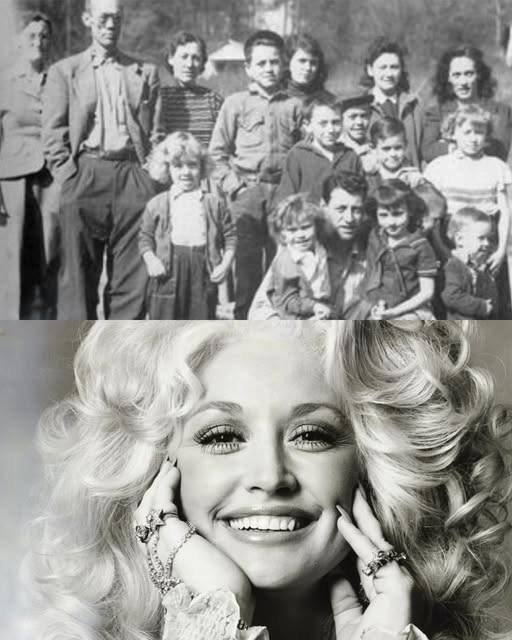
A doctor once delivered a baby girl in the heart of the Smoky Mountains and received a sack of cornmeal as payment. That baby girl, born in 1946, was Dolly Parton — a name that would eventually echo across the world through music, literature, and acts of unparalleled generosity. Dolly was the fourth of twelve children, born into what she has famously called “dirt-poverty.” Their home was a one-room cabin on Locust Ridge, its walls cracked wide enough for the winter wind to whistle through. Old newspapers stuffed into the gaps barely kept the chill at bay. At night, with no electricity or running water, Dolly and her siblings caught fireflies in mason jars to serve as lanterns, their soft glow illuminating the tiny, crowded space. Three or four children slept end-to-end on straw-filled mattresses, learning the art of shared endurance, of making room for one another, even in scarcity. In this raw, demanding environment, Dolly learned lessons that would shape her character: resilience, empathy, and the ability to see magic in the simplest moments.
A Mother’s Magic: Turning Hunger into Hope
Dolly’s mother, Avie Lee, had a gift that went beyond sewing and cooking. She had the ability to turn scarcity into enchantment. When the cupboards were nearly empty, she would gather the children and announce it was time to make Stone Soup. Each child would be sent out to find the perfect rock to boil in a pot of water. But this wasn’t simply a playful diversion. Avie Lee made sure that the child who had struggled the most that day felt special when their rock was chosen. Through this ritual, she transformed hunger into hope and boredom into imagination. Dolly has often reflected on these moments, noting that it wasn’t the food that mattered—it was the feeling of being seen, of being important, of being part of something bigger than the immediate struggle. These experiences taught Dolly that creativity and care could overcome any lack of material wealth, and that generosity is as much about attention as it is about money.
Childhood Challenges That Forged a Star
By age four, Dolly was already singing into a tin can on a stick, pretending it was a microphone. She woke at 4 a.m. to pack her father’s lunch before he went to work in the fields and took care of her younger siblings with a maturity beyond her years. Life in the mountains was harsh, and accidents were inevitable. When Dolly suffered a serious injury that nearly severed her toes, there was no money for a doctor. Her mother stitched her toes together using a sewing needle and kerosene, right there in the cabin. This moment could have been a source of fear or trauma, yet it became an emblem of resourcefulness and courage. Dolly absorbed these lessons early: pain is inevitable, but suffering can be transformed into determination. Each small challenge shaped her ability to face life’s obstacles with grace, resilience, and a sense of humor that would later define her public persona.
Dolly’s father, Robert Lee Parton, was one of the smartest men she had ever known, yet he carried a lifelong quiet shame: he never learned to read. His signature remained an “X” his entire life. This was a mark of opportunity denied, but it became a compass for Dolly. She felt a responsibility to honor her father’s unrealized potential, and this motivation led her to a mission that would touch millions of lives. She vowed to make a difference in the lives of children who, like her father, had no guaranteed access to education. Dolly’s drive to empower others was rooted in a deeply personal understanding that knowledge is transformative, and that every child deserves the chance to learn, imagine, and dream without limitations.

The Imagination Library: Igniting a Love of Reading
Out of this mission came the Imagination Library, a program that mails a free book every month to children from birth to age five, regardless of their family’s income. The program began in her home county of Sevier, Tennessee, as a way to honor her father’s legacy, but it quickly expanded into a worldwide phenomenon. Over 200 million books have been sent to children across the United States, Canada, the United Kingdom, Australia, and Ireland. Each book represents not just a story, but a gift of imagination, literacy, and opportunity. The Imagination Library embodies Dolly’s belief that early access to books and storytelling can unlock a lifetime of curiosity and growth. Through this program, children who have never seen the inside of a library can explore distant lands, meet extraordinary characters, and envision futures they may never have imagined possible.
Dolly’s generosity extends beyond programs and foundations. In 2016, wildfires tore through her Tennessee homeland, destroying homes and uprooting families. Instead of sending cards or posting prayers, Dolly acted directly. She wrote monthly $1,000 checks to every family who had lost their home, continuing this support for six months. Over a thousand families received her quiet assistance, totaling more than a million dollars. She deflected praise with laughter, a subtle refusal to let recognition overshadow the act itself. Dolly’s approach exemplifies authentic compassion: responding to suffering with tangible, direct action rather than performative gestures. Her philosophy has always been clear — help first, explain later, and never let ego dictate the measure of your giving.
Turning Pain into Purpose
Dolly Parton’s life story is a blueprint for transforming adversity into meaningful action. The cold nights, the hunger, the limited opportunities of her childhood were not just obstacles; they became the source of her empathy, creativity, and drive. From singing into tin cans to delivering millions of books worldwide, she consistently demonstrates that personal hardships can fuel a life of purpose. Her success is measured not by wealth or fame, but by the impact she leaves on others. Every initiative, every check, every book mailed is a testament to the lessons she learned in a tiny cabin on Locust Ridge: that love, generosity, and resilience are stronger than any circumstance, and that the way we rise is inseparable from how we lift others.
Dolly Parton could have left the Smoky Mountains and never looked back, but she chose to build a bridge between her past and the future. Her scars became the foundation of her philanthropy, her artistry, and her example. From the music that has touched hearts globally to the charitable acts that have transformed lives quietly and consistently, Dolly’s life is a testament to the power of giving back. She demonstrates that even the humblest beginnings can birth an extraordinary legacy. Her story teaches us that the measure of a life well-lived is not the distance one travels away from adversity, but the hands one reaches back to lift along the way. Dolly Parton’s mark on the world is permanent, not because of fame or fortune, but because she turned her life into a gift for countless others — a gift that continues to grow, inspire, and transform.
Dolly Parton’s voice wasn’t just a gift; it was her lifeline. From the moment she sang into that tin can on a stick, her music became a conduit for both joy and survival. In the Smoky Mountains, she would sing at local church gatherings, school events, and family gatherings, her voice carrying above the whispering wind and crackling fire. Every note she sang was an expression of longing, of hope, and of a spirit too large to be contained by the cabin walls. Music offered her an escape, but it also offered a purpose: a way to connect with others, to tell stories that mattered, and to shape a world that often seemed indifferent to the dreams of a poor child in rural Tennessee. By her teenage years, she had become a local sensation, performing on radio shows and traveling small towns, each stage building the confidence that would eventually carry her to the Grand Ole Opry, Nashville, and beyond.

Nashville Dreams and Relentless Determination
Arriving in Nashville at the age of 18, Dolly faced a city teeming with talent, ambition, and competition. Yet, she carried with her the lessons of the mountains: resilience, creativity, and the belief that hard work and heart could overcome almost any obstacle. She faced rejection after rejection from music producers who couldn’t see past her humble roots or her unconventional style. But Dolly refused to bend, refusing to trade her authenticity for acceptance. She wrote her own songs, often inspired by the struggles and stories of those around her — from family hardships to the dreams of children she met along the way. It was this authenticity that eventually caught the attention of Porter Wagoner, a country music legend who became both mentor and collaborator. Together, they transformed Dolly’s small-town charm into national acclaim, her songs reaching homes across the country, each lyric carrying the warmth, humor, and heartbreak of her upbringing.
What set Dolly apart from other rising stars was her ability to weave storytelling into every melody. Songs like “Coat of Many Colors” weren’t just music; they were narratives drawn directly from her life. She sang of a coat her mother had stitched from rags, a symbol of love and pride in a life of scarcity. Listeners everywhere found themselves reflecting on their own memories of family, struggle, and the quiet moments that define a childhood. Dolly understood instinctively that the power of a song isn’t only in its tune but in its ability to touch hearts, to make the listener feel seen, understood, and less alone. This gift of empathy embedded in her music would later translate seamlessly into her philanthropy and public initiatives, creating a bridge between her personal stories and universal human experiences.
Beyond the Spotlight: A Heart of Generosity
Even as her fame skyrocketed, Dolly never lost sight of where she came from or the values instilled by her parents. Fame, wealth, and awards never eclipsed her commitment to giving back. Beyond the Imagination Library, she engaged in countless acts of kindness — from funding scholarships for local students to supporting disaster relief efforts across the United States. She approached philanthropy with the same directness and authenticity that defined her life, preferring hands-on support over empty gestures. For Dolly, giving wasn’t about recognition; it was about impact. She understood that the true measure of success lies not in accolades or chart positions but in the lives you touch, the doors you open, and the hope you plant.