For nearly twenty years, I believed my daughter had disappeared without leaving anything behind. Then another daughter opened an old seam and returned the truth to me.
Part One – The Birthday Morning
On the morning Grace turned eighteen, I stood alone in the kitchen holding a small birthday box and staring at the closed curtains. Ellen had always opened them before the kettle began to sing. Even years after her death, I sometimes entered the room expecting to find her at the window, pulling the fabric aside and welcoming the day as if sunlight were a guest she had invited herself.
That morning, however, the house remained dim. Perhaps I had left it that way because darkness had become familiar. Perhaps I was afraid that too much light would reveal how many people were missing from the celebration.
Inside the box was a silver locket I had kept hidden for years. It resembled one Ellen used to wear, and inside it I had placed a tiny photograph of the three of us: Ellen, Grace as a toddler, and me. Ellen was laughing at something outside the frame. Grace had one fist wrapped around my finger. I looked younger in the picture, but more than that, I looked like a man who still believed happiness could be trusted.
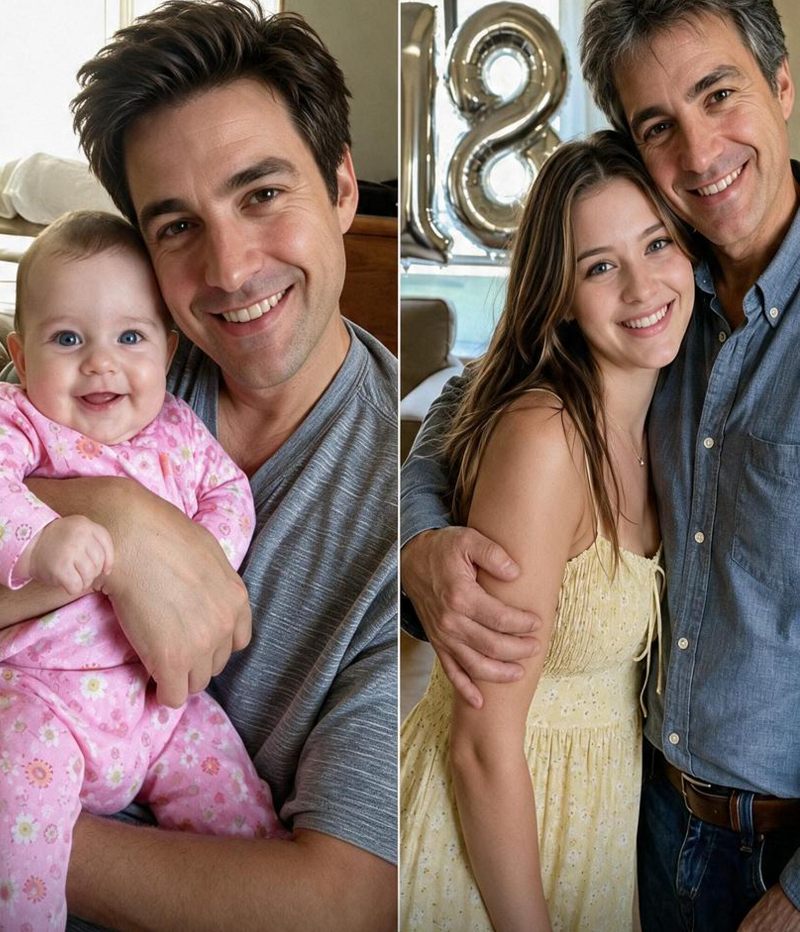
Grace deserved a beautiful eighteenth birthday. I had spent weeks planning breakfast, ordering her favorite cake, and pretending I was not troubled by how quiet she had become. For nearly a month, she had been disappearing into her room after dinner. The cedar chest at the foot of her bed was often open, and books about genealogy and public records covered her desk.
Two evenings earlier, she had asked me a question so casually that I almost missed the worry beneath it. “When you found me, do you remember exactly where the bench was?”
I had remembered without thinking. “The third bench from the fountain in Sycamore Park.”
She lowered her eyes to her plate. “And there was nothing with me except the jacket?”
“Nothing I could see.” I had tried to smile. “Why all the questions?”
“It is for my family-history project,” she replied. Then she barely touched the rest of her dinner.
I carried the locket upstairs that birthday morning and paused beside the photograph hanging in the hallway. Mia was sixteen in it, caught halfway through a laugh, her dark hair blown across one cheek. Ellen had placed the frame there after Mia vanished because she wanted our daughter to be the first person we greeted every morning and the last one we remembered at night.
Almost twenty years earlier, Mia had left for school on an ordinary Wednesday and had not returned. There had been searches, posters, interviews, and calls that arrived after midnight. For two years we lived from one rumor to the next. Then Detective Paul Henderson, who led the investigation, sat in our living room and told us there was little reason to believe she was still alive.
Ellen never truly recovered from that sentence. She loved Grace deeply when Grace later came into our lives, but the uncertainty surrounding Mia remained a wound no doctor could reach. Several years later, Ellen’s heart failed after a long period of illness and strain. By then, grief had already taken so much from her that death felt like the final theft.
I touched two fingers to Mia’s photograph, as I did every morning, and whispered, “Today is Grace’s birthday. Stay close to us.” Then I continued down the hall and knocked on Grace’s bedroom door.
Part Two – The Child on the Third Bench
The night I found Grace had begun with nothing unusual. My car was being repaired, so I walked home from the furniture shop, taking the path through Sycamore Park. The air smelled of wet leaves, and the lamps beside the fountain had just come on. I was thinking about dinner when a thin cry rose above the sound of the water.
At first, I thought a parent must be nearby. Then I reached the third bench and saw a newborn lying alone beneath the yellow light. She was wrapped in a faded denim jacket several sizes too large for her. One tiny hand had worked free of the sleeve and was opening and closing against the cold air.
I called out, searched behind the trees, and hurried to the sidewalk, but no one answered. The park looked deserted. I took off my coat, gathered the child carefully against my chest, and called the police. The instant she felt warmth, her crying softened. She looked up at me with wide, dark eyes, and something inside me – something that had been numb since Mia disappeared – stirred awake.
The officers found no note, bag, or identifying mark. I gave my statement at the hospital and returned home after midnight, carrying only the memory of her small weight in my arms. Ellen sat at the kitchen table and listened while I told her everything. When I described the baby’s hand gripping my finger, she began to cry.
For days, I called the station and the child-welfare office. No parent or relative came forward. A social worker eventually asked whether Ellen and I would consider temporary foster care. We said yes before she finished explaining the process.
Temporary became permanent. We named the baby Grace because her arrival felt like an undeserved kindness in the middle of our sorrow. Loving her did not replace Mia, and we never asked it to. Instead, Grace gave our love somewhere living to go.
I kept the denim jacket. After the police returned it, Ellen washed it gently, folded it, and laid it in a cedar chest. We agreed that it belonged to Grace and that when she was old enough, we would tell her every detail we knew. We raised her with the truth: she had been found, she had been chosen, and she was loved without condition.
What we did not know was that the jacket carried a second truth – one hidden so carefully that it waited eighteen years to be discovered.

Part Three – What the Seam Had Kept
Grace did not answer my knock, so I opened the door a few inches. She was sitting on the carpet in her pajamas with the denim jacket spread across her knees. A small sewing tool lay beside her, and a line of loosened thread curled across the floor.
My first feeling was confusion. My second was fear.
“Grace, what happened?”
She lifted her face. She had clearly been crying, yet her expression held a new firmness. “Please sit down, Dad.”
I placed the birthday box on her dresser and lowered myself onto the edge of the bed. She ran her thumb over an opening in the jacket’s back seam. It was narrow and precise, as though she had performed delicate surgery.
“I wasn’t only working on a class assignment,” she began. “I requested everything I was allowed to see – the police report, the hospital intake record, the foster-placement paperwork, and the adoption documents. I kept finding small gaps. No witness saw who left me. The time estimates did not agree. And the jacket was the only object that connected me to the person who brought me there.”
I wanted to reassure her, but she continued before I could speak.
“One section of this seam felt heavier than the rest. At first I thought the fabric had folded over itself. Last night I used a flashlight and could see the outline of something underneath.”
She reached beside her and picked up a square of yellowed paper. It had been folded so tightly that the creases seemed permanent.
“I found this inside.”
She placed it in my hand. The paper trembled, although I could not tell whether the shaking came from her fingers or mine. When I unfolded it, the room seemed to narrow around me.
The message was brief: “To the man who receives this jacket: the story you are given will not be the whole truth. Detective Henderson knows where the answers begin. – Mia.”
I recognized the handwriting before I reached the name. Mia’s letters had always leaned slightly forward, impatient to arrive at the next word. The capital M was the same one she had written on birthday cards, school forms, and the notes she used to leave beside the coffee pot.
For several seconds, I could not hear anything except the beating of my own heart.
“It cannot be hers,” I said, though I knew it was. “Someone could have copied it. The note might have been put there years earlier. Henderson worked on many cases.”
Grace’s voice was gentle, which made it harder to resist. “Dad, you know what you are holding.”
I read the message again. Every explanation I tried to build collapsed beneath Mia’s signature.
Then Grace said the words she had been trying to find all morning. “I think this jacket belonged to her. And I think my beginning is connected to her disappearance.”
I looked at my daughter – the child I had carried from a park bench, the girl whose scraped knees I had bandaged, the young woman who had spent five days protecting me from a truth she feared would destroy me. I understood that she had not delayed because she doubted me. She had delayed because she loved me.
I stood, took the gift box from the dresser, and slipped it into my coat pocket. “Get dressed,” I said. “We are going to see Henderson.”
Part Four – The Man Behind the Christmas Cards
Detective Henderson had retired years earlier, but he still sent me a card every December. Each one carried the same careful wish for peace. I had kept them in a hallway drawer because I believed they came from a man who understood what our family had endured.
During the forty-minute drive to his house, those cards returned to me one by one. I remembered his steady voice during the searches, the cups of coffee he drank at our kitchen table, and the hand he placed on my shoulder when he told Ellen and me that hope could become its own kind of suffering. I had trusted him at the moment when trust mattered most.
Grace sat beside me with the note held flat between both palms. Neither of us turned on the radio.
Henderson answered the door wearing a brown cardigan and holding a mug. Surprise crossed his face when he saw me. Alarm followed when he noticed the jacket over Grace’s arm.
“Walter? It is barely eight.”
“We need to talk about Mia.”
His gaze moved to Grace, then back to me. He stepped aside without another question.
In his kitchen, I placed the note on the table. He read it once. The color drained from his face, and the mug made a soft sound when he set it down too quickly.
“Where did you find this?” he asked.
“It was sewn into the jacket Grace wore the night I found her.”
He pressed his fingertips against the edge of the table. “Walter, you may be drawing the wrong conclusion.”
“Then give me the right one.”
He began with excuses. The case was old. Memory changed over time. Departments misplaced reports. He had handled hundreds of missing-person investigations. But while he spoke, he would not meet my eyes. He kept studying Grace’s face as if he were seeing a ghost grow clearer with every second.
I leaned toward him. “You remember Mia. You remember this jacket. And you know who Grace is.”
The silence that followed was not uncertainty. It was surrender.
Henderson lowered himself into a chair. The refrigerator hummed behind him; somewhere in the house, a clock marked each second. Finally, he said, “We found Mia more than a year after she left home.”
I gripped the back of the nearest chair. “Alive?”
He nodded once. “She was staying at a protected women’s shelter two states away. She was frightened and asked that her location not be shared with anyone. She believed the man she had fled would trace her through her family.”
The words struck with two opposite forces. Mia had survived long enough to be found. Mia had been found, and no one had told us.
“You let Ellen and me think she was gone,” I said.
“At first I believed I was honoring her request. I should have involved the proper agencies and arranged safe contact, but I handled it alone. When the situation became worse, admitting what I had done would have exposed every rule I had broken.”
“So you protected your career.”
His eyes closed. “Yes.”
One word, and twenty years of grief changed shape.
Part Five – The Confession He Could Not Finish
I wanted to shout, but anger felt too small for what he had taken from us. Ellen had waited beside the telephone for years. She had blamed herself for arguments that every parent and teenager have. She had carried the belief that Mia died alone and unreachable. Henderson had visited our home, accepted our gratitude, and watched that belief consume her.
Grace stepped closer to the table. Her voice remained calm. “What does my jacket have to do with Mia?”
Henderson looked at her for a long time. “The jacket was Mia’s,” he said at last. “And you were not abandoned in the way the report suggests.”
Grace’s hand found the back of my chair. “Then who put me there?”
He shook his head. “I cannot explain all of it without the supplemental file. Some of the information came from another state, and the records were restricted because the shelter protected its residents.”
“You have already hidden behind procedure for twenty years,” I said. “Do not hide behind it now.”
His face tightened. “I know enough to tell you that Mia intended for Walter to find you. Beyond that, you need the official record.”
Grace inhaled sharply. I felt the room tilt, but I would not let Henderson watch me fall apart. I took Mia’s note from the table and folded it carefully.
“We are going to the county police department,” I told him. “We will give them this note, this jacket, and your name. You can call them before we arrive and tell the truth yourself, or you can wait for them to come to you.”
He stared at his hands. When Grace and I reached the doorway, he spoke behind us. “Walter, I am sorry.”
I turned back. He seemed older than he had ten minutes earlier, but I felt no comfort in that. “I believe you regret it,” I said. “That does not return the years you chose to take.”
Outside, the morning was painfully bright. Grace climbed into the passenger seat and opened the county police website on her phone. She did not ask whether we should continue. She only asked which entrance we needed.
As I started the car, I saw Ellen in the set of Grace’s jaw – not in her features, but in her refusal to be intimidated by the truth. For the first time that day, my fear made room for pride.

Part Six – The File That Changed Our Family
Detective Elena Reyes met us at the county station. She listened without interrupting while Grace described the hidden seam and I explained Henderson’s confession. She photographed the jacket, copied the note, and located Mia’s old case number. The supplemental records were restricted, and she could not release them immediately, but she promised to request emergency authorization.
Waiting through that day was harder than waiting through any ordinary night. Every possible answer felt both precious and dangerous. Grace stayed close to me, though I sensed she was fighting a private fear: if Mia was connected to her birth, would the truth alter the meaning of the life we had shared?
After dinner, I finally gave her the birthday box. “This was supposed to be the important moment today,” I said. “I was wrong about that. But it still belongs to you.”
She opened the locket and stared at the photograph. Her fingers traced Ellen’s smiling face. “She loved me, didn’t she?”
“Completely,” I answered. “Whatever we learn tomorrow, nothing can revise that. Nothing can revise us.”
Grace closed the locket around her palm. “I know. I just needed to hear you say it.”
Reyes called shortly after eight the next morning. Henderson had contacted the department, and the authorization had been approved. An hour later, Grace and I sat across from Reyes as she opened a thick file between us.
“Mia left town with an older boyfriend who had gradually isolated her from everyone she trusted,” Reyes said. “More than a year later, she escaped and reached a protected shelter in another state. She refused to contact home because he had threatened to follow any message back to her family.”
I stared at the papers without seeing them. “She stayed away to protect us.”
“That appears to be what she believed she had to do,” Reyes replied. “The safest and lawful response would have been coordinated contact through the shelter and local authorities. Henderson instead made a private promise to keep her discovery out of the active case file. That decision left her without the full protection she should have received and kept your family in the dark.”
There was no comfort in learning that Mia had loved us from a distance. Yet beneath the pain, a burden I had carried for years began to loosen. She had not forgotten us. She had been trying, with the frightened judgment of a very young woman, to keep danger away from our door.
Reyes turned another page and looked directly at Grace. “There is something else. Mia was pregnant when she reached the shelter.”
Grace’s hand closed around mine. The answer had been moving toward us since she opened the jacket, but hearing it aloud still stole the air from the room.
“Mia was my mother,” she whispered.
Reyes nodded. “Yes.”
Part Seven – Mia’s Last Gift
The rest of the story came from the shelter records and from a former staff member Reyes had located the night before.
Three days after Grace was born, Mia learned that the man she had escaped was searching nearby. She feared that if he found the baby, he would use the child to control her or discover the family she was trying to protect. Mia did not trust herself to approach our house without being followed, so she asked a shelter worker named Ruth to help.
Mia gave Ruth the denim jacket, described Sycamore Park, and told her which route I usually walked when my car was unavailable. She knew my habits because she had grown up watching them. She chose the third bench near the fountain because it could be seen from the road and because I would pass close enough to hear a baby cry.
“Ruth waited across the street,” Reyes explained. “She placed Grace on the bench only when she saw you coming into the park. She remained nearby until you picked her up and called for help. Grace was never left unwatched.”
I remembered the wet leaves, the glowing lamps, and the strange feeling that someone had been nearby. For eighteen years I had believed chance led me to that bench. Now I understood that Mia had guided Grace into my arms with the last plan she was able to make.
“Did Ruth know about the note?” Grace asked.
“No. Mia had already sewn it into the lining. Ruth believed the jacket itself would be enough to connect the baby to your family. But because the police treated it as ordinary clothing, the connection was missed.”
Grace looked down at the frayed edge of the opened seam. “What happened to Mia after that?”
Reyes paused, and in that pause I knew the answer would hurt.
A few days later, the man Mia had fled found her. Mia told him the baby had been surrendered anonymously through the shelter and gave him no information that could lead to us. She did not survive his violence. He was later convicted through the investigation in that state, but the case remained under a different name for a time because Mia had used an alias while seeking protection.
Eventually, the shelter records and identification evidence connected her to our missing-person report. Henderson received the notification. By then, revealing it would also reveal that he had found Mia alive earlier and had concealed that fact. He placed the information in a restricted supplement instead of coming to us.
Grace covered her mouth as tears slid down her face. “She kept me hidden from him.”
“She did,” Reyes said. “Her final choices ensured he never learned where you had gone.”
Grace turned toward me. For an instant she looked very young again – like the little girl who used to search my face whenever thunder shook the windows.
“Dad,” she said, “Mia chose you for me.”
I put my arms around her. “She knew exactly where she wanted you to be.”
She cried against my shoulder, grieving a mother she had never met and loving her at the same time. I held her and thought of Mia stitching that note into the jacket, forcing hope through layers of fear. I had spent twenty years believing I failed to bring my daughter home. The truth was that, when she could not return herself, Mia had sent home the most precious part of her life.
Grace drew back and wiped her cheeks. “I am her daughter,” she said. Then she touched the locket at her neck. “And I am yours and Ellen’s too. None of those truths has to erase another.”
That was the moment I understood that family was not a line that had to be divided. It was a circle Mia had completed without knowing whether any of us would ever see its shape.
Part Eight – Opening the Curtains
The investigation into Henderson’s conduct continued. He gave a formal statement, surrendered the records he had kept, and faced the consequences of his choices. I did not attend every hearing. For years, his decisions had controlled the story of our family. I refused to give him control over the rest of it.
What mattered more was bringing Mia’s truth into the light. Reyes helped arrange for her remains to be returned and buried beside Ellen. On a clear morning several weeks after Grace’s birthday, we stood together beneath the maple trees at the cemetery.
I had repaired the jacket by hand. The seam was not invisible – I did not want it to be. A narrow line of new thread marked the place where the truth had waited. Grace wore it over a dark blue dress, along with the silver locket.
At the grave, I placed one of Ellen’s rings beside the flowers before it was secured in a small memorial box. Ellen had waited for Mia until her own heart could wait no longer. I wished I could tell her that our daughter had loved us, that she had tried to shield us, and that Grace had carried Mia back into our home from the very beginning.
Grace knelt and rested her fingers against Mia’s name. “I wish I had known you,” she said. “But I know what you did for me. I will carry that with love, not fear.”
I stood beside her and said the words I had been unable to say for nearly twenty years. “Mia, you made it home.”
The sentence did not erase the loss. It did something gentler: it gave the loss an ending.
When we returned to the house, Grace asked me to help preserve the jacket properly. We placed Mia’s note in an archival sleeve, added copies of the official records, and wrote down everything we remembered about the night at Sycamore Park. The jacket went back into the cedar chest, not as evidence of abandonment, but as proof of a mother’s desperate courage and a family’s hidden connection.
At dawn the next day, I paused in the hall before Mia’s framed picture. For years I had greeted it as though part of me were still waiting for the front door to open. This time I touched the frame and said, “Thank you for trusting me with her.”
From downstairs came the pop of the toaster, followed by Grace complaining that it had burned her breakfast again.
“Morning, Dad!” she called.
“Morning, Grace.”
I walked into the kitchen. The curtains were still closed, but the room no longer felt dark. I crossed to the window and pulled them apart. Sunlight spread across the table, caught the silver locket at Grace’s throat, and filled the home that Mia had found a way to return to.
For the first time in many years, remembering my daughter did not feel like standing at the edge of an unfinished goodbye. I could grieve her, honor her, and still step forward. So I sat across from Grace, reached for the jam, and let a new morning begin.
Disclaimer: This fictional story is inspired by situations from everyday life. Names, characters, businesses, and locations are created for storytelling purposes, and any resemblance to actual people or events is coincidental.