PART 1
When I agreed to marry Adrian Kessler, I didn’t care whether he was innocent.
That’s the ugliest sentence I’ve ever had to write, so I’m putting it first. I want you to understand exactly who I was when this started, because nothing that happened later makes sense unless you know how little I believed in anything back then.
I was twenty-seven years old. I worked breakfast shifts at a diner on Route 9 and cleaned office buildings downtown four nights a week. My mother had died two winters earlier, and my father had stopped being a real person in our lives long before that, which left me and my little brother, Danny, in a one-bedroom apartment with a radiator that clanked like a ghost dragging chains and a landlord who taped notices to our door in bright orange paper.
FINAL WARNING. PAST DUE.
Danny was fourteen. He slept on the pullout couch and did his homework at the kitchen table under a lamp we’d found on the curb. He was smart, smarter than me, and he had asthma that flared every time the weather turned. His inhalers cost sixty-two dollars each. I knew that number the way some people know their own birthday.
One of the buildings I cleaned at night belonged to the Kessler Family Foundation. Thirty floors of glass and polished stone, with a lobby that smelled like lilies. I vacuumed the executive suite every Tuesday and Thursday, and that’s how Margaret Kessler found me.
She was standing in her office at nine at night when I came in with my cart. Silver hair cut sharp at the jaw, a cream-colored suit, reading glasses on a thin gold chain. I apologized and started to back out. She told me to stay.
She watched me work for a full ten minutes. Then she asked me my name, my age, whether I was married, and whether I had any family to support.
I thought I was about to be fired for something. Instead, a week later, I was sitting across from her in that same office with a cup of tea I was too nervous to drink, and she was explaining the most insane offer anyone had ever made me.
“My son is in prison,” she said, folding her hands on the desk. “Perhaps you saw the news three years ago.”
I had. Everyone had. Adrian Kessler, thirty-one, heir to one of the oldest family fortunes in the state, convicted of embezzling four million dollars from his own family’s charity. The newspapers had loved it. The Prince Who Robbed the Poor. He’d been sentenced to twelve years.
“His attorneys are preparing a petition to reduce his sentence,” Margaret went on. “Judges look favorably on stability. On family ties. On a man who has someone waiting for him.” She slid a folder across the desk. “I need him to have a wife.”
I actually laughed. I couldn’t help it.
She didn’t.
“Two thousand dollars a month,” she said. “Deposited on the first. You visit him twice a month. You write him letters. You appear at hearings when his attorneys ask. You sign a prenuptial agreement waiving any claim to his assets. And when he is released, whenever that is, you file for divorce within thirty days, and I pay you a final fifty thousand dollars.”
“Why me?” I asked.
She looked at me over her reading glasses. “Because you need it. People who need things are reliable.”
There was one more condition. She said it lightly, the way you’d mention parking instructions.
“I’d like you to tell me what he talks about. His mood. His plans. Whether he’s still obsessing over his case. My son has never handled disappointment well, and I worry about him.”
I should have heard what she was really asking. Maybe part of me did. But two thousand dollars a month was rent, groceries, Danny’s inhalers, and the electric bill, with something left over. It was the difference between drowning and floating.
I said yes before my shame could catch up with me.
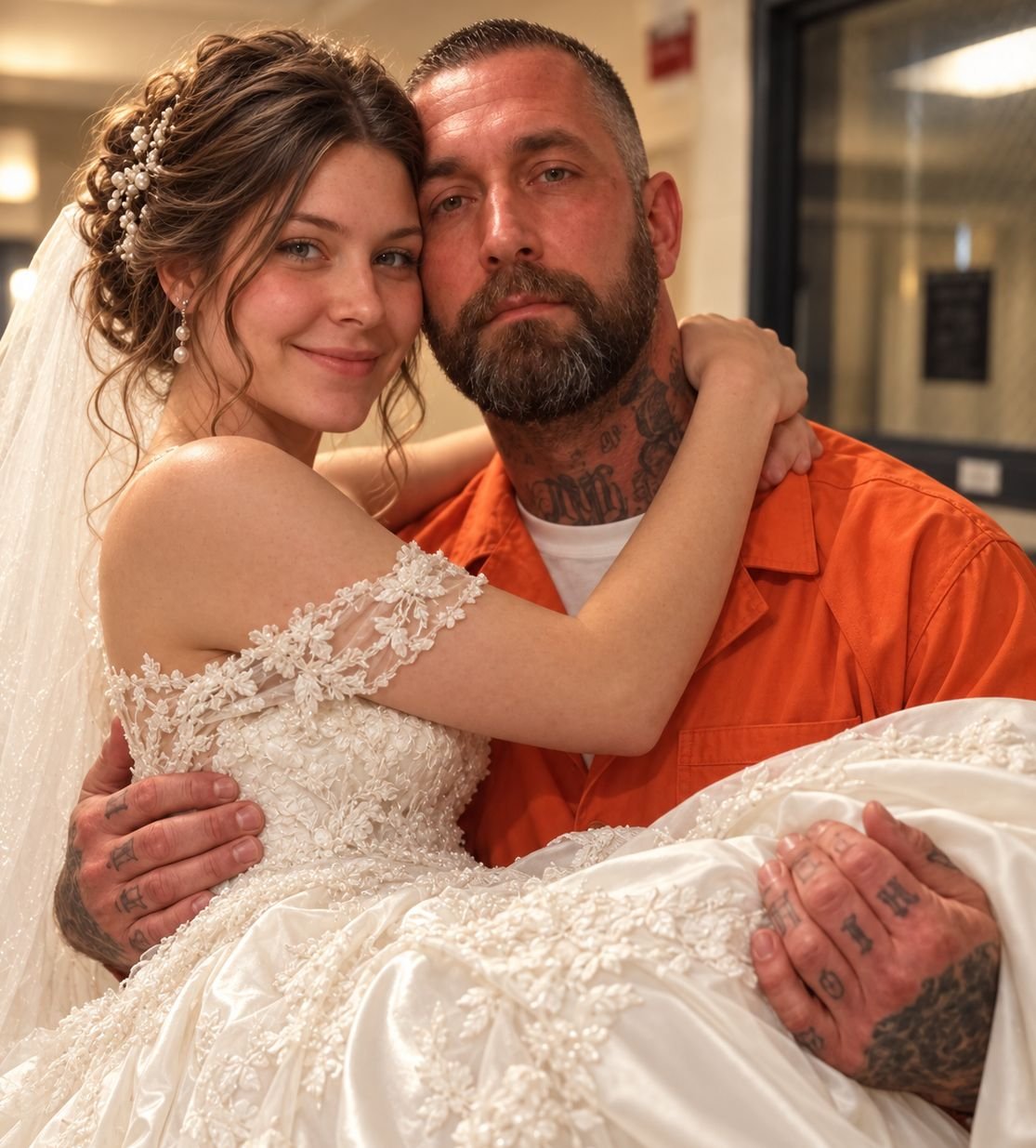
Our wedding took place on a Wednesday afternoon in the visiting room of the state correctional facility, behind a sheet of scratched plexiglass, with a chaplain reading from a laminated card and a guard checking his watch.
I wore a blue dress from a thrift store. Margaret’s attorney, a thin man named Mr. Weller, handed me a plain gold band through the slot in the partition, and I slid it onto my own finger, because nobody was allowed to touch.
I’d prepared myself for the man in the newspapers. Cold. Entitled. Bitter. Maybe cruel.
Adrian Kessler was none of those things.
He was tall and too thin for his prison khakis, with dark hair cut short and gray eyes that seemed to take in everything at once. When the chaplain asked if he took me as his wife, he looked at me for a long moment, not at the chaplain, not at the guard, at me.
“I do,” he said. Then, so quietly only I could hear through the speaker, “I’m sorry it’s like this. You deserve a real one someday.”
That was the first surprise.
The second came two weeks later, when his first letter arrived.
It was three pages long, written in neat, slanted handwriting. He didn’t talk about his case. He asked about Danny. He asked whether the diner was busy. He described the one tree he could see from the yard, a crooked maple that had just started turning red. In the margins, he’d drawn small pencil sketches: the maple, a coffee cup, a little cartoon of a radiator with angry steam coming out of it, because I’d mentioned ours on my first visit.
I laughed out loud at my kitchen table. Danny looked up from his homework and asked what was so funny.
“Nothing,” I said. And I folded the letter and put it in my coat pocket, where I could feel it all day.

At first, I acted like I cared.
I visited on the first and third Saturdays. I wrote back every week. And every month, I sat in a coffee shop near Margaret’s office and gave her my report. He seems calm. He’s reading a lot. He asked about the appeal process once, but he didn’t push it.
She’d nod, write something down, and hand me nothing but a cold smile.
Then, somewhere around the sixth month, I stopped acting.
I don’t know the exact day. Maybe it was the visit when Danny had a bad asthma attack the night before, and I came in with no makeup and swollen eyes, and Adrian spent the entire hour asking me questions about Danny’s medication and his doctor and whether the school nurse knew his triggers, as if nothing else in the world mattered. Maybe it was the letter where he wrote, You don’t have to pretend to be happy when you come here. I’d rather see you tired and real than smiling and gone.
Maybe it was just that no one had asked me if I’d eaten in two years, and he asked every time.
All I know is that one night I came home from cleaning the Kessler building, sat down at the kitchen table, and read his case file for the first time.
Mr. Weller had given me a copy months earlier, “for appearances,” in case a reporter ever asked me questions. I had shoved it in a drawer without opening it.
I opened it at one in the morning and didn’t stop until the sun came up.
I’m not a lawyer. I didn’t even finish community college. But I’ve spent my whole life reading bills, notices, and fine print, looking for the trick that would cost me money, and I know when numbers don’t line up.
These didn’t line up.
There were transfer authorizations signed by Adrian on dates when, according to the hospital records attached to his own sentencing report, he had been in a recovery ward after a serious car accident. There was a witness, an accountant at the foundation, who had testified against him and then moved out of state two weeks after the trial. There were signatures on some documents that looped differently from the ones on others, and nobody had seemed to notice.
In the margin of one page, someone had written a bank routing number in pencil and then partially erased it.
I stared at that erased number for a long time. Then I got up, found Adrian’s last letter, and looked at the sketch in its margin: a little row of birds sitting on a telephone wire. Nine birds. Some with their heads up, some with their heads down.
I told myself I was imagining things.
I wasn’t.
For the next two years, I fought for my husband with everything I had.
I took the case file to every legal aid clinic in the county. I sat in waiting rooms for hours. I stood outside the courthouse with a folder pressed against my chest and stopped attorneys on the steps until a security guard told me to move along. I spent money I didn’t have on copies, on postage, on bus fare to the state archives.
Most people laughed at me. One public defender told me, kindly, that every wife thinks her husband is innocent.
Then I met Harold Price.
Harold was seventy-three, retired from thirty-five years of appellate work, and bored half to death. He read the file in his kitchen while I sat across from him drinking terrible instant coffee. When he got to the hospital records, he set down his glasses.
“Who else has seen this?” he asked.
“Nobody seems to care.”
“Well,” Harold said, “I care now.”
He took the case for free. It took him fourteen months, three motions, and a subpoena for bank records that Adrian’s trial attorneys had never requested. But when the records came back, they showed exactly where the four million dollars had gone.
Not to Adrian.
To his cousin, Grant Kessler, the foundation’s chief financial officer. Grant had moved the money through a chain of consulting firms, forged Adrian’s signature on the authorizations while Adrian was in the hospital, and then let him take the fall.
Grant was arrested in March. The accountant who’d fled the state was found in Arizona and recanted her testimony within a day.
On a gray morning in April, three years after our wedding behind the glass, a judge vacated Adrian’s conviction and ordered his immediate release.
There was one more thing that happened before that day, and it matters more than anything else in this story.
Two weeks before the hearing, I sat across from Adrian in the visiting room, and I told him the truth.
I told him his mother had paid me. Two thousand dollars a month. I told him about the reports. I told him about the fifty thousand dollars waiting if I divorced him within thirty days of his release. I told him I’d stopped giving her anything real more than two years ago, that every report since then had been invented, but that I had still taken her money, every single month, because Danny needed it.
I cried so hard the guard came over to ask if I was all right.
Adrian didn’t look angry. He didn’t even look surprised.
He just pressed his hand flat against the glass, and after a moment, I pressed mine against the other side.
“I know,” he said quietly.
“How long have you known?”
He was silent for a moment. “Thank you for telling me,” was all he said. “That took courage. I won’t forget it.”
The day Adrian walked out of the facility, I was waiting by the gate with Danny and Harold. I thought he’d run to me. I thought there’d be some movie moment.
Instead, he stopped just outside the doors and stood very still in the April wind, and his face tightened, as if freedom itself had bruised him. As if the sky was too big.
Then he walked to me, took my hand for the first time in our marriage, and said, “Come home with me.”
He didn’t mean the Kessler estate. He’d made it clear he wasn’t setting foot there. He meant my tiny apartment with its clanking radiator, where Danny gave up the pullout couch without being asked and slept on an air mattress in the hallway like it was a camping trip.
For seven days, I believed we had survived the worst of it.
Adrian made pancakes every morning, badly. He walked Danny to the bus stop. He fixed the radiator with a wrench and a YouTube video. At night, we sat on the couch with our knees touching and talked until two in the morning, and when I fell asleep against his shoulder, he didn’t move for hours.
Margaret called me three times that week. I didn’t answer.
On the eighth night, after Danny had headed downstairs to sleep over at his friend Marcus’s apartment, Adrian came out of the bedroom carrying something I had never seen before.
It was a box. Matte black, heavy-looking, about the size of a shoebox, with a small brass combination lock on the front. He set it down in the middle of the kitchen table with a soft, solid thunk.
“Where did that come from?” I asked.
“Harold’s safe. I picked it up this afternoon.”
“What’s in it?”
He sat down across from me and folded his hands on top of the lid. For the first time since he’d come home, he looked exactly the way he had looked behind the glass. Careful. Measured. Like a man who had rehearsed something for a very long time.
“Two weeks ago, you told me your secret,” he said. “Now it’s my turn to be honest.”
I tried to smile. “Adrian, you’re scaring me.”
He didn’t smile back.
“I know,” he said softly. “But I have to. Because when you married me, Tessa, you agreed to something far bigger than a name on a piece of paper. And my mother is about to find out exactly how big.”
PART 2
The apartment went so quiet that I could hear the refrigerator humming and the faint rattle of a truck downshifting on the street below.
Adrian turned the brass dials on the lock. Four numbers. I watched his fingers and recognized the date before the lid clicked open.
It was our wedding day.
Inside, lying on top of everything else, was a thin stack of paper held together with a binder clip. He took it out and placed it in front of me without a word.
I looked down, and the floor dropped out from under me.
They were my reports.
Every monthly summary I had given Margaret in that coffee shop. Not my handwritten notes, but typed versions, on Kessler Foundation letterhead, each one stamped with a date and initialed in the corner with a looping M.K. Thirty-four of them.
Subject remains calm. Subject asked about the appeal process but did not press. Subject’s wife reports no contact with outside attorneys.
That last line was from a report I’d given her the same month I’d first sat in Harold Price’s kitchen.
“Where did you get these?” My voice came out thin.
“They were in the discovery Harold subpoenaed,” Adrian said. “When the court ordered the foundation to turn over its internal records, Grant’s lawyers dumped everything they had onto us, hoping we’d drown in it. Forty thousand pages. These were in a folder labeled Personal – A.K. on my mother’s assistant’s drive. My mother had been forwarding your reports to Grant every month.”
I put my hand over my mouth.
“She wasn’t worried about me, Tessa,” he said gently. “She was keeping track of whether I was getting close.”
“You knew,” I whispered. “When I confessed, you said you knew. Did you know from the start?”
“I knew from the day she told me she’d found me a wife.” He said it without any bitterness. “My mother has never given anyone anything without a reason. A stranger who suddenly wants to visit me twice a month, chosen by her, paid by her? I’d have been a fool not to know.”
“So you never trusted me.”
“Not at first.” He held my gaze. “I’m not going to lie to you tonight. That’s the whole point of this box.”
He reached in again and pulled out a manila folder, soft and worn at the edges. Inside were photocopies of his own letters to me, every one of them, dozens of pages. He fanned them out across the table. The crooked maple tree. The radiator. The coffee cups. The birds on the telephone wire.
“Every letter I sent out of that prison was read,” he said. “By the mailroom, and then, I assumed, by you, and then by my mother, if you were reporting to her. I couldn’t write the dates on the transfer forms match my hospital stay. I couldn’t write find the accountant who left the state. If my mother saw that, the evidence would disappear before anyone could touch it.”
He tapped the sketch of the birds. “Nine birds. Heads up for odd numbers, heads down for even. It’s the routing number someone erased in pencil on page two hundred and twelve of my file. The bank Grant used.” He moved his finger to another letter. “The coffee cup with the steam spelling out an S. Sheila Marsh, the accountant. The calendar I drew in the spring with three days circled. The three days I was in surgery.”
My skin went cold, then hot.
“I put the clues there and waited,” he said quietly. “If you were only my mother’s spy, you’d never notice them, or you’d pass them on to her and nothing would happen. But if you were something more, if you were the person I hoped you were from that first visit, you’d find them. And you’d go looking.”
“And I did,” I said. My voice cracked. “I sat up every night for two years. I thought I was figuring it out myself. I thought I was saving you.”
“You were.”
“You steered me, Adrian!” I shoved the chair back and stood up so fast it scraped the floor. “You turned me into a puzzle you were solving from a cell! Do you know how many nights I cried over that file? How many times I stood in the rain outside the courthouse while lawyers walked past me like I was a beggar?”
“Yes,” he said. He didn’t stand. He didn’t raise his voice. “I know every single one. You told me about them in your letters. I read each one maybe fifty times.”
“Then why didn’t you just tell me? After I stopped reporting to her? You must have noticed.”
“I noticed,” he said. “Month eight. Your report to her said I’d been quiet and depressed, and the same week you’d written me four pages of questions about the hospital records. That’s when I knew you’d chosen me.” He swallowed. “And that was exactly why I couldn’t tell you. If my mother ever suspected you’d switched sides, you and Danny would have been the easiest people in the world for her to hurt. A cleaning job. An apartment with an eviction notice. A boy with asthma whose inhalers you could barely afford. She’d have had you fired and evicted in a week. Maybe worse. As long as she thought you were her spy, you were safe.”
I stood by the counter with my arms wrapped around myself and said nothing. My heart was a mess of anger and something much more frightening than anger.
“I gave you a map,” Adrian said. “That part is true, and I’m sorry for every night it cost you. But I couldn’t walk the road. You did that. Nobody else in my life would have.”

He waited until I sat back down. Then he reached into the box a third time.
This time, he took out a bound legal document, old enough that the paper had yellowed slightly. The cover read: The Walter Kessler Irrevocable Family Trust. Executed June 1996.
“My grandfather,” Adrian said. “He built everything. The foundation, the real estate company, all of it. Before he died, he put his controlling shares into this trust and divided the beneficial interest between his two children. My father and my uncle. When my father died, his share passed to me.”
He flipped to a page marked with a yellow tab and turned the document so I could read the highlighted paragraph.
I read it twice before the words made sense.
Should a beneficiary be convicted of a felony offense against the Trust or any entity it controls, his interest shall be suspended, and its voting rights exercised by the nearest adult family member, until such conviction is overturned or the beneficiary’s death.
“The nearest adult family member,” I said slowly. “Your mother.”
“For three years, my mother has controlled my entire share of the trust,” Adrian said. “Forty-one percent of the voting power over a company worth about two hundred million dollars. She’s been running the board. Signing contracts. Moving money.” He paused. “And the day my conviction was vacated, all of it came back to me.”
He turned two more pages to a second highlighted paragraph.
Upon the death of a beneficiary, his interest shall pass to his lawful spouse, or, if none, to his issue. If the beneficiary leaves neither spouse nor issue, his interest shall revert to the nearest adult family member.
I looked up at him.
“My grandfather was old-fashioned,” Adrian said quietly. “He wanted the money to follow the family. Not wives who’d divorced out. Not girlfriends. Lawful spouses and children.”
And suddenly, I understood the fifty thousand dollars.
I understood why Margaret had made me sign a contract promising to divorce him within thirty days of his release. I understood why she’d been calling me every day for a week.
“When she hired me,” I said, my voice barely audible, “she thought you’d be in prison for twelve years. A paper marriage didn’t matter. She could make me disappear long before it ever counted.”
“She never planned on me getting out,” Adrian said. “But I did. And right now, tonight, if anything happened to me—a car accident, a fall, an overdose of the pain pills I was prescribed after my surgery—my share of that trust wouldn’t go back to my mother.” He looked straight into my eyes. “It would go to you.”
The kitchen seemed to tilt.
“That’s what you agreed to,” he said softly. “You thought you were signing up to be a name on a visitor’s list. But you became the only thing standing between my mother and everything she’s been stealing for years.”
“Stealing,” I repeated.
He reached into the box one last time and held up a small silver flash drive between two fingers.
“Grant didn’t think of the embezzlement himself,” Adrian said. “Grant has never had an original idea in his life. Harold found a second set of transfers in those bank records. Smaller. Older. Going back three years before my arrest, long before Grant had access to anything. They lead to an account in Delaware held by a company called Larchmont Holdings.” He set the drive down on top of the trust document. “Larchmont Holdings is owned by my mother.”
“She framed you,” I breathed.
“She needed the voting rights. The board was about to approve an audit my father had requested before he died, and I was going to see it through. So she and Grant made sure I’d be in a cell instead of a boardroom. Grant took the money. My mother took the company.”
“Why didn’t Harold use this at your hearing?”
“Because the hearing was about one thing: whether I stole four million dollars. I didn’t. That was enough to get me out. If we’d thrown accusations at my mother in the middle of it, her lawyers would have buried us in motions for another two years, and every one of those papers in that box might have disappeared.” His jaw tightened. “Harold has been in quiet contact with a federal prosecutor for a month. They need more than bank records to charge her. They need her intent. In her own words.”
“And this box?”
“Is every piece of the truth I have,” he said. “I didn’t want to keep a single secret from you once I was free. You’ve earned the right to know what you’re standing in the middle of. You can still walk away, Tessa. I mean that. If you want the divorce, I’ll sign it tonight, and I’ll make sure you and Danny never have to worry about money again. You owe me nothing.”
I opened my mouth to answer.
And on the counter behind me, my phone lit up and began to buzz.
I turned around.
The screen showed a photo I didn’t recognize at first. A white tablecloth. A silver bread basket. A boy in a gray hoodie with a menu open in front of him, smiling awkwardly at whoever was holding the camera.
It was Danny.
My brother, who had hugged me at the door two hours earlier with his backpack over his shoulder and told me he’d be at Marcus’s playing video games until midnight. Who was supposed to be two floors below me, not sitting at a table I’d never seen.
Under the photo was a text from a number I knew by heart.
Your brother is having a lovely dinner with me at the club. Such a polite young man. Come and get him, Tessa. Come alone. Bring the box. — M.
PART 3
I called Danny four times on the drive. Every call went straight to voicemail.
Adrian had wanted to come. He’d stood in the doorway with his jacket half on and his face gone white, and I had put both hands flat on his chest and pushed him back inside.
“She said alone,” I told him. “If you walk into that club, she’ll have a reason to call security, or the police, or say you threatened her. You’ve been out of prison for eight days, Adrian. Who do you think they’ll believe?”
He knew I was right. I watched him hate it.
So we did the only thing we could do in the eleven minutes before I left. He called Harold, who picked up on the first ring, listened for thirty seconds, and then said something I would remember for the rest of my life.
“Tessa, this state only requires one party’s consent to record an in-person conversation. Yours. Put your phone in your jacket pocket, start the voice memo before you walk in, and don’t touch it again. Let her talk. People like Margaret Kessler always talk when they think they’ve already won.”
“And the box?” I asked.
“Take it,” Harold said. “The prosecutor has had copies of everything in it for three weeks. Let her have the originals. Paper won’t save her.”
Adrian took the trust document out and replaced it with a photocopy. As he did, I saw something at the very bottom of the box, lying flat beneath everything else: a white envelope with my name written across the front in his slanted handwriting. And underneath my name, one word.
Last.
“What’s that?” I asked.
“Something I wanted you to read after everything else.” His voice was rough. “It can wait. Go get your brother.”
The Ridgemont Club sat at the top of a long, curving drive lined with old oaks. White columns, gas lamps, valets in green jackets. I had cleaned buildings like this. I had never once walked through the front door of one.
A man in a gray suit was waiting for me in the lobby. Broad shoulders, buzz cut, a face like a closed door. He didn’t introduce himself. He just looked at the black box under my arm, nodded once, and led me through a dining room full of quiet conversation and clinking silverware to a private room in the back.
Danny was sitting at a round table with a half-eaten plate of steak in front of him. When he saw me, his whole face crumpled with relief and guilt at the same time.
“Tess—”
“Are you okay?” I crossed the room in three steps and grabbed his shoulders. “Are you hurt?”
“I’m fine. I’m fine. I’m sorry.” His words tumbled out. “She messaged me on Instagram last week. She said she was Adrian’s mom and she wanted to set up a college fund for me as a surprise for you, and that I couldn’t tell you or it would ruin it. Her driver picked me up outside Marcus’s building. I thought—I thought it was a nice thing.”
“It’s okay,” I said, and pulled him against me. He was taller than me now. I still held him like he was eight. “You didn’t do anything wrong.”
“He’s quite right, Daniel. You didn’t.” Margaret Kessler sat on the other side of the table, in a dove-gray suit with pearls at her throat, swirling a glass of white wine. “Now, why don’t you go wait in the lobby with Mr. Dolan while your sister and I have a grown-up conversation?”
Danny looked at me. I nodded. The man in the gray suit, Mr. Dolan, walked him out and shut the door.
I slid my hand into my jacket pocket for half a second, felt the phone, and left it there. The recording had been running since the parking lot.
Then I set the black box down on the white tablecloth and sat across from my mother-in-law.
“You haven’t been answering my calls,” Margaret said.
“I’ve been busy.”
“With my son.” She smiled thinly. “I imagine he’s told you all sorts of things this week. He was always a storyteller as a boy.”
“He told me about the trust,” I said.
Something flickered behind her eyes. It was there and gone in an instant, like a fish turning under dark water.
“Then you understand the situation,” she said smoothly. “So let me make this simple, Tessa. You were hired to do a job. You did it, for a while, and then you got confused. That happens. Young women get sentimental.” She reached into a leather folio beside her plate and slid three documents across the table. “This is the divorce petition, already prepared. This is a disclaimer, in which you renounce any present or future interest in the Walter Kessler Trust. And this is an affidavit.”
I picked up the third one and skimmed it. My stomach turned.
I, Tessa Moreno Kessler, state that during my visits to Adrian Kessler at the state correctional facility, he instructed me to locate and alter certain financial documents…
“You want me to say he fabricated evidence,” I said.
“I want you to tell the truth, as I see it.” She sipped her wine. “Sign all three, and I will wire one million dollars to any account you choose before you leave this room. Not fifty thousand. One million. You and your brother can go anywhere. Start over. Daniel can go to whatever college he wants, and you will never clean another toilet in your life.”
One million dollars.
I’d be lying if I said I didn’t feel it. Not as greed. As exhaustion. Every orange notice. Every sixty-two-dollar inhaler. Every night I’d stood in a stranger’s office with a vacuum while my brother did his homework alone.
But I thought about a crooked maple tree drawn in pencil. Nine birds on a wire. A man pressing his palm to scratched glass and saying thank you for telling me.
And I thought about Harold. Let her talk.
So I let my shoulders drop, like a woman who was tired and frightened and thinking about it.
“Why should I trust you?” I asked quietly. “There’s a federal prosecutor looking at your family right now. Adrian told me. If I sign this and something goes wrong, I’m the one who goes to jail for lying.”

Margaret laughed. It was a light, almost charming sound.
“Oh, sweetheart. Federal prosecutors look at families like mine every few years. They look, and they leave.” She set her glass down. “Do you know how long Larchmont Holdings has existed without a single person noticing it? Nine years. My husband didn’t notice. The board didn’t notice. The auditors didn’t notice.”
“Adrian noticed,” I said.
“Adrian almost noticed.” Her mouth went tight. “He was always his father’s son. My husband’s audit request was sitting in a drawer when he died, and the moment he was in the ground, Adrian pulled it out and wanted to see it through. Forty-one percent of the vote and a conscience. A dangerous combination.” She shrugged. “So Grant took care of the paperwork, and I took care of the board. Twelve years would have been plenty of time to clean everything up.”
My hands were shaking under the table. I pressed them flat against my knees.
“You put your own son in prison,” I said.
“I put my son somewhere safe while the adults handled things.” She picked up a pen and held it out to me. “And I’ll handle you, too, one way or another. You can be the girl who walks out of here a millionaire, or you can be the girl whose little brother’s scholarship disappears, whose landlord gets a phone call, whose husband has an unfortunate relapse with his pain medication. Men who’ve been in prison have such a hard time adjusting.”
The room went very cold.
I looked at the pen in her hand for a long moment.
Then I stood up.
“Keep the box,” I said. “You’ll want to read it carefully. Your lawyers will need to.”
Her eyes narrowed. “Sit down, Tessa.”
“No.” I pushed the chair in neatly, the way my mother taught me. “You paid me two thousand dollars a month because you thought a poor girl with a sick brother was the easiest thing in the world to buy. You made two mistakes, Margaret. You thought my loyalty had a price. And you never once asked yourself what your son was doing with all those hours you left him alone in a cell.”
I walked to the door.
“Tessa.” Her voice stopped me with my hand on the knob. It wasn’t angry anymore. It was soft. Almost pitying. “Before you run home to him, ask him one question for me.”
I didn’t turn around. But I didn’t leave, either.
“Ask him who was really driving the night of his accident,” Margaret said. “Ask him why he signed whatever I put in front of him in that hospital without reading a word. And then decide whether my son is the saint you think he is.”
I didn’t speak during the entire drive home. Danny sat in the passenger seat, apologizing over and over until I reached across and squeezed his hand to make him stop.
My phone sat in my cupholder, the voice memo saved. Forty-seven minutes and twelve seconds. I’d texted the file to Harold and to Adrian from the club parking lot.
Neither of them had answered.
I told myself Adrian was at Harold’s, with the prosecutor, that they were listening to it right now. I told myself that the whole way up the three flights of stairs to our apartment, with Danny trudging behind me.
Then I reached the landing and stopped so suddenly that Danny walked into my back.
Our front door was standing open.
Not ajar. Open. The wood around the lock was splintered and pale where something had forced it.
Inside, the apartment had been torn apart. Couch cushions slashed. Kitchen drawers pulled out and dumped on the floor. Every letter Adrian had ever written me was scattered across the linoleum like fallen leaves, some of them torn in half.
“Adrian?” I called. My voice echoed. “Adrian!”
Nothing.
His jacket was gone from the hook. His shoes were gone from the mat.
But in the middle of the kitchen floor, lying face-up among the broken dishes, was his phone, its screen cracked into a spiderweb.
And beside it, on the edge of the counter where he had set down the black box only hours earlier, was a smear of something dark and red.
PART 4
I had dialed 911 and was halfway through giving our address when my own phone buzzed with an incoming call.
Harold.
“Tessa,” he said, before I could get a word out. His voice was steady, but I could hear the effort behind it. “Listen to me. Adrian is alive. He’s at St. Vincent’s. He’s awake and he’s asking for you.”
I sat down on the floor of my ruined kitchen and couldn’t stand up again for almost a full minute.
The story came out in pieces over the next few hours, from Harold, from the police, and finally from Adrian himself, propped up in a hospital bed with a bandage across his left temple and seven stitches above his ear.
He had gone to Harold’s house to meet the federal prosecutor, Assistant U.S. Attorney Dana Whitfield, a sharp-eyed woman who’d been working quietly on the Larchmont case since Harold first brought it to her. They’d listened to the first twenty minutes of my recording while I was still inside the club.
Then Adrian had decided to go home. He wanted to be there when Danny and I walked through the door, not sitting in someone else’s living room. Harold had offered to drive him. Adrian had said it was ten minutes away and he’d call the moment I got back.
He walked up the stairs and found our door already broken open and Mr. Dolan, the man in the gray suit, standing in our kitchen, going through my drawers.
Ray Dolan. A former police detective, fired eleven years ago for evidence tampering, who had been on Margaret Kessler’s private payroll ever since. While Margaret kept me busy at the club, Dolan had left Danny on a bench in the lobby with a valet and slipped out the back door. She’d known the box I brought might be copies. She wanted the originals. The trust document, the drive, anything else.
Adrian had told him to get out. Dolan had shoved him into the edge of the counter on his way to the door, and Adrian’s phone had gone skidding across the floor.
Dazed and bleeding, Adrian had stumbled across the hall and knocked on our neighbor’s door. Mrs. Petrakis, seventy and fearless, had taken one look at him, decided she wasn’t waiting forty minutes for an ambulance on a Friday night, and driven him to St. Vincent’s herself, calling Harold from the car.
What Dolan didn’t know was that Mrs. Petrakis had also installed a video doorbell after her car was broken into last winter. It caught him forcing our lock. It caught him running out eleven minutes later with a canvas bag. It caught his face, perfectly lit, under the hallway bulb.
He was arrested at two in the morning at a motel off the interstate. The canvas bag in his trunk was full of my husband’s letters, the photocopy of the trust, and a burner phone.
The last call on the burner phone had been made at 9:52 p.m., to a number registered to Margaret Kessler.
I sat beside Adrian’s hospital bed until the sun came up. Danny fell asleep in the chair by the window with his hood pulled over his face.
Around five in the morning, when the hallway outside had finally gone quiet, Adrian turned his head on the pillow and looked at me.
“Did she ask you about the accident?” he said.
My breath caught. “How did you know?”
“Because it’s the last card she has.” He closed his eyes for a moment. “Do you have the envelope? The one from the bottom of the box?”
I did. I’d grabbed it off the kitchen floor before the police arrived, from under a pile of torn letters. Dolan had never even seen it.
“Read it,” he said. “Please. I wrote it four months ago, when Harold told me we had a real chance. I wanted you to hear it from me before you ever heard it from her.”
I opened the envelope with shaking fingers.
Tessa,
Seven years ago, my mother called me at midnight from a party in Greenwich. She’d been drinking, and she asked me to come get her. I did. But when I got there, she insisted on driving her own car home, and I was too tired to fight her. I sat in the passenger seat.
She ran a red light at forty miles an hour. A pickup truck hit my side.
When the police came, she was crying, and she begged me. She said she’d lose her license, her board seat, everything. She said no one would ever trust the foundation again. So I told the officer I’d been driving. I was her son. I thought that was what you did.
I spent three weeks in the hospital with a shattered pelvis and more morphine than I can remember. Every few days, she came to visit with a folder of papers. Insurance forms, she said. Medical authorizations. Things for the accident. I signed every one of them without reading a word, because I was in pain and she was my mother.
Some of those papers were blank transfer authorizations for the foundation.
That’s why some of the signatures in my file matched mine perfectly, and some didn’t. Grant forged the rest. But I signed the first ones myself. I gave her the pen. I’ve had to live with that.
I lied to the police for her. I signed away my own freedom for her without knowing it. I’m not a saint, Tessa. I was a son who trusted the wrong person for too long. You’re the first person I’ve trusted since, and I wanted you to know everything I am before you decide whether to stay.
Whatever you choose, thank you for bringing me home.
— A.
I folded the letter carefully and held it in my lap for a long time.
“Harold says I’ll probably have to give a statement about the accident,” Adrian said quietly. “Lying to the police about who was driving. There may be consequences.”
“Seven years ago,” I said. “To protect your mother. While she was busy planning to destroy you.”
“It was still a lie.”
I reached over and took his hand, the one without the IV taped to it.
“You told me the truth,” I said. “Before you had to. Before she could use it. That’s the only part I care about.”
His eyes were wet. He didn’t try to hide it.
Margaret Kessler was arrested three days later, at eight in the morning, in the dining room of the Ridgemont Club, with her coffee still steaming.
Assistant U.S. Attorney Whitfield charged her with wire fraud, money laundering, conspiracy, obstruction of justice, and witness tampering. My recording was played at her detention hearing. Forty-seven minutes. Her own voice, calm and light, explaining Larchmont Holdings and the nine years nobody noticed and the son she’d put somewhere safe while the adults handled things.
The judge denied bail.
Grant Kessler, already facing twenty years, signed a cooperation agreement within a week. He testified that Margaret had designed the entire scheme, chosen which accounts to drain, and handed him the blank authorizations Adrian had signed in the hospital. Ray Dolan pleaded guilty to burglary and assault and agreed to testify about every job he’d done for her.

Eight months later, Margaret Kessler pleaded guilty to avoid trial. She was sentenced to fourteen years in federal prison. Two years longer than the sentence she’d been perfectly happy to let her son serve.
Adrian gave his statement about the accident. The prosecutor in that county took one look at the circumstances and declined to file charges.
It took more than a year for the lawyers to untangle the Walter Kessler Trust.
When they were finished, the foundation had been repaid every dollar Larchmont Holdings had stolen, with interest. Adrian’s forty-one percent was fully restored to him. And the first thing he did as a voting beneficiary was call an emergency board meeting and finally approve the audit his father had requested before he died.
The second thing he did was restructure the foundation entirely.
It’s called the Second Look Project now. It pays for forensic accountants, private investigators, and appellate lawyers for people in prison who can’t afford them, people whose files are sitting in boxes with numbers that don’t add up and nobody to read them. Harold Price came out of retirement to run its legal department. He says it’s the most fun he’s had since 1987.
In its first year, the Second Look Project helped overturn three wrongful convictions.
Danny got into the state university on a full academic scholarship, one he earned himself, with no help from anyone named Kessler. He wants to study law. He says someone in the family needs to know what they’re doing.
On the thirtieth day after Adrian’s release, the deadline in Margaret’s old contract, I came home from my first day at my new job, as an intake coordinator for the Second Look Project, to find two things waiting on our kitchen table.
The radiator was clanking. Some things you can’t fix with a YouTube video.
The first thing on the table was a thick envelope. I opened it and found divorce papers, already signed by Adrian, along with a settlement agreement that would have given me enough money that Danny and I would never worry about rent again.
The second thing was a small box. Black velvet this time, not matte composite. No brass lock.
Adrian was leaning against the counter with his arms crossed, watching me.
“Another black box, Adrian?” I said. “I thought we were done with those.”
He smiled, a little nervously. “My mother bought you for two thousand dollars a month. You married me through a sheet of plastic because you needed the money. I never want you to wonder if you stayed because you had no choice.” He nodded toward the envelope. “So that’s your choice. A real one. Walk away free, with everything you need, and I’ll still be grateful to you for the rest of my life.”
Then he picked up the velvet box and opened it.
Inside was a ring. Simple, a thin platinum band with a single round stone. Nothing like the cheap gold one Mr. Weller had slid through the slot in the glass.
“Or,” Adrian said, his voice dropping into that low, gentle tone I’d first fallen in love with through a crackling prison speaker, “you marry me again. For real this time. No glass. No guards. No contracts. Nobody watching the clock.”
I looked at the divorce papers for a long moment.
Then I picked them up, tore them neatly in half, and dropped them in the recycling bin by the door.
“You know,” I said, holding out my left hand, “for three years, I thought I was the one who’d been bought.”
He slid the ring onto my finger. His hand was shaking.
“And now?” he asked.
“Now it’s my turn to be honest,” I said. “I’d have married you for free.”
We got married in October, in Harold’s backyard, under a crooked old maple tree that had just started turning red. Harold officiated. Danny was the best man and lost the rings twice before the ceremony. Mrs. Petrakis from across the hall brought a cake and a copy of the doorbell footage on a flash drive, tied with a ribbon, “for the wedding album.”
There was no scratched glass between us this time. No guard. No speaker.
Just my husband’s hand in mine, warm and steady, and nine birds sitting on the power line above Harold’s fence, as if someone had drawn them there.
THE END
Disclaimer: This fictional story is for entertainment only. It does not represent any person or organization and does not encourage inappropriate behavior. Created with AI assistance.