On May 7, 1945, in a forgotten corner of Czechoslovakia, a young American soldier walked toward an abandoned factory building and saw something he would never forget.
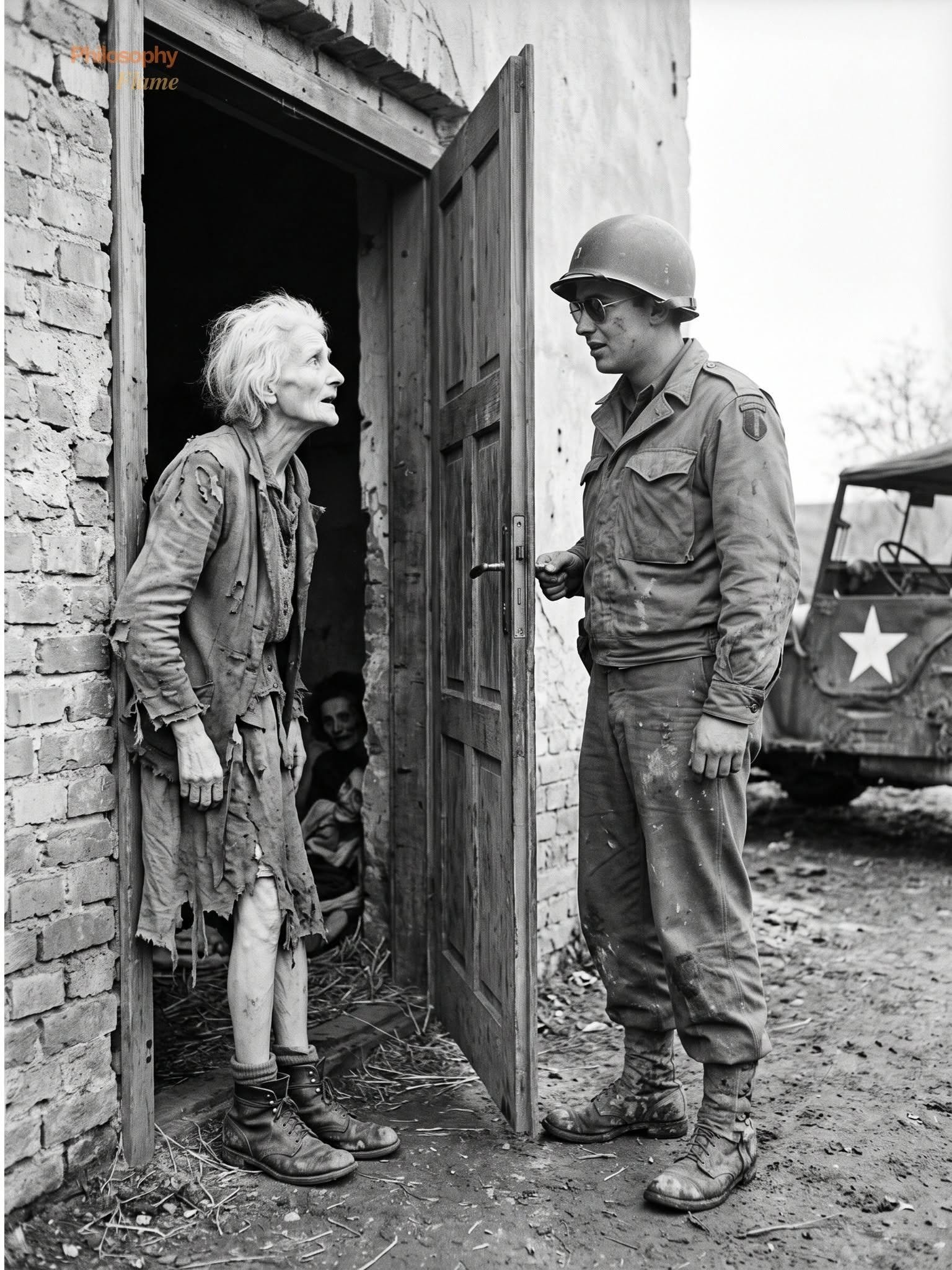
Standing near the entrance was a woman who looked almost impossible to recognize as human. She was only twenty-one years old, but years of starvation, violence, and unimaginable suffering had transformed her into a fragile figure who weighed barely thirty kilograms. Her hair had turned completely white. Her body was covered by torn clothing. Her eyes carried the exhaustion of someone who had witnessed the darkest side of humanity.
The war was almost over, but for her, survival had already felt impossible.
The soldier approached carefully. He did not know that this moment would change both of their lives forever. He did not know that the woman standing before him would become his wife, his closest companion, and one of the most powerful voices reminding the world why humanity must never forget.
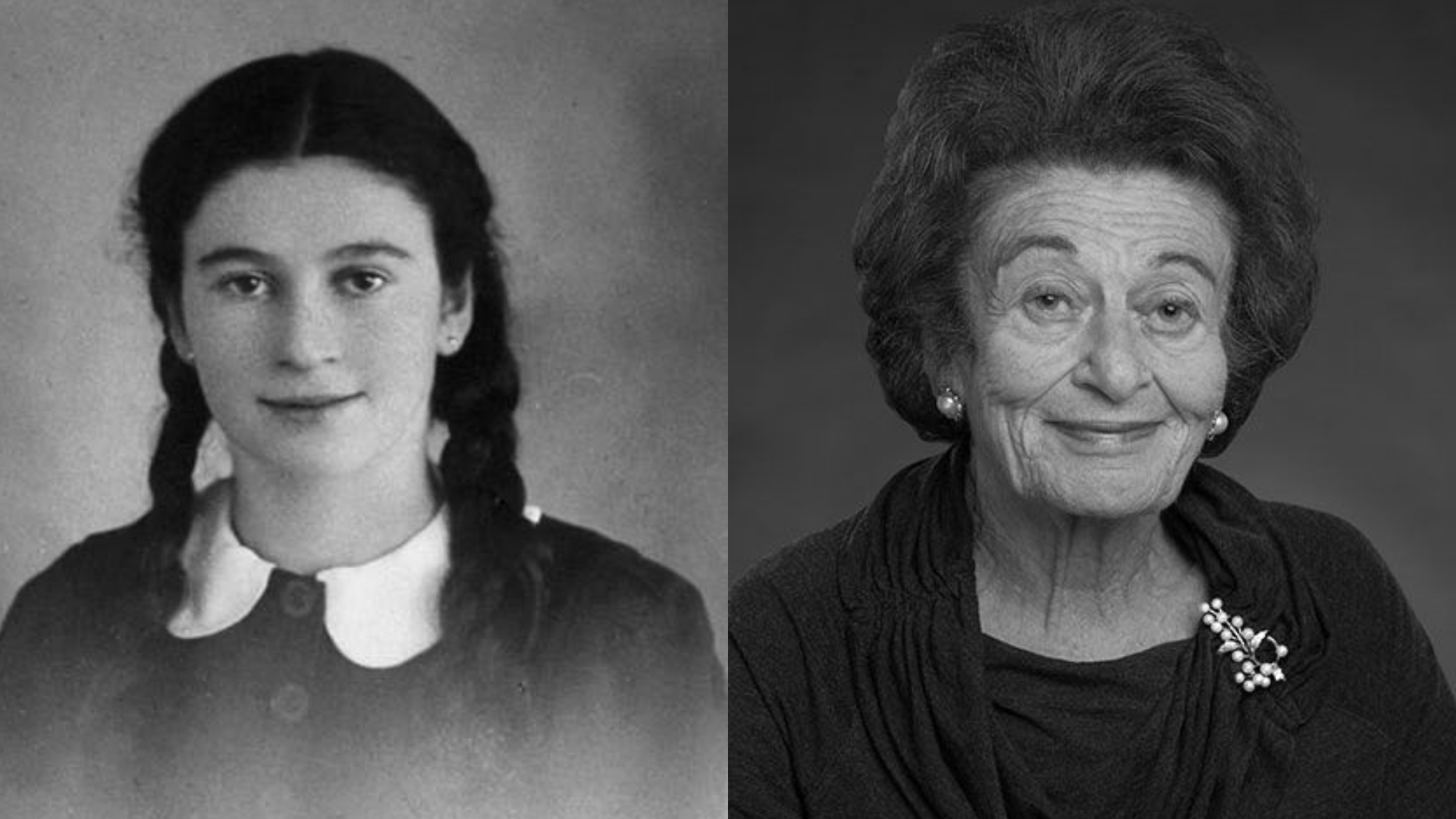
Her name was Gerda Weissmann.
And the first words she spoke to him were not words of celebration, gratitude, or relief.
They were words filled with fear.
“We are Jewish, you know.”
The young soldier looked at her silently.
For six years, those words had meant danger.
They had meant punishment.
They had meant death.
But then the soldier answered with two simple words that Gerda would remember for the rest of her life.
“So am I.”
In that instant, after years of cruelty and hatred, Gerda experienced something she had almost forgotten existed.
Human kindness.
A Childhood That Disappeared Overnight
Before she became known around the world as a Holocaust survivor and humanitarian, Gerda Weissmann was simply a young girl with ordinary dreams.
She was born on May 8, 1924, in Bielsko, Poland, into a loving Jewish family. Her childhood was filled with warmth and security. Her father, Julius Weissmann, was a successful fur manufacturer who worked hard to provide for his family. Her mother, Helene, created a home filled with affection and stability.
Gerda had everything a child should have.
A family.
A home.
Friends.
A future.
Her older brother Arthur was her closest companion. Like many teenagers growing up in the 1930s, Gerda thought about school, friendships, and the possibilities waiting ahead.
She never imagined that the world around her would soon collapse.
On September 1, 1939, German forces invaded Poland.
The sound of military aircraft flying above Bielsko marked the beginning of a nightmare that would change millions of lives.
Gerda was fifteen years old.
Within months, the life she knew disappeared.
Jewish families were stripped of their rights. New laws appeared that treated them as less than human. Their freedom was taken away piece by piece. They were isolated, humiliated, and eventually forced into labor.
The world that had once felt safe became a place where survival depended on luck, courage, and endurance.
By 1942, Gerda and her parents were forced into the Bielsko ghetto.
Then came the moment every Jewish family feared.
Deportation.
Her parents were sent away to Auschwitz.
Her brother Arthur had already been taken.
Gerda never saw any of them again.
They were murdered during the Holocaust.
In only a few years, the family she loved was destroyed.
But before Gerda was separated from her father, he gave her a small piece of advice that would eventually save her life.
It seemed strange at the time.
He told her to wear her ski boots.
It was summer.
The weather was warm.
The boots were heavy and uncomfortable.
But Julius insisted.
Gerda obeyed.
She had no idea that those boots would carry her through one of the longest and most brutal journeys of survival in modern history.
Three Years of Darkness
After the destruction of her family, Gerda was sent into the Nazi concentration camp system.
From 1942 until 1945, she endured forced labor in several camps connected to Gross-Rosen.
The names of these places became symbols of suffering.
Bolkenhain.
Marzdorf.
Landshut.
Grünberg.
Every day was a battle.
The prisoners were forced to work under brutal conditions. Food was almost nonexistent. Disease spread quickly. Exhaustion became normal. Violence could happen at any moment.
The Nazis attempted to destroy not only the bodies of their prisoners, but also their sense of identity and humanity.
Yet Gerda held onto something they could not take away.
Her memories.
She remembered her parents.
She remembered her childhood home.
She remembered the person she had been before the world tried to erase her.
Sometimes survival depended on something as simple as promising yourself to live one more day.
One more hour.
One more moment.
Gerda later explained that hope was not always a grand feeling. Sometimes hope was simply refusing to give up.
And then, in early 1945, the situation became even worse.
The Allied forces were advancing.
The Nazis knew defeat was approaching.
Instead of freeing prisoners, they attempted to erase evidence of their crimes.
They evacuated concentration camps.
Thousands of prisoners were forced onto death marches.
Gerda was among them.
The 106-Day Death March
On January 29, 1945, approximately two thousand Jewish women were forced to leave the Grünberg camp.
They began walking westward.
There were no warm coats.
There was almost no food.
There was no mercy.
The women marched through the freezing winter landscape of Central Europe.
Snow covered the ground.
The wind cut through their thin clothing.
Every step became painful.
Those who collapsed were often shot.
Those who could no longer continue were abandoned.
The march became a moving line of suffering.
A journey where every day meant choosing between life and death.
Gerda watched people around her disappear.
Women she had worked beside.
Women who had shared their fears.
Women who had become like family.
One by one, they fell.
The march lasted 106 days.
More than three months of hunger, exhaustion, and terror.
But Gerda kept walking.
And with every step, those old ski boots her father had insisted she wear carried her forward.
A simple decision made years earlier had become the difference between life and death.
By the beginning of May 1945, the war was finally coming to an end.
But the prisoners were still suffering.
Of the approximately two thousand women who started the march, fewer than one hundred and fifty survived.
Among them was Gerda Weissmann.
The Doorway Where Humanity Returned
On May 7, 1945, the surviving women reached Volary, Czechoslovakia.
They were abandoned inside an old factory building.
Gerda was barely alive.
She was sick.
Starving.
Exhausted.
Her body had been pushed beyond what anyone should endure.
Then something happened that seemed impossible.
She heard vehicles approaching.
But this time, the sound did not bring fear.
It brought hope.
A jeep appeared outside.
On the side was not a Nazi symbol.
It was a white star.
American soldiers had arrived.
Among them was a young lieutenant named Kurt Klein.
Kurt was born in Germany in 1920.
Like Gerda, he had been Jewish.
Like Gerda, his family had been destroyed by Nazi persecution.
His parents had sent him to America as a teenager in an attempt to save his life.
They succeeded in saving their son.
But they could not save themselves.
They were later deported to Auschwitz and murdered.
Now, years later, Kurt stood inside a ruined factory in Europe, facing a woman whose story reflected the tragedy of his own family.
He approached Gerda.
He asked whether she spoke German or English.
She answered in German.
Then she said:
“We are Jewish, you know.”
The words carried years of fear.
Years of being hunted.
Years of being told that her existence was a crime.
Kurt remained silent.
Then he answered:
“So am I.”
For Gerda, those two words meant more than shared identity.
They meant safety.
They meant understanding.
They meant that after years of hatred, she had finally found another human being who saw her not as a prisoner, but as a person.
A Small Gesture That Restored Dignity
Kurt asked about the other survivors.
Gerda replied:
“Come, let me show you.”
He asked:
“May I see the other ladies?”
The word “ladies” stunned her.
For years, prisoners had been treated as objects.
Numbers.
Things.
Not human beings.
But this American soldier spoke to them with respect.
He opened the door.
And he allowed Gerda to walk ahead of him.
It was such a small gesture.
But to Gerda, it represented everything she had lost.
Dignity.
Respect.
Humanity.
She later described that moment as the restoration of everything the Nazis had tried to destroy.
Inside the factory, Kurt saw the full horror of what the women had endured.
Many were lying on the floor.
Many were dying.
The scene was almost impossible to comprehend.
Yet Gerda, standing among the ruins of her world, quoted the words of German writer Johann Wolfgang von Goethe:
“Noble be man, merciful and good.”
Kurt could hardly believe what he was hearing.
A woman who had suffered unimaginable cruelty was still able to speak about goodness.
That moment stayed with him forever.
From Survivors to Soulmates
After liberation, Kurt and Gerda worked to help the surviving women.
Many did not survive long after freedom arrived. Their bodies had endured too much.
Gerda herself became seriously ill and was taken to a hospital.
But Kurt continued visiting her.
They talked.
They wrote letters.
They shared their memories.
And slowly, something beautiful grew from the ashes of tragedy.
Love.
In September 1945, Kurt proposed.
However, their journey was not simple.
Immigration restrictions and military obligations kept them apart.
Kurt returned to America.
Gerda continued recovering in Europe.
But neither forgot the other.
On June 18, 1946, they were married in Paris.
Two people who had lost almost everything began building a new life together.
They moved to Buffalo, New York.
They raised three children.
They created the family that the Nazis had tried to destroy.
But Gerda knew she had another responsibility.
She had survived when millions did not.
And she believed survival carried an obligation.
An obligation to remember.

The Woman Who Refused to Let the World Forget
In 1957, Gerda published her memoir, All But My Life.
The book became one of the most respected firsthand accounts of the Holocaust.
But Gerda did not write because she wanted fame.
She wrote because silence was dangerous.
She wanted future generations to understand what happened when hatred was allowed to grow.
For decades, she traveled across the world sharing her story.
She spoke in schools.
Universities.
Government institutions.
The United Nations.
She believed young people especially needed to understand that freedom and human rights could never be taken for granted.
In 1995, her story became the HBO documentary One Survivor Remembers, which won the Academy Award for Best Documentary Short Subject.
During her acceptance speech, Gerda reflected on how her understanding of victory had changed.
After surviving the Holocaust, winning once meant something simple:
A piece of bread.
Another day alive.
In 2011, President Barack Obama awarded Gerda Weissmann Klein the Presidential Medal of Freedom, honoring her decades of humanitarian work and Holocaust education.
But even with the highest honors, Gerda always focused on those who did not survive.
The Door Remains Open
Kurt Klein passed away in 2002.
After fifty-six years of marriage, Gerda lost the man who had opened that door for her in 1945.
But the message they carried together continued.
Gerda spent her final years teaching, speaking, and reminding people that humanity is a choice.
She died on April 3, 2022, at the age of ninety-seven.
Two thousand women began the death march from Grünberg.
Fewer than one hundred and fifty survived.
Gerda Weissmann Klein was one of them.
Her life was not only a story about surviving evil.
It was a story about refusing to allow evil to define the future.
A young American soldier opened a door for a starving woman in a ruined factory.
It was a simple act.
But sometimes the smallest acts reveal the greatest truths.
After six years of being treated as less than human, Gerda was finally treated as a person again.
She walked through that doorway.
And she walked into a new life.
A life filled with love.
A life filled with purpose.
A life dedicated to remembering.
Because Gerda understood something the world still needs to hear:
Hatred can destroy lives.
But kindness can restore humanity.
And as long as her story continues to be told, the door she walked through on that spring morning in 1945 will never close.