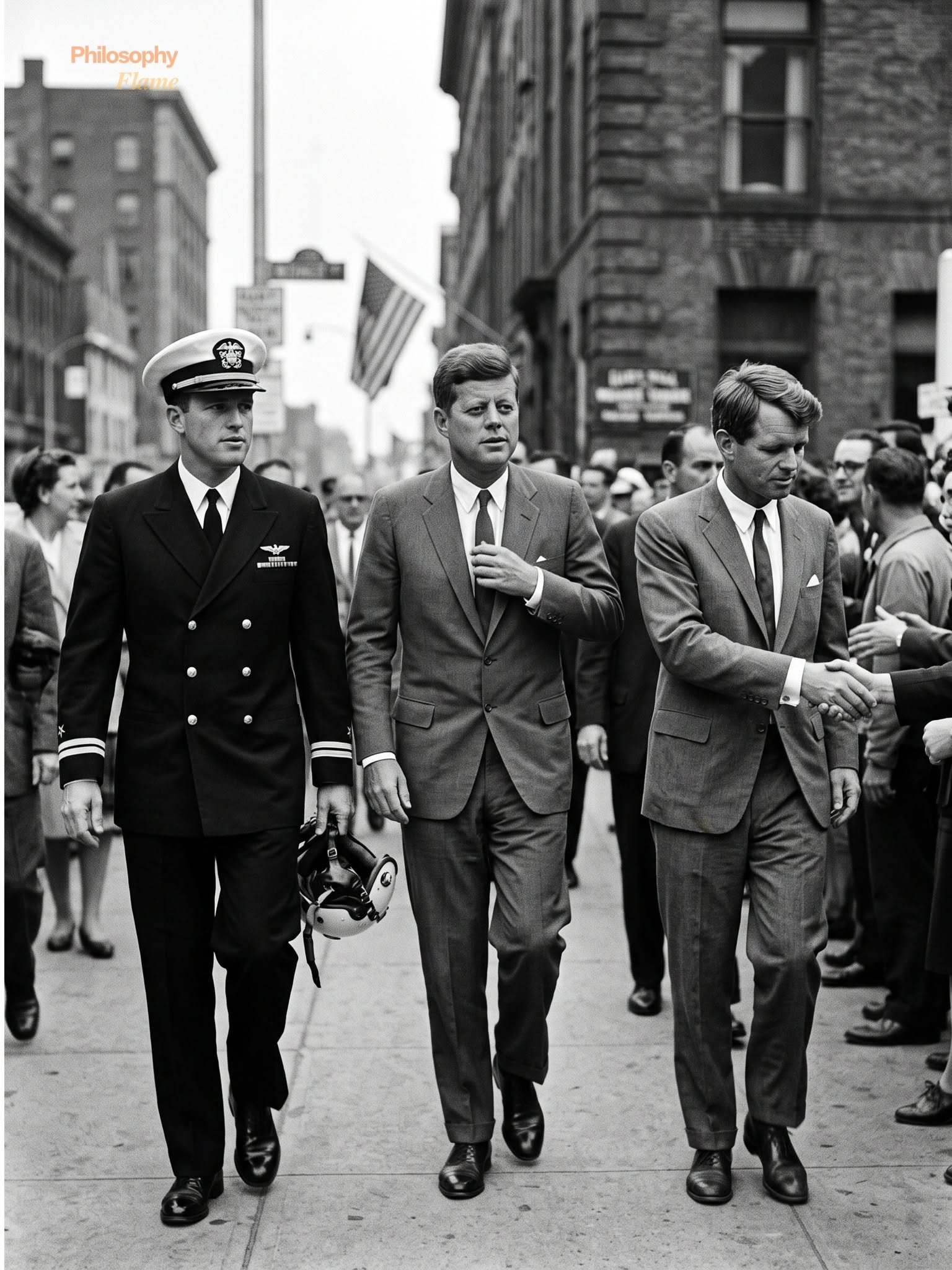
There are few families in American history whose story carries as much hope, ambition, heartbreak, and sacrifice as the Kennedy family.
For generations, the Kennedy name has been associated with power, politics, and public service. But behind the famous speeches, elections, and headlines was a deeply personal story — the story of three brothers who believed that a life of privilege came with a responsibility to serve others.
Joseph Patrick Kennedy Jr., John Fitzgerald Kennedy, and Robert Francis Kennedy were born into one of America’s most influential families. They had opportunities that millions could only dream of. They had wealth, education, connections, and a future that seemed almost limitless.
But each brother chose a different path of service.
And each one paid the ultimate price.
Their story is not simply a story of tragedy.
It is a story about courage.
About sacrifice.
About the belief that America could always become something better.
Joseph Kennedy Jr.: The Son Expected to Change History
Before the world knew the name John F. Kennedy, the hopes of the Kennedy family rested on another son.
Joseph Patrick Kennedy Jr. was born in 1915 and was the eldest child of Joseph P. Kennedy Sr. and Rose Kennedy. From an early age, he was viewed as the family’s future.
He was intelligent, confident, and charismatic. He attended Harvard University, excelled academically, and possessed the kind of personality that attracted people naturally.
His father believed Joseph was destined for the highest office in the country.
The presidency.
In many ways, Joseph seemed perfectly prepared for that future.
But history had other plans.
When World War II changed the world forever, Joseph did not use his family’s influence to avoid danger. Instead, he chose to serve.
He joined the United States Navy and became a military pilot.
The decision reflected something deeply rooted in the Kennedy family philosophy: privilege was not an excuse to avoid responsibility.
If others were willing to sacrifice, Joseph believed he should do the same.
The Young Pilot Who Refused Safety
During the war, Joseph flew patrol missions over the Atlantic Ocean, searching for German submarines and protecting Allied forces.
The missions were dangerous.
The skies were filled with enemy threats, and every flight carried the possibility that the crew would not return.
By 1944, Joseph had completed twenty-five combat missions.
Under normal circumstances, he could have returned home.
His service obligation was complete.
He had already done enough.
But Joseph Kennedy Jr. made a decision that would define his legacy.
He stayed.
Rather than return to safety, he volunteered for Operation Aphrodite — one of the most dangerous and experimental missions attempted during World War II.
The mission involved converting older aircraft into flying bombs filled with explosives. These unmanned planes were designed to destroy heavily fortified German targets.
The technology was new.
The risks were enormous.
The mission had never been successfully completed before.
Joseph understood the danger.
He volunteered anyway.
On August 12, 1944, Joseph and his co-pilot, Lieutenant Wilford Willy, took off from RAF Fersfield in England aboard a modified B-24 Liberator packed with explosives.
The plan was for them to fly the aircraft into position, activate the explosives, transfer control to another aircraft, and escape by parachute before the plane reached its target.
But the mission never reached that point.
Eighteen minutes after takeoff, something went terribly wrong.
The explosives detonated prematurely.
The aircraft exploded over Suffolk, England.
Joseph Kennedy Jr. was twenty-nine years old.
The man who had been expected to become president never had the chance.
His political future disappeared in a moment above the English countryside.
But his example would shape the lives of his younger brothers forever.
Joseph’s sacrifice became a powerful lesson inside the Kennedy family:
Service was not something you spoke about.
It was something you lived.
John F. Kennedy: The Brother Who Carried the Dream Forward
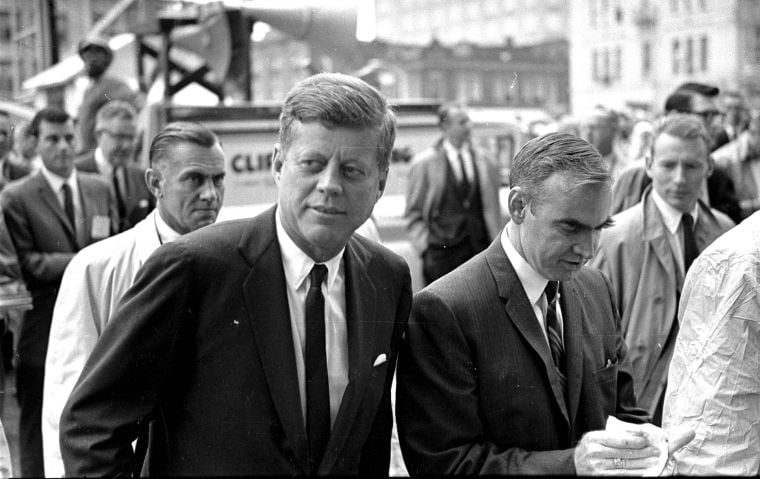
After Joseph’s death, the responsibility of carrying the family’s political hopes fell to his younger brother, John.
John Fitzgerald Kennedy had already experienced his own brush with death years earlier.
During World War II, he served as a Navy officer commanding PT-109 in the Pacific.
In August 1943, the patrol boat was struck by a Japanese destroyer and split apart.
Several crew members were injured.
The situation seemed hopeless.
But Kennedy refused to abandon his men.
Despite suffering injuries himself, he helped lead his surviving crew through dangerous waters. He reportedly swam for hours, towing an injured sailor by gripping a strap from the man’s life jacket.
His actions saved lives.
For his courage, Kennedy received the Navy and Marine Corps Medal.
The recognition was not for defeating an enemy.
It was for protecting his own people.
That moment revealed something about John Kennedy’s character: leadership meant responsibility.
The Young President Who Inspired a Nation
In 1960, John F. Kennedy ran for president.
At forty-three years old, he became the youngest person ever elected to the presidency of the United States.
His victory represented a new generation of leadership.
On January 20, 1961, he delivered his inaugural address and spoke words that would become among the most famous in American history:
“Ask not what your country can do for you — ask what you can do for your country.”
The message was simple.
Citizens had responsibilities.
A nation was built not only by leaders but by ordinary people willing to contribute.
Soon after taking office, Kennedy created the Peace Corps, giving thousands of Americans the opportunity to serve around the world as educators, health workers, and community builders.
He also challenged the nation to accomplish what seemed impossible:
Landing a person on the moon before the end of the decade.
He believed great achievements required courage.
The goal was not chosen because it was easy.
It was chosen because difficult challenges revealed what people were capable of achieving.
The Cuban Missile Crisis: Thirteen Days That Changed History
Perhaps the most dangerous moment of Kennedy’s presidency came in October 1962.
American intelligence discovered that the Soviet Union had placed nuclear missiles in Cuba.
The discovery created a crisis unlike anything the world had experienced.
The possibility of nuclear war became real.
For thirteen terrifying days, humanity stood closer to destruction than ever before.
Many military advisors urged immediate action.
Some recommended an invasion of Cuba.
Others supported aggressive responses that could have triggered a larger conflict.
Kennedy chose another path.
He pursued diplomacy.
He searched for a solution that would allow both sides to step back without forcing either nation into humiliation.
The crisis ended peacefully.
Millions of lives may have been saved because of that restraint.
A Presidency Cut Short
John Kennedy’s presidency was not without controversy.
Like all leaders, he faced criticism and made mistakes.
His early approach to civil rights was cautious, shaped partly by political realities.
But by 1963, his position had evolved.
He began strongly advocating for racial equality and introduced major civil rights legislation.
He was becoming a different kind of leader — one willing to confront some of America’s deepest problems.
Then, on November 22, 1963, everything changed.
During a motorcade in Dallas, Texas, President John F. Kennedy was assassinated.
He was forty-six years old.
The nation entered a period of grief.
A president was gone.
A vision was unfinished.
And once again, the Kennedy family faced unimaginable loss.
Robert Kennedy: The Brother Who Chose Compassion
After Joseph represented sacrifice and John represented leadership, Robert Kennedy carried another quality:
Empathy.
Robert Francis Kennedy was different from his brothers.
He was known not only for political ambition but for his ability to connect with people’s struggles.
As Attorney General during his brother’s presidency, Robert took on powerful opponents.
He fought organized crime.
He pushed for civil rights enforcement.
He sent federal marshals to protect Freedom Riders facing violence in the South.
He challenged leaders who resisted integration.
But after John Kennedy’s assassination, Robert changed.
The loss of his brother transformed him.
Instead of becoming bitter, he became more compassionate.
He began traveling across America to see problems firsthand.
He visited poor communities.
He listened to struggling families.
He walked through migrant labor camps.
He saw poverty in Appalachia.
He witnessed the discrimination faced by Black Americans in the South.
He did not simply study these issues from a government office.
He sat with the people experiencing them.
He listened to their stories.
And he carried those stories back to Washington.
The Speech That United a City
On April 4, 1968, America suffered another devastating loss.
Dr. Martin Luther King Jr. was assassinated in Memphis, Tennessee.
Across the country, grief turned into anger.
Many cities experienced unrest and violence.
That night, Robert Kennedy was scheduled to speak at a campaign rally in Indianapolis.
Police warned him that the event was dangerous.
They advised him to cancel.
Kennedy refused.
He stood before the crowd and delivered the heartbreaking news that Dr. King had been killed.
Many in attendance had not yet heard.
The reaction was immediate.
People cried.
The crowd was overwhelmed.
Then Kennedy did something extraordinary.
He did not deliver a political speech.
He spoke as a grieving human being.
He talked about losing his own brother.
He shared his personal pain.
He quoted the Greek poet Aeschylus, explaining that suffering can eventually bring wisdom.
He asked people not to respond with hatred.
He asked them to choose compassion.
That night, while violence spread across many American cities, Indianapolis remained peaceful.
His words had reached people at exactly the moment they needed them.
The Final Tragedy
Two months later, Robert Kennedy won the California Democratic primary.
His presidential campaign was gaining momentum.
Many believed he represented a new possibility for America.
But shortly after delivering his victory speech at the Ambassador Hotel in Los Angeles, he was shot.
Robert Kennedy died on June 6, 1968.
He was forty-two years old.
Three brothers.
Three lives ended far too soon.
Joseph Kennedy Jr. — twenty-nine years old.
John F. Kennedy — forty-six years old.
Robert Kennedy — forty-two years old.
Each one gone before reaching fifty.
A Legacy Built on Service
The Kennedy brothers were not perfect.
They made mistakes.
They faced criticism.
They had political failures.
But their story has endured because it was never only about success.
It was about commitment.
Joseph gave his life in military service before he could begin the public career expected of him.
John gave his life while leading the nation.
Robert gave his life while trying to bring Americans together.
Each brother believed something larger than himself was worth fighting for.
They believed service mattered.
They believed compassion was strength.
They believed America was not simply a country with a history — it was a promise still being written.
Their lives ended unfinished.
But their message continues.
A better future does not happen automatically.
It requires people willing to serve.
People willing to sacrifice.
People willing to believe that progress is possible even when the path is difficult.
The Kennedy brothers never saw the completion of the dreams they carried.
But they left behind something more powerful than achievements.
They left an example.
Three brothers.
Three sacrifices.
One enduring belief:
That serving others is one of the highest callings a person can choose.